Provenance
Count Grigory Stroganov [1829-1910], Rome.[1] (Count Alessandro Contini Bonacossi, Rome, 1927); purchased 1931 by the Samuel H. Kress Foundation, New York;[2] gift 1939 to NGA.
[1] According to National Gallery of Art, _Preliminary Catalogue of Paintings and Sculpture_, Washington, D.C., 1941: 169. This painting and its pendant (NGA 1939.1.72) do not appear in catalogues of Stroganov sales or in those of the collection, which include only selected works. According to Antonio Muñoz, _La collezione Stroganoff_, Rome, 1910, Stroganov amassed his collection c. 1880-1890 and bought many things from the sale of Cardinal Immenraet. It has not been possible to locate a catalogue of the Immenraet collection.
[2] The dates are given on the back of a photograph sent to the Frick Art Reference Library by Alessandro Contini Bonacossi at the NGA on 1 July 1969. The painting and its pendant are documented in the Kress collection in 1932 by Alfred M. Frankfurter, "Eighteenth Century Venice in a New York Collection", _The Fine Arts_ 19 (December 1932): 30; see also The Kress Collection Digital Archive, https://kress.nga.gov/Detail/objects/64.
Accession Number
1939.1.71
Medium
oil on canvas
Dimensions
overall: 84.9 × 35.2 cm (33 7/16 × 13 7/8 in.) | framed: 95.4 × 46.2 × 5.4 cm (37 9/16 × 18 3/16 × 2 1/8 in.)
Classification
Painting
Credit Line
Samuel H. Kress Collection
Tags
Painting Baroque (1600–1750) Oil Painting Canvas Italian
Background & Context
Background Story
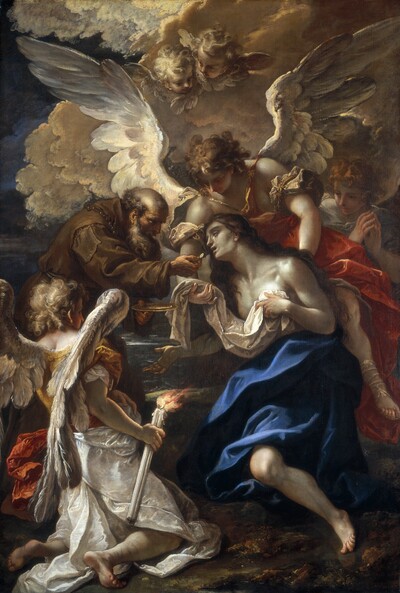
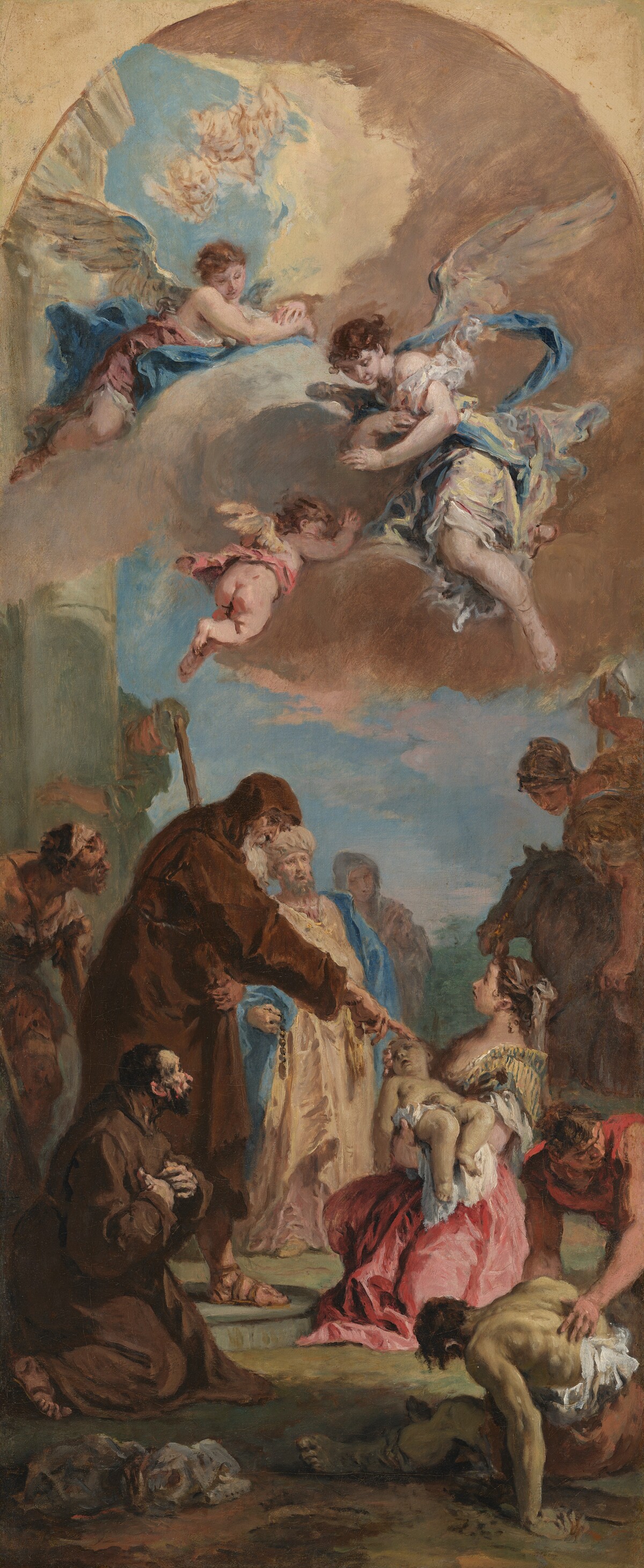
Sebastiano Ricci (1659-1734) was one of the most important Venetian painters of the early 18th century, known for his decorative ceilings and his ability to combine the color and light of the Venetian tradition with the dynamic composition of the Roman Baroque. A Miracle of Saint Francis of Paola from 1733, the year before Ricci's death, is a late work that demonstrates the continued vitality of his style: the saint performs a miracle amid a crowd of amazed witnesses, arranged in a dynamic composition that sweeps the eye across the canvas. The 1733 date places this in the context of the late Venetian Baroque, when Ricci was one of the few painters still working in the grand decorative tradition of Veronese and Tintoretto.
Cultural Impact
Saint Francis of Paola was the founder of the Minims, a particularly austere Franciscan order, and his miracles were a popular subject in 18th-century Italian painting because they combined devotional content with the dramatic narrative that Baroque painting demanded. Ricci's treatment is characteristically dynamic: the miracle and the amazed witnesses are arranged in a sweeping composition that makes the supernatural event feel like a natural extension of Baroque theatricality.
Why It Matters
A Miracle of Saint Francis of Paola is Ricci's late Baroque at its most dynamic: a miracle performed amid a crowd of amazed witnesses, arranged in a composition that sweeps the eye across the canvas with the energy and color that distinguish Venetian painting at its best. The 1733 date makes this a testament from the end of a career devoted to the grand tradition.
![The Ecstasy of Saint Francis [recto]](https://api.nga.gov/iiif/3df95859-f883-419d-8f1e-2910adce7aac/full/400,/0/default.jpg)
![Biblical Scene [verso]](https://api.nga.gov/iiif/36722160-44a6-48ea-8068-45c3484f550b/full/400,/0/default.jpg)