Provenance
Count Grigory Stroganov [1829-1910], Rome.[1] (Count Alessandro Contini Bonacossi, Rome, 1927); purchased 1931 by the Samuel H. Kress Foundation, New York;[2] gift 1939 to NGA.
[1] According to National Gallery of Art, _Preliminary Catalogue of Paintings and Sculpture_, Washington, D.C., 1941: 169. This painting and its pendant (NGA 1939.1.71) do not appear in catalogues of Stroganov sales or in those of the collection, which include only selected works. According to Antonio Muñoz, _La collezione Stroganoff_, Rome, 1910, Stroganov amassed his collection c. 1880-1890 and bought many things from the sale of Cardinal Immenraet. It has not been possible to locate a catalogue of the Immenraet collection.
[2] The dates are given on the back of a photograph sent to the Frick Art Reference Library by Alessandro Contini Bonacossi at the NGA on 1 July 1969. The painting and its pendant are documented in the Kress collection in 1932 by Alfred M. Frankfurter, "Eighteenth Century Venice in a New York Collection", _The Fine Arts_ 19 (December 1932): 30; see also The Kress Collection Digital Archive, https://kress.nga.gov/Detail/objects/2165.
Accession Number
1939.1.72
Medium
oil on canvas
Dimensions
overall: 84 x 35 cm (33 1/16 x 13 3/4 in.)
Classification
Painting
Credit Line
Samuel H. Kress Collection
Tags
Painting Baroque (1600–1750) Oil Painting Canvas Italian
Background & Context
Background Story
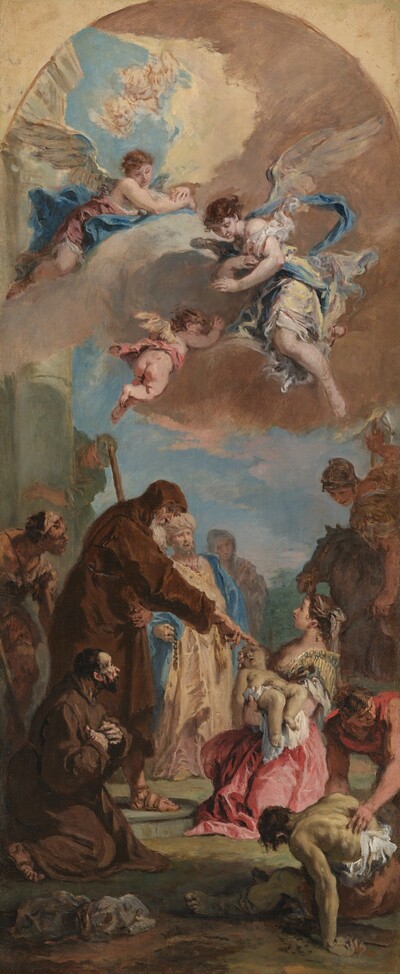
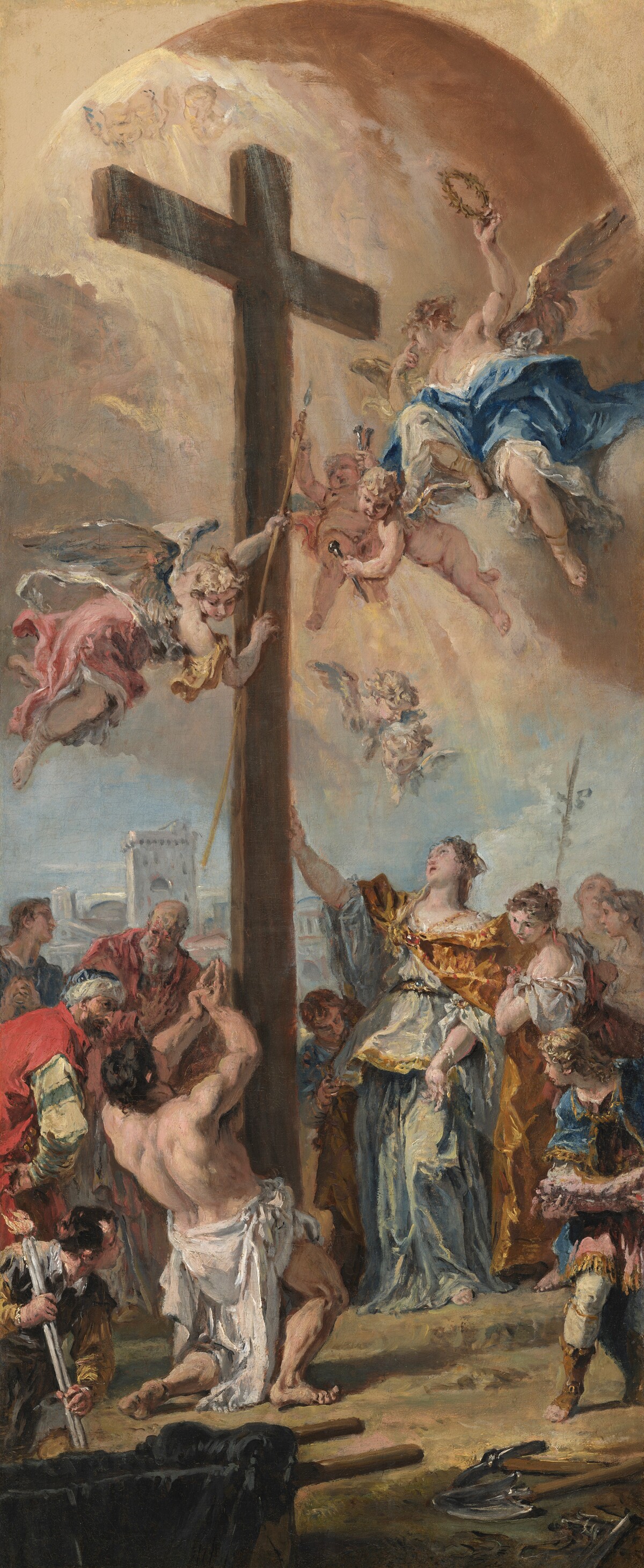
The Exaltation of the True Cross from 1733 is a pendant to A Miracle of Saint Francis of Paola, painted for the same commission and displaying the same late Baroque dynamism. The subject—the exaltation (elevation and veneration) of the True Cross discovered by St. Helena—allows Ricci to combine the dramatic composition of a Baroque ceiling painting with the devotional content of a religious altarpiece. The cross, elevated above the crowd of worshippers, becomes the compositional focal point that organizes the entire painting, and the crowd of witnesses provides the narrative drama that Baroque painting demanded.
Cultural Impact
The Exaltation of the True Cross and its pendant, A Miracle of Saint Francis of Paola, were painted as a pair for a specific commission, and their complementary compositions demonstrate Ricci's ability to create works that function both individually and as a pair. The vertical emphasis of the exalted cross in one painting balances the horizontal sweep of the miracle in the other, creating a visual dialogue that enhances both works.
Why It Matters
The Exaltation of the True Cross is Ricci's late Baroque devotional painting at its most dynamic: the cross elevated above a crowd of worshippers, organizing the composition with the same compositional intelligence that distinguishes his decorative ceilings. The 1733 date makes this a late testament from one of the last great Venetian Baroque painters.
![The Ecstasy of Saint Francis [recto]](https://api.nga.gov/iiif/3df95859-f883-419d-8f1e-2910adce7aac/full/400,/0/default.jpg)
![Biblical Scene [verso]](https://api.nga.gov/iiif/36722160-44a6-48ea-8068-45c3484f550b/full/400,/0/default.jpg)