Provenance
Adriaen Swalmius [1689-1747], Schiedam;[1] (sale, Rotterdam, 15 May 1747, no. 2); Jacques Ignace de Roore [1686-1747], Antwerp; (his estate sale, The Hague, 4 September 1747, no. 84);[2] Pieter Bisschop [c. 1690-1758] and Jan Bisschop [1680-1771], Rotterdam; purchased 1771 with the Bisschop collection by Adrian Hope [1709-1781] and his nephew, John Hope [1737-1784], Amsterdam; by inheritance after Adrian Hope's death to John Hope, Amsterdam and The Hague; by inheritance to his sons, Thomas Hope [1769-1831], Adrian Elias Hope [1772-1834], and Henry Philip Hope [1774-1839], Bosbeek House, near Heemstede, and, as of 1794, London, where the collection was in possession John's cousin, Henry Hope [c. 1739-1811]; by inheritance 1811 solely to Henry Philip Hope, Amsterdam and London, but in possession of his brother, Thomas Hope, London; by inheritance 1839 to Thomas' son, Henry Thomas Hope [1808-1862], London, and Deepdene, near Dorking, Surrey; by inheritance to his wife, Adèle Bichat Hope [d. 1884], London and Deepdene; by inheritance to her grandson, Henry Francis Hope Pelham-Clinton-Hope, 8th duke of Newcastle-under-Lyme [1866-1941], London; sold 1898 to (Asher Wertheimer, London); sold 1899 to Peter A.B. Widener, Lynnewood Hall, Elkins Park, Pennsylvania; inheritance from Estate of Peter A.B. Widener by gift through power of appointment of Joseph E. Widener, Elkins Park, Pennsylvania; gift 1942 to NGA.
[1] For a detailed discussion of the provenance, see Ben Broos, _Great Dutch Paintings from America_, exh. cat. Mauritshuis, The Hague; Fine Arts Museums of San Francisco, Zwolle and The Hague, 1990: 355-359.
[2] The seller's name in the 1747 sale catalogue is given as Jaques de Roore; he was a painter and art dealer in Antwerp. There are many variants of his name in the literature.
Accession Number
1942.9.48
Medium
oil on canvas
Dimensions
overall: 44 x 39.5 cm (17 5/16 x 15 9/16 in.) | framed: 74.3 x 69.2 x 7.6 cm (29 1/4 x 27 1/4 x 3 in.)
Classification
Painting
Credit Line
Widener Collection
Tags
Painting Baroque (1600–1750) Oil Painting Canvas Dutch
Background & Context
Background Story
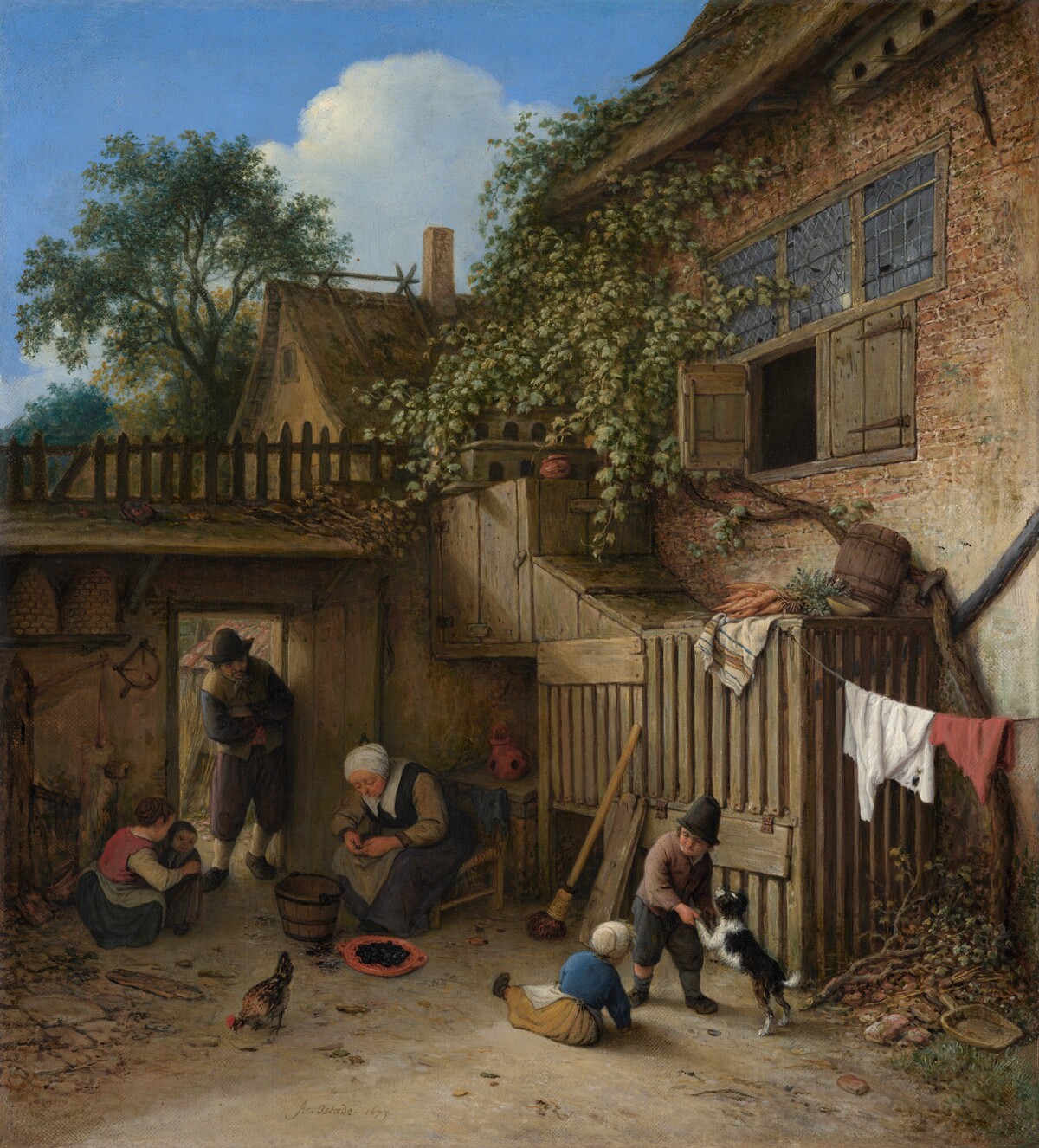
Adriaen van Ostade's "The Cottage Dooryard" (1673) presents a quintessential scene of Dutch peasant life with the warmth, detail, and gentle humor that made van Ostade the most celebrated painter of rural genre subjects in the Dutch Golden Age. The painting depicts the humble doorstep of a country cottage, where peasant figures gather in the dappled light, engaged in the quiet routines of daily existence — a mother tends to her child, a man leans against the doorframe, and the yard is alive with the textures of rural architecture and domestic debris.
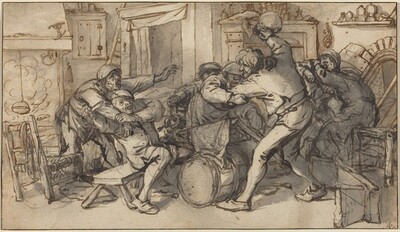
Van Ostade (1610–1685) was born in Haarlem and spent nearly his entire career there, producing an enormous body of work — over 800 paintings and 50 etchings — focused almost exclusively on peasant life. His depictions of village taverns, cottage interiors, and rural gatherings defined the popular image of Dutch peasant culture for centuries. Early in his career, influenced by the coarse humor of Adriaen Brouwer, van Ostade's peasants were raucous and caricatured — brawling, drinking, and howling with leering expressions. But around 1650, his style shifted dramatically. Under the influence of the Haarlem classicist philosopher and painter Salomon van Ruysdael, and perhaps of his own maturing sensibilities, van Ostade's peasants became calmer, more dignified, and more sympathetically observed.
"The Cottage Dooryard" belongs to this mature phase. The figures are no longer objects of ridicule but subjects of gentle, even affectionate, attention. Van Ostade renders the crumbling brickwork, the weathered wood, the scattered household objects, and the patches of outdoor light with a meticulousness that transforms squalor into something approachable and even beautiful. The composition is masterful in its apparent casualness — every element is carefully placed to draw the eye through the scene, from the foreground figures to the cottage interior glimpsed through the open door.
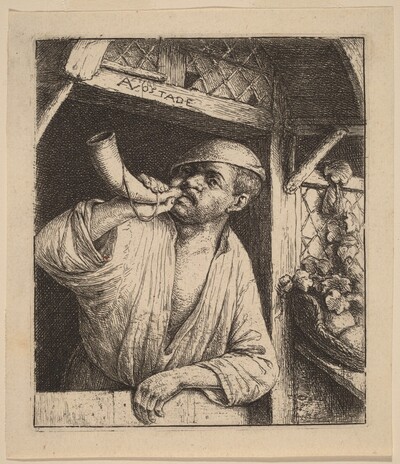
Van Ostade's influence extended beyond painting. His etchings were widely collected and reproduced, spreading his vision of Dutch peasant life throughout Europe. Rembrandt himself owned van Ostade's prints, and the two artists' work in etching shows a mutual awareness. Van Ostade's cottage scenes also influenced the development of English genre painting, particularly the work of George Morland in the eighteenth century.
Cultural Impact
Van Ostade's evolution from caricature to empathy parallels a broader shift in Dutch Golden Age painting — from depicting peasants as figures of fun to recognizing their humanity and dignity. His mature work established a visual vocabulary for rural life that persisted in European art for centuries.
Why It Matters
"The Cottage Dooryard" represents van Ostade's mature vision of peasant life — sympathetic, detailed, and infused with warm humor — demonstrating how the Dutch Golden Age transformed the genre of peasant painting from social satire into art of genuine human insight.