Provenance
Sybrand Feitama; (sale, Amsterdam, 16 October 1758, no. 14). John MacGouan (Lugt 1496); (sale, London, 26 January 1804, on. 422 or 424). (Sale, Christie's, Amsterdam, 1 December 1986, no. 13). (C.G. Boerner), 1987. Edward William Carter and Hanna Locke Carter; gift 1990 to NGA.
Accession Number
1990.51.1
Medium
pen and dark brown ink over graphite (by Ostade) and pen and light brown ink with gray-brown wash (by Dusart) on laid paper
Dimensions
overall: 14.9 x 26 cm (5 7/8 x 10 1/4 in.)
Classification
Drawing
Credit Line
Gift of Edward William Carter and Hannah Locke Carter, in Honor of the 50th Anniversary of the National Gallery of Art
Tags
Drawing Baroque (1600–1750) Ink Graphite & Pencil Paper Dutch
Background & Context
Background Story
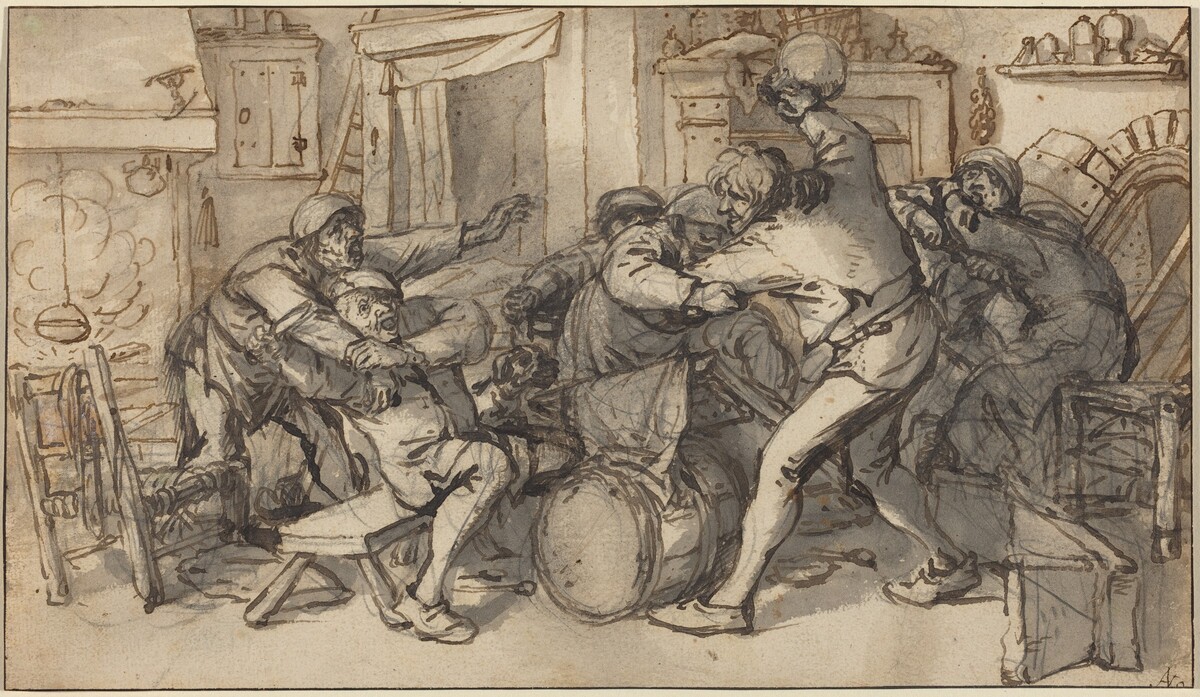
Peasants Fighting in a Tavern is a collaborative drawing by Adriaen van Ostade (1610-1685) and his pupil Cornelis Dusart (1660-1704), with the original drawing by Ostade from c. 1640 and additions by Dusart after 1685. The drawing depicts a tavern brawl in the genre subject of peasant life that was Van Ostade's specialty, and the collaboration between master and pupil demonstrates the workshop practice that was common in 17th-century Dutch art. The drawing's two phases—the original c. 1640 drawing by Van Ostade and the subsequent additions by Dusart—make it a document of both Van Ostade's draftsmanship and the continuation of his style by his pupil.
Cultural Impact
Collaborative drawings like Peasants Fighting in a Tavern are important documents of 17th-century Dutch workshop practice because they demonstrate the relationship between master and pupil in the production of art. The drawing's two phases—Van Ostade's original c. 1640 drawing and Dusart's additions after 1685—show how a pupil continued and completed a master's work, providing a rare visual record of the workshop practice that was fundamental to 17th-century Dutch art production.
Why It Matters
Peasants Fighting in a Tavern is a document of Dutch workshop practice: Adriaen van Ostade's original c. 1640 drawing with additions by his pupil Cornelis Dusart after 1685, showing the master-pupil relationship in action. The two phases of the drawing provide a rare record of 17th-century Dutch workshop practice in producing genre drawings.