Provenance
Principi di Fondi, Naples. Principessa Pignatelli della Leonessa; acquired 1937 by private collection, Europe; (sale, Christie, Manson & Woods, London, 11 July 1980, no. 46, as _The Martyrdom of Saint Januarius_); private collection, England;[1] purchased 22 June 2000 through (Gurr-Johns, London) by NGA.
[1] Provenance as provided by Gurr-Johns, and as recorded in the 1980 sale catalogue, where the painting is described as "The property of a European princely house."
Accession Number
2000.75.1
Medium
oil on canvas
Dimensions
overall: 156 x 205 cm (61 7/16 x 80 11/16 in.) | framed: 185.4 x 237.8 x 8.3 cm (73 x 93 5/8 x 3 1/4 in.)
Classification
Painting
Credit Line
Patrons' Permanent Fund
Tags
Painting Baroque (1600–1750) Oil Painting Canvas Italian
Background & Context
Background Story
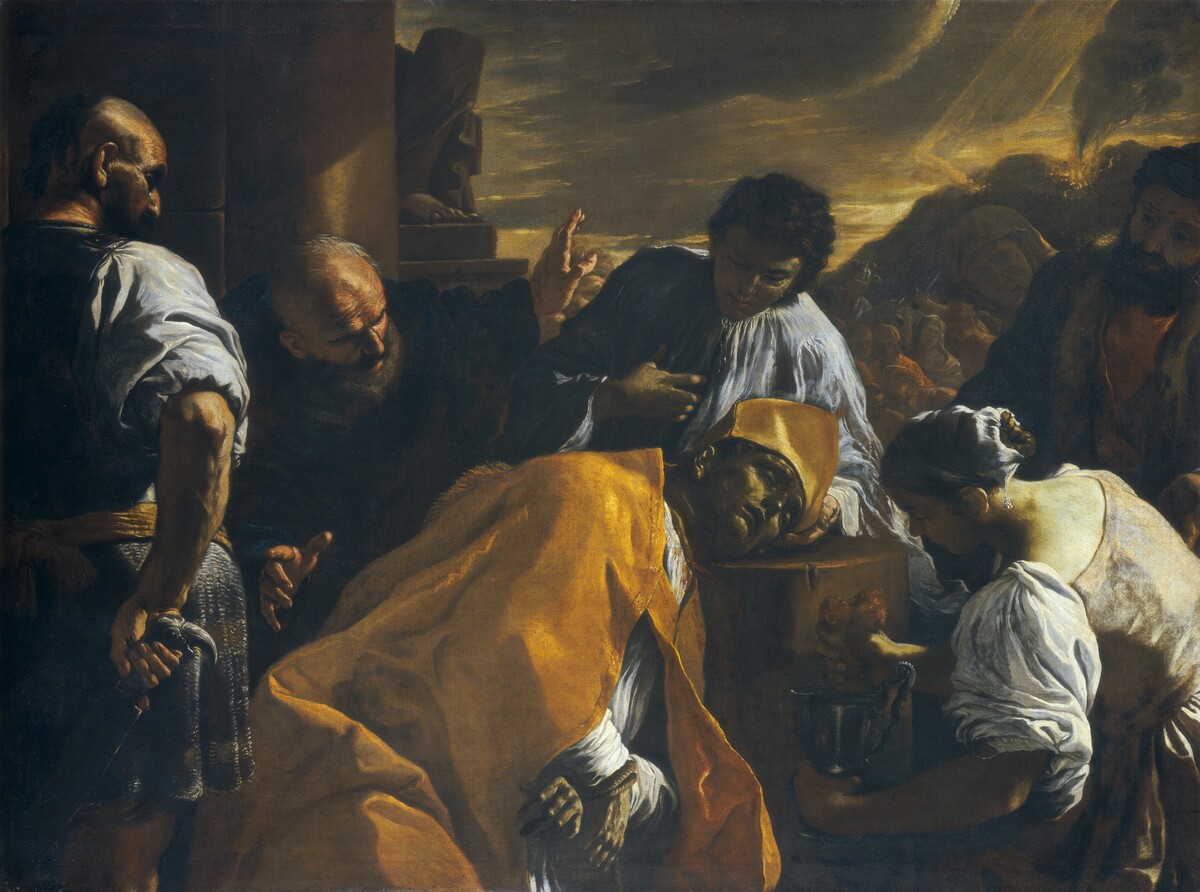
Mattia Preti (1613-1699), called Il Cavalier Calabrese, was a Calabrian painter who worked in Naples, Malta, and Rome, known for the dramatic chiaroscuro and emotional intensity that distinguish his religious paintings. The Martyrdom of Saint Gennaro from c. 1685 depicts the martyrdom of Saint Gennaro, the patron saint of Naples, in the dramatic, emotionally intense manner that distinguishes Preti's best religious painting. The c. 1685 date places this in Preti's Neapolitan period, when he was producing the dramatic religious paintings that influenced the development of Neapolitan Baroque painting.
Cultural Impact
The Martyrdom of Saint Gennaro is important in the history of Neapolitan Baroque painting because it demonstrates the dramatic chiaroscuro and emotional intensity that Preti brought to Neapolitan religious painting. Preti's influence on Neapolitan painting was profound, and the dramatic chiaroscuro of this martyrdom scene would influence the Neapolitan tradition of emotionally intense religious painting that led to Solimena and the later Neapolitan Baroque.
Why It Matters
The Martyrdom of Saint Gennaro is Preti's Neapolitan Baroque drama: the patron saint of Naples in the dramatic chiaroscuro and emotional intensity that distinguish his best religious painting. The c. 1685 painting shows Preti at his most theatrically intense, producing the type of emotionally charged religious painting that would influence the Neapolitan Baroque tradition.
![Saint Bernard and Saint Catherine of Alexandria with the Virgin of the Annunciation [right panel]](https://api.nga.gov/iiif/e6890364-4d99-4684-a62b-5060ee3c3446/full/400,/0/default.jpg)