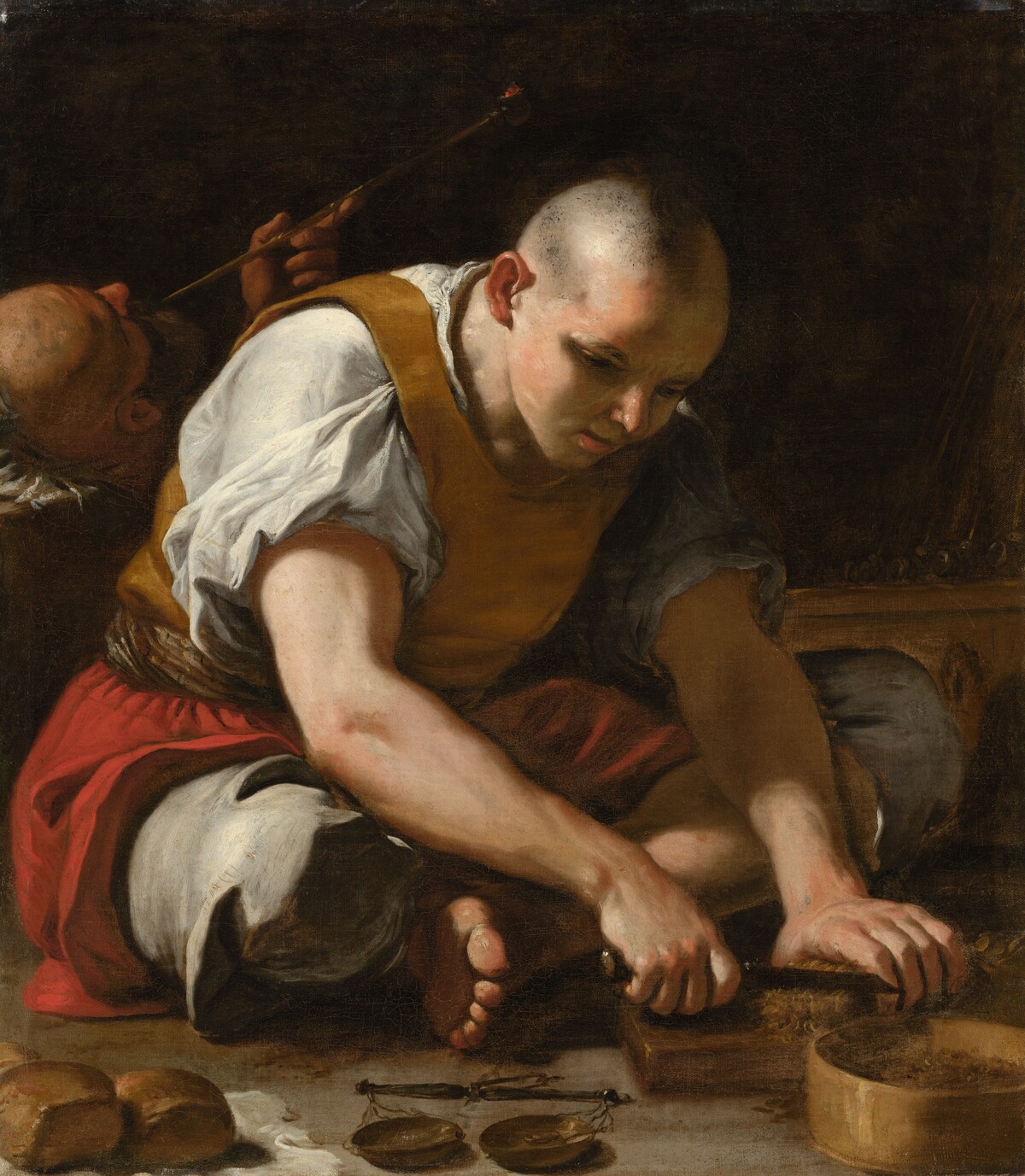
Provenance
(Sale, Sotheby's London, 13 December 2001, no. 48); (Jean-Luc Baroni, London); purchased 2002 by private collection, New York; (sale, Sotheby's New York, 26 January 2023, no. 1); purchased 2023 by NGA.
Accession Number
2023.19.1
Medium
oil on canvas
Dimensions
overall: 103.19 × 90.49 cm (40 5/8 × 35 5/8 in.)
Classification
Painting
Credit Line
Patrons' Permanent Fund, Pepita Milmore Memorial Fund, and New Century Fund
Tags
Painting Baroque (1600–1750) Oil Painting Canvas Italian
Background & Context
Background Story
Mattia Preti (1613-1699) was a Calabrian painter known for the dramatic chiaroscuro and muscular figure style that he developed under the influence of Caravaggio and the Neapolitan Baroque. A Man Cutting Tobacco from the 1660s depicts a man cutting tobacco in the dramatic chiaroscuro and muscular figure style that distinguishes Preti's best genre subjects from his more familiar religious paintings. The 1660s date places this in Preti's most productive period, when he was working in Malta and producing both the religious paintings that are his most familiar works and the genre subjects that show his Caravaggist manner in a more everyday mode.
Cultural Impact
A Man Cutting Tobacco is important in Preti's oeuvre because it demonstrates the Caravaggist chiaroscuro and muscular figure style that he typically applied to religious subjects, in the more everyday mode of a genre subject. The tobacco cutter shows Preti applying the dramatic chiaroscuro and muscular figure style of the Neapolitan Baroque to a homely subject that is more familiar from Dutch genre painting, creating a type of Southern genre painting that is simultaneously dramatic in manner and everyday in subject.
Why It Matters
A Man Cutting Tobacco is Preti's Caravaggist genre: a man cutting tobacco rendered in the dramatic chiaroscuro and muscular figure style that he typically reserved for religious subjects. The 1660s painting applies the Neapolitan Baroque manner to an everyday genre subject, creating a dramatic Southern genre painting.
![Saint Bernard and Saint Catherine of Alexandria with the Virgin of the Annunciation [right panel]](https://api.nga.gov/iiif/e6890364-4d99-4684-a62b-5060ee3c3446/full/400,/0/default.jpg)