Description
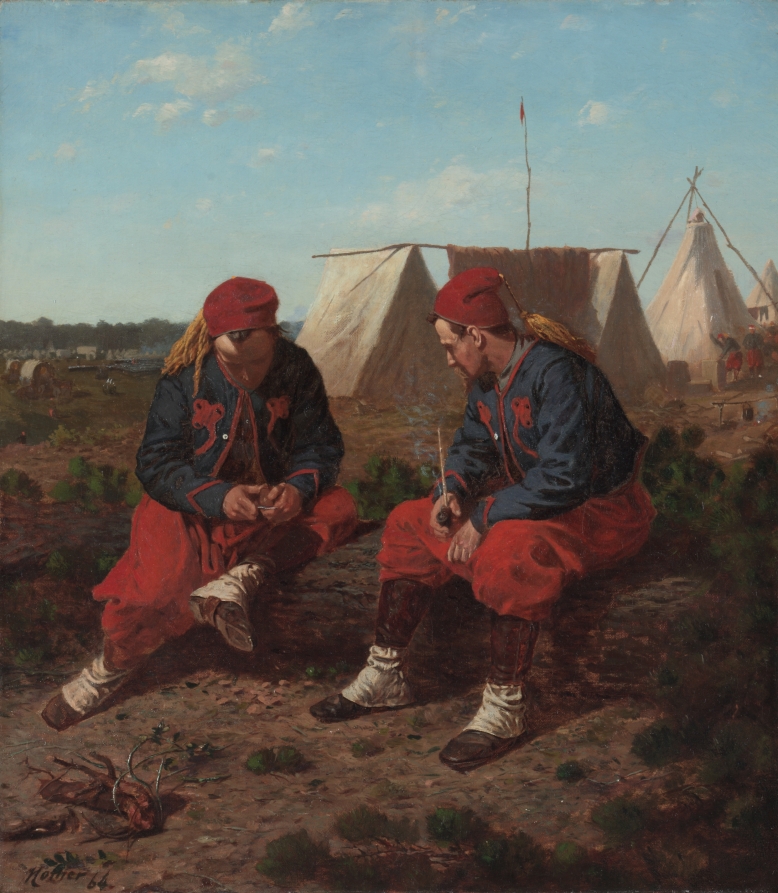
Homer’s subject was inspired by a sentimental poem popular at the time, in which a Civil War soldier carves a wooden pipe and daydreams of the time when the conflict will end so that he can return home. The painting depicts two volunteers for the Union Army who sport their regiment’s highly colorful uniforms, a design soon discovered as impractical due to its ability to be spotted by sharpshooters. The museum acquired this work during World War II. It seems likely that the painting’s imagery was viewed as especially significant for its wartime audience.
Provenance
The Cleveland Museum of Art, Cleveland, Ohio (1944-); Mrs. Z. Boylston Adams (Helen Foster), Brookline, MA, sold to the Cleveland Museum of Art (Probably 1940-1944); Zabdiel Boylston Adams [1875-1940], Brookline, MA, to his wife, Mrs. Z. Boylston Adams1 (1915 - probably 1940); Annie Adams Fields (Mrs. James T. Fields) [1834-1915], Boston, MA, by bequest to her nephew, Zabdiel Boylston Adams (1881-1915); James Thomas Fields [1817-1881], Boston, MA (-1881)
Accession Number
1944.524
Medium
oil on canvas
Dimensions
Framed: 68.9 x 64.1 x 9.2 cm (27 1/8 x 25 1/4 x 3 5/8 in.); Unframed: 42.8 x 37.5 cm (16 7/8 x 14 3/4 in.); Former: 69 x 64 x 8 cm (27 3/16 x 25 3/16 x 3 1/8 in.)
Classification
Painting
Credit Line
Mr. and Mrs. William H. Marlatt Fund