Description
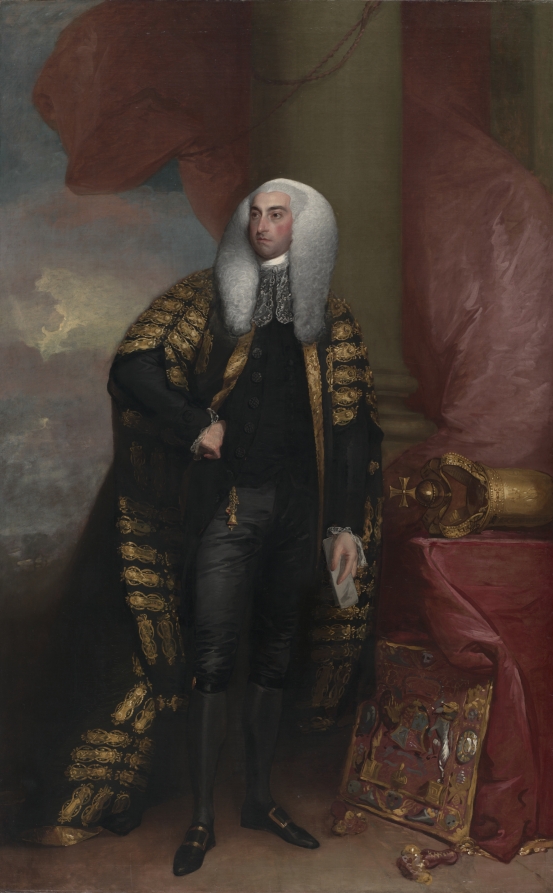
A fearless politician who engineered the act of uniting Ireland with England, FitzGibbon was the newly appointed Lord Chancellor of Ireland (whose duties included that of chief judge) when Stuart painted his portrait. The crownlike upper portion of FitzGibbon's mace, or ceremonial staff, is seen on the table at the right. Propped against the table is a satin and velvet purse embroidered with the royal coat of arms. Worn around the neck like an apron, the purse held the official texts of FitzGibbon's speeches. At the time he painted this work, Stuart was living in Dublin, having spent a dozen years in London. In fact, his Irish patrons regarded him as a British painter. Stuart returned to his native America in 1793, where he remained the rest of his life.
Provenance
Baron John FitzGibbon, 1st Earl of Clare [1748-1802], County Limerick, by descent to his sons (1789-probably 1802); John Fitzgibbon, 2nd Earl of Clare [1792-1851] and Richard Hobart Fitzgibbon, 3rd Earl of Clare [1793-1864], sons of Baron FitzGibbon1 (Probably 1802-1864); Alexander James Beresford-Hope [1820-1887], Bedgebury, Kent, by descent to his son, Alexander James Beresford-Hope1 (1864-1887); Alexander James Beresford-Hope, Bedgebury, Kent1; Isaac Lewis, Esq. [1849-1927], Bedgebury, Kent (-1919); (Bedgebury Mansion sale, Knight Frank & Rutley, London, May 12-19, 1919, no. 23, sold to Knoedler & Co.)1 (1919); (Knoedler & Co., New York, NY, sold to the Cleveland Museum of Art) (1919); The Cleveland Museum of Art, Cleveland, Ohio (1919-)
Accession Number
1919.910
Medium
oil on canvas
Dimensions
Framed: 272 x 181 x 11 cm (107 1/16 x 71 1/4 x 4 5/16 in.); Unframed: 245 x 154 cm (96 7/16 x 60 5/8 in.)
Classification
Painting
Credit Line
General Income Fund