Provenance
The artist's daughter, Mme. Ernst Rouart (née Julie Manet; 1878-1966), from 1895 [Lugt 1826]. Grant J. Pick (died 1963), Chicago; given by the estate of Grant J. Pick to the Art Institute, 1963.
Accession Number
17564
Medium
Watercolor, over graphite, on ivory wove paper
Dimensions
31.1 × 23.7 cm (12 1/4 × 9 3/8 in.)
Classification
watercolor
Credit Line
Gift of the Estate of Grant J. Pick
Background & Context
Background Story
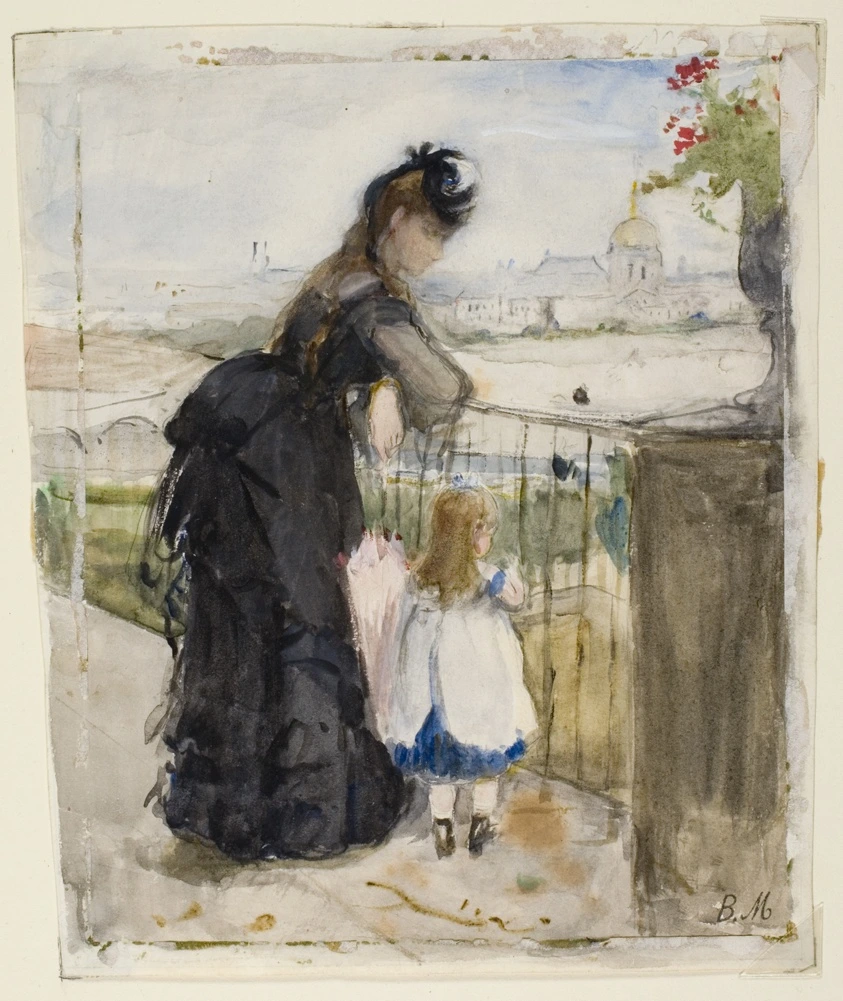
"Jeanne Pontillon" is a c. 1893 watercolor over graphite on ivory wove paper by Berthe Morisot that captures the French Impressionist painter in her most delicately intimate and quietly observational mode, the image showing a portrait of Jeanne Pontillon rendered with the same attention to feminine grace and coloristic subtlety that characterized her most refined works. The composition is a medium-sized watercolor—31.1 × 23.7 centimeters—showing Jeanne Pontillon with the watercolor over graphite on ivory wove paper creating a surface of extraordinary delicacy and intimate warmth. The ivory wove paper provides a warm, luminous ground that makes the watercolor washes appear rich and luminous, enhancing the sense of personal connection and feminine friendship. The c. 1893 date places this work in the period of Morisot's mature Impressionist production and her continued engagement with the theme of feminine intimacy and personal portraiture. Art historians have connected this work to the broader tradition of the female portrait in French art, from the paintings of Cassatt to the watercolors of the period, noting that Morisot's treatment is more focused on the feminine tenderness and the coloristic subtlety, the transformation of observed friend into visual poem, than the formal analysis or the social commentary of these other traditions.
Cultural Impact
This c. 1893 watercolor made Jeanne Pontillon intimately delicate through medium 31cm graphite-underdrawing subtlety and ivory-paper warm luminous feminine friendship, using mature Impressionism to transform observed female friend into visual tender poem beyond Cassatt formal social analysis.
Why It Matters
It matters because Morisot painted a friend and made the paper feel like it was holding a whisper between women who understood each other—proving that even a portrait could be a letter if the watercolor was sincere enough.