Woman at Her Toilette

Description

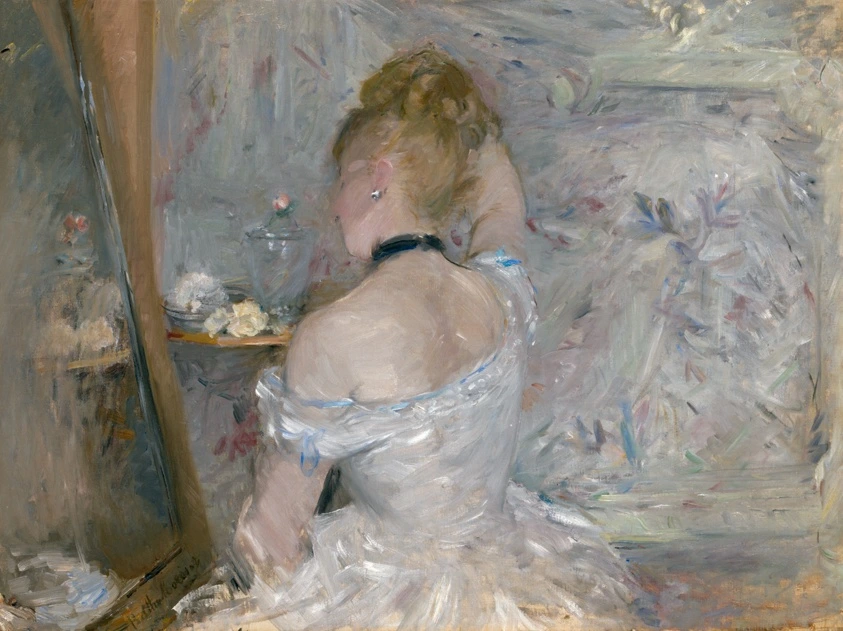
In Woman at Her Toilette, Berthe Morisot provided a glimpse into the private life of a Parisienne—one of the fashionable, urban women who epitomized modernity in late nineteenth-century France. The figure is shown at her vanity table after a ball, still wearing her earrings and a velvet ribbon around her neck as she reaches up to take down her chignon hairstyle. In the background, Morisot’s soft, feathery brushstrokes suggest a fl oral-patterned bedspread and wallpaper. The artist applied the same gauzy technique to the mirror, obscuring the fi gure’s reflection and thus disrupting the trope of women gazing into mirrors as a symbol of vanity. Morisot signed her name along the bottom of the mirror, an enigmatic detail that may suggest that the figure is a stand-in for the artist herself.

Consistent with the Impressionist aesthetic that Morisot fervently espoused, In Woman at Her Toilette attempts to capture the essence of modern life in summary, understated terms. Morisot exhibited in seven of the eight Impressionist group shows; in 1880 this painting was included in the fifth exhibition, where her work received high acclaim. In addition to domestic interiors such as this one, Morisot’s pictorial realm included studies of women and children, gardens, fields, and vacation homes by the sea.

Provenance

William Merritt Chase, New York; his sale, New York, American Art Galleries, 1896, lot 1093 [according to Clairet 1997]. Mary Cassatt, 1896 [see Paris 1896]. Durand-Ruel, Paris, 1905 [see London 1905]. Wildenstein & Co., New York [according to Chicago 1933]. Paul Rosenberg, New York by 1924; sold to the Art Institute, 1924.

Woman at Her Toilette

Berthe Morisot

1875–80

Accession Number

11723

Medium

Oil on canvas

Dimensions

60.3 × 80.4 cm (23 3/4 × 31 5/8 in.); Framed: 85.8 × 105.5 × 10.5 cm (33 3/4 × 41 1/2 × 4 1/8 in.)

Classification

Painting

Museum

The Art Institute of Chicago

Chicago, United States

Credit Line

Stickney Fund

Tags

Painting Impressionist & Modern (1851–1900) Oil Painting Canvas

Background & Context

Background Story

Woman at Her Toilette, painted between 1875 and 1880, depicts a woman at her dressing table, seen from behind, her back bare, her hair loose. The painting is one of Morisot's most intimate and most radical works: an image of female privacy that makes the viewer acutely aware of their intrusive gaze. The subject of the woman at her toilette was central to Impressionist painting - Berthe Morisot, Mary Cassatt, Edgar Degas, and Pierre-Auguste Renoir all produced major works on this theme. But where the male Impressionists painted the toilette as a spectacle for the male viewer, Morisot painted it from the woman's perspective: a private ritual, not a performance. The painting's handling of paint is among Morisot's most abstract. The woman's back, the mirror, the furniture, and the surround dissolve into a field of rapid, gestural brushwork that anticipates the sketch-like quality of late Degas and the bravura painting of John Singer Sargent. Morisot's refusal to finish - to render every surface with the same degree of definition - is not a failure of technique but a statement of priorities: she has chosen to record the movement and atmosphere of the moment rather than the permanent features of the room.

Cultural Impact

Morisot's toilette paintings created a female alternative to the male Impressionist tradition of depicting women's private lives. Her women are not objects of the gaze but subjects of their own experience - a distinction that influenced every subsequent woman artist who depicted the female body.

Why It Matters

This painting is Morisot's most radical statement: a woman's body seen from a woman's perspective, rendered with a freedom of brushwork that matches the freedom of the gaze. The woman at her toilette is not posing; she is living - and Morisot's brush records her life with the urgency and the tenderness of intimate knowledge.