Provenance
Possibly estate of the artist [stamp (see Lugt 1826), recto, lower left, in blue ink]. Lucien Lefebvre-Foinet, Paris [according to New York 1967 auc. cat.]. Grant Pick, Chicago; by descent; sold, Sotheby-Parke-Bernet, New York, Dec. 13, 1967, to Dorothy Braude Edinburg, Brookline, MA.; given to the Art Institute of Chicago, 2013.
Accession Number
186320
Medium
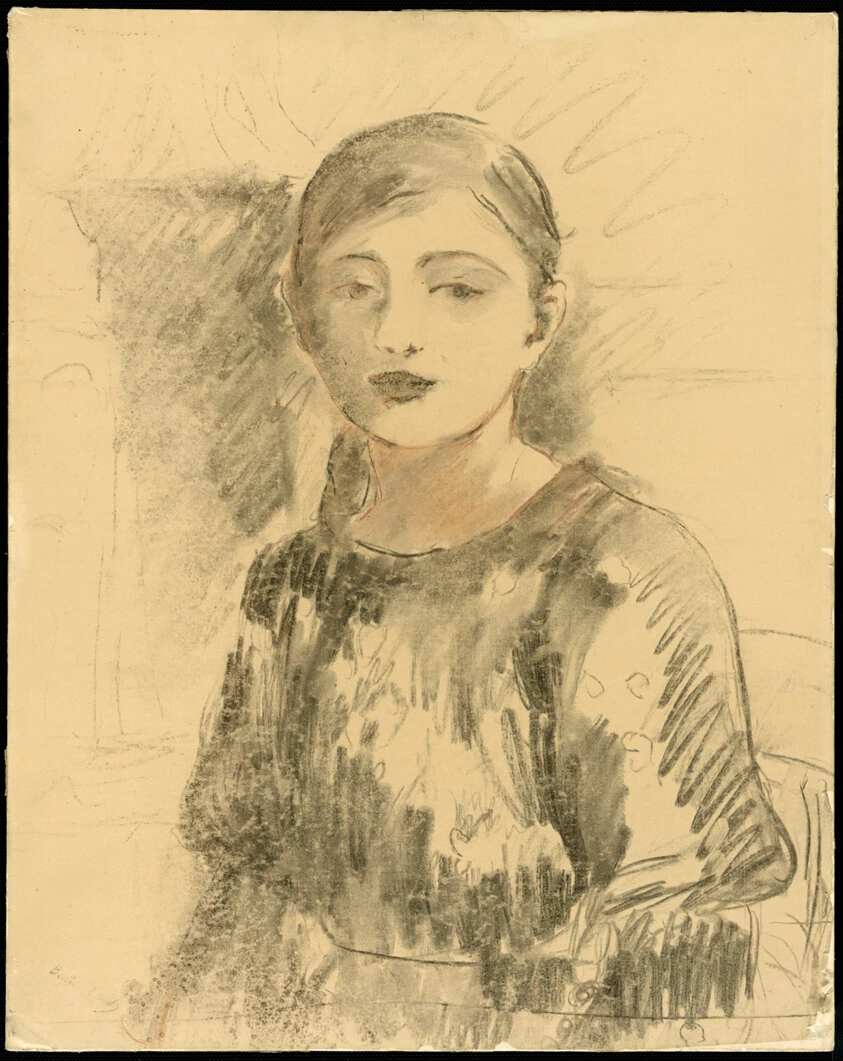
Transfer drawing in charcoal and red chalk, on light tan tracing paper, laid down on white wove paper, wrapped around millboard
Dimensions
53.8 × 43 cm (21 3/16 × 16 15/16 in.)
Classification
prints and drawing
Credit Line
Gift of Dorothy Braude Edinburg to the Harry B. and Bessie K. Braude Memorial Collection
Background & Context
Background Story
"Portrait of Julie Manet" is one of Berthe Morisot's most touching late works, a transfer drawing in charcoal and red chalk on tracing paper executed in 1890 and depicting her daughter, who would become the subject of numerous portraits throughout Morisot's final decade. The technique of transfer drawing—copying an original drawing onto a new sheet by rubbing—was unusual for Morisot, who more commonly worked directly from life, and its use here suggests either an experimental impulse or the desire to preserve a precious original while creating a version that could be worked further. The image shows Julie in profile or three-quarter view, her young face rendered with the tender attention that mothers bring to their children, the charcoal providing subtle tonal gradations while the red chalk adds warm highlights that suggest the flush of youth. The tracing paper support creates a slight transparency that makes the image feel delicate and ephemeral, as if the portrait might fade like memory itself. The 1890 date places this work in the period when Morisot was increasingly concerned with preserving the image of her daughter, perhaps sensing her own declining health and the imminence of separation. Art historians have connected these late portraits of Julie to the broader tradition of maternal imagery in art, from the Madonna and Child to the mother-and-child scenes of Cassatt, noting that Morisot's treatment is more intimate, less idealized than these precedents. The work also demonstrates the technical range of Morisot's draftsmanship: she was equally proficient in oil, watercolor, pastel, and drawing, and the transfer technique shows her willingness to experiment with unfamiliar methods in pursuit of the right effect.
Cultural Impact
This 1890 transfer drawing preserved maternal tenderness through experimental charcoal-red-chalk transparency, making daughter Julie's youth feel ephemeral while documenting Morisot's late-life experimental technical range.
Why It Matters
It matters because Morisot drew her daughter on tracing paper and made the paper feel like breath—proving that even a copy could hold more love than an original if the mother was watching.