Description
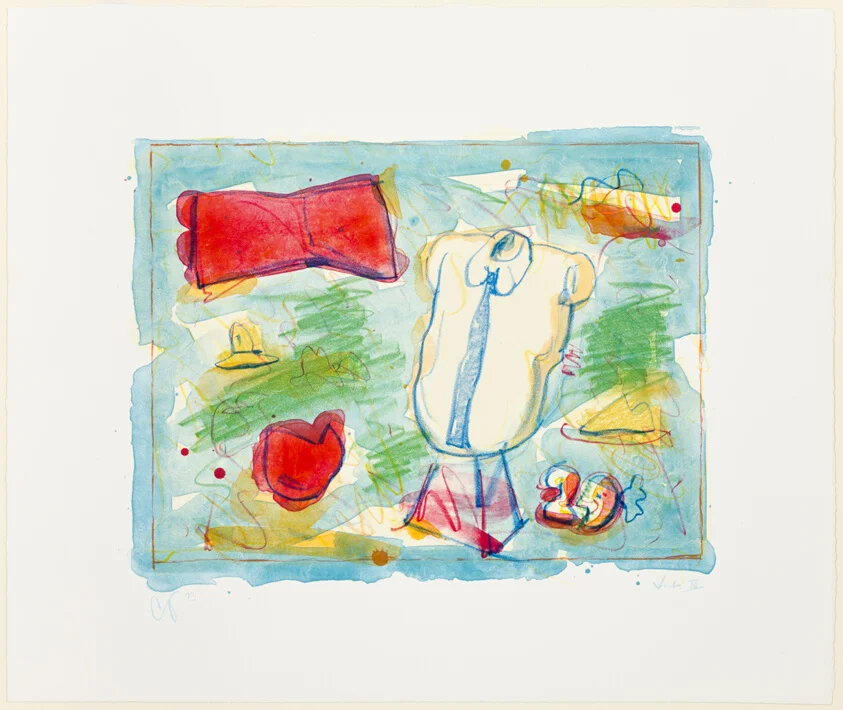
This lithograph brings together a number of items that the artist has made use of over the years. They are presented buoyantly, with all the verve and freshness of watercolor. The transparent hues are brilliant and the items are drawn with Oldenberg's special fealing for soft forms.
Accession Number
45368
Medium
Color lithograph on white wove paper
Dimensions
67.9 × 57 cm (26 3/4 × 22 1/2 in.)
Classification
lithograph
Credit Line
Gift of Mr. and Mrs. Stanley M. Freehling
Background & Context
Background Story
Claes Oldenburgs Store window: bow, hats, heart, shirt, 29 cent from 1973 is a color lithograph that captures the visual chaos and commercial energy of downtown Manhattan store windows, a subject that occupied Oldenburg throughout the 1960s and 1970s. The print depicts a jumbled arrangement of merchandise — hats, a bow, a heart, a shirt, and a sign advertising the improbable price of 29 cents — rendered in the thick outlines and flat colors that characterize Oldenburgs graphic style. The store window was for Oldenburg both a found sculpture and a social document: an arrangement of consumer goods that, when viewed with the right eyes, became a ready-made Pop composition as complex as anything in a gallery. The price of 29 cents is characteristically absurdist, suggesting a world where value has become so detached from meaning that any number will do. The print belongs to a series of lithographs that Oldenburg made from his drawings and notes of Lower East Side storefronts, translating the gritty reality of cheap merchandise and hand-lettered signs into the refined medium of color lithography without losing the originals sense of vitality and disorder. The process of making a lithograph from a store window observation is itself a Pop gesture: taking the lowest of commercial imagery and elevating it through a fine art medium.
Cultural Impact
Oldenburgs store window lithographs are key documents of the Pop Art movements engagement with the commercial streetscape as a source of artistic material. His insistence on finding art in cheap signage and window displays influenced generations of artists, photographers, and designers who continue to mine the urban commercial landscape for visual material.
Why It Matters
A color lithograph by Oldenburg that transforms a Lower East Side store window into a Pop composition of commercial chaos, demonstrating the artists practice of finding sculptural and pictorial possibility in the most ordinary merchandise displays.