Accession Number
21285
Medium
Engraving with etching in black ink on ivory laid paper
Dimensions
Image: 20.2 × 25.8 cm (8 × 10 3/16 in.); Plate: 20.5 × 25.8 cm (8 1/8 × 10 3/16 in.); Sheet: 20.8 × 25.8 cm (8 1/4 × 10 3/16 in.)
Classification
Credit Line
Gift of Bernard F. Rogers, Sr.
Background & Context
Background Story
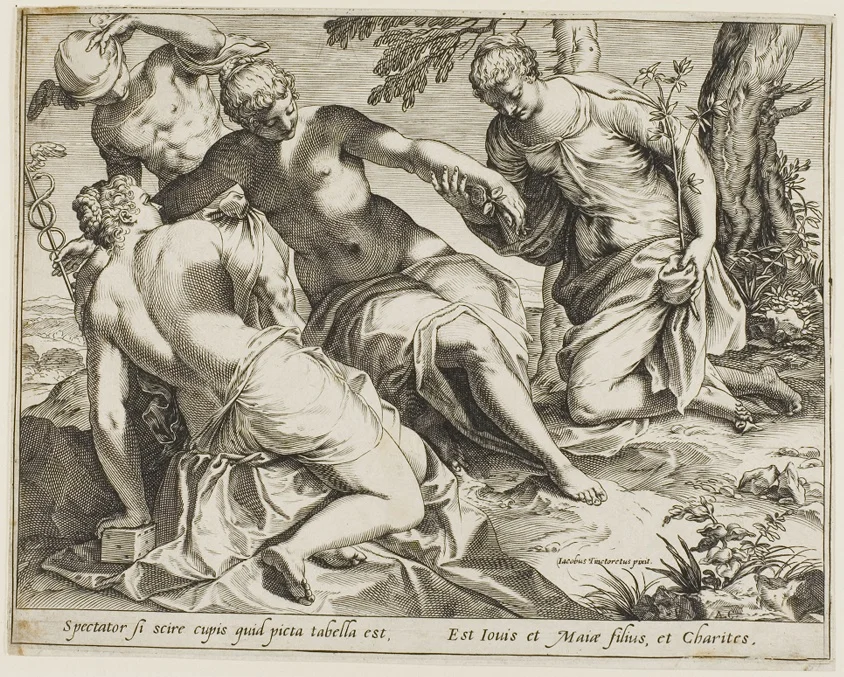
Mercury and the Graces, engraved by Agostino Carracci in 1589, depicts the mythological scene of the messenger god Mercury encountering the three Graces, daughters of Zeus who embodied beauty, charm, and creativity. The print demonstrates Agostinos mastery of the combined engraving and etching technique, using etched lines for broader tonal areas and engraved lines for sharper contour definition, creating a rich interplay of light and shadow. The composition derives from classical models but Agostino infuses the figures with a naturalism and physical presence that distinguishes Carracci reform from Mannerist preciosity. The three Graces interlock their arms in the traditional pose known from antiquity, while Mercurys animated pose and outward gesture suggest a narrative moment of divine intervention. This print belongs to a series of mythological subjects that Agostino produced as both artistic statements and commercial enterprises, capitalizing on the growing market for affordable reproductive prints that brought elevated subject matter to a broader educated audience.
Cultural Impact
Agostino Carraccis mythological prints were instrumental in popularizing the Carracci reform style across Europe. By combining classical erudition with naturalistic figural treatment and reproductive precision, these prints established a model for narrative art that balanced ideal beauty with convincing physical presence.
Why It Matters
A masterful engraving combining etching and burin technique, depicting Mercury and the Graces with the naturalistic idealism that characterized the Carracci reform of Italian art at the turn of the 17th century.