Description
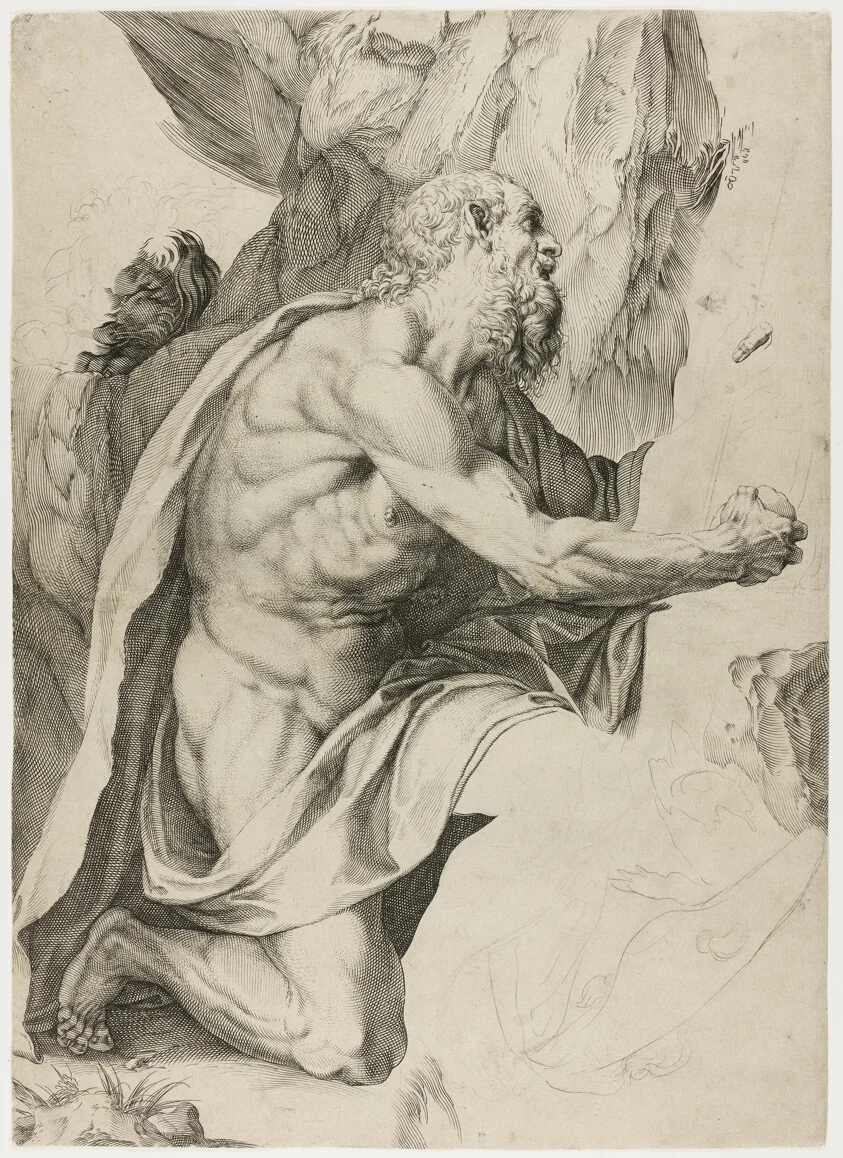
The Bolognese artist Agostino Carracci died before finishing this print. The partially engraved copper plate was printed after his death—hence the unusual appearance of this impression, which provides invaluable insight into Carracci’s process. The artist began by scratching the general outlines of the composition onto the plate. He then moved on to defining the figure and introducing shading using lines engraved with a sharp steel tool called a burin, starting at the center and working outward.
Accession Number
39361
Medium
Engraving on ivory laid paper
Dimensions
Image/sheet; cut within platemark: 38.7 × 27.7 cm (15 1/4 × 10 15/16 in.)
Classification
Credit Line
John H. Wrenn Memorial Collection
Background & Context
Background Story
This engraving of Saint Jerome in Penitence by Agostino Carracci captures the Bolognese Renaissance master in his most dramatically expressive and technically accomplished mode, the image showing the penitent saint in the wilderness with the muscular energy and emotional intensity that made the Carracci academy the leading force in Baroque art. The composition is a large engraving—38.7 × 27.7 centimeters—showing Saint Jerome in a rocky landscape, the saint's body rendered with the anatomical precision and the dramatic chiaroscuro that Agostino Carracci brought to all his graphic work. The engraving technique creates a surface of extraordinary clarity and tonal range, the fine lines suggesting both the physical texture of the rocks and the spiritual radiance of the divine vision. The ivory laid paper provides a warm, sympathetic ground that makes the black engraved lines appear rich and substantial. The c. 1602 date places this work in the period of Agostino's maturity, when he was producing the prints that disseminated the Carracci academic program to a wider audience and established the family's reputation as the founders of the Baroque style. Art historians have compared this print to the paintings of Annibale Carracci and the engravings of Dürer, noting that Agostino's treatment is more focused on the dramatic gesture and the emotional expression than the idealized beauty or the compositional harmony of these other traditions.
Cultural Impact
This c. 1602 engraving made penitent saint dramatically Baroque through large 38cm rocky anatomical precision and ivory-paper chiaroscuro warmth, using Carracci-academy technical clarity to disseminate emotional expressive intensity beyond Dürer idealized harmony.
Why It Matters
It matters because Agostino Carracci carved a saint in the rocks and made the paper feel like it was hearing his prayers—proving that even a print could repent if the lines were fierce enough.