Description
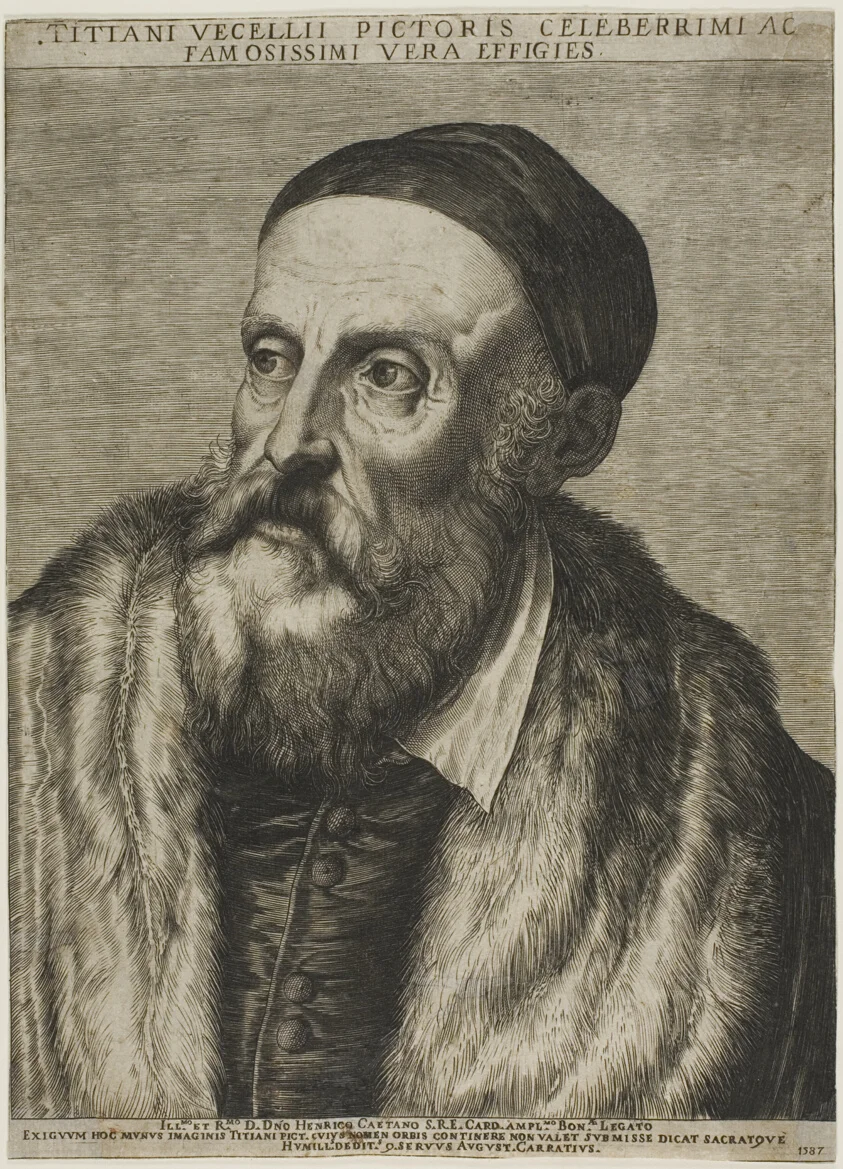
Although an optical illusion makes Titian’s bust portrait seem to change size, the two impressions of Agostino Carracci’s Portrait of Titian (1938.1432 and 1919.2562) represent two subsequent states printed from the same reworked copper plate. The background lines at the top of the plate were burnished down to accommodate additional text celebrating Titian’s fame. This sheet has also been repaired in several places, with some of the details and lettering redrawn by hand, making the two prints seem oddly dissimilar on first glance, although Titian’s silhouette has in fact never changed.
Accession Number
28199
Medium
Engraving on ivory laid paper
Dimensions
Image/sheet, cut within platemark: 32.3 × 23.4 cm (12 3/4 × 9 1/4 in.)
Classification
Credit Line
Clarence Buckingham Collection
Background & Context
Background Story
This engraving portrait of Titian by Agostino Carracci captures the Bolognese Renaissance master in his most historically aware and culturally ambitious mode, the image showing the great Venetian painter rendered with the respect and understanding that one genius brings to another, the portrait serving as both a tribute and a document of artistic lineage. The composition is a large engraving—32.3 × 23.4 centimeters—showing Titian in a three-quarter pose with the classical bearing and the noble expression that suggest both the historical reality of the sitter and the idealized image of the artist-hero. The engraving technique creates a surface of extraordinary precision and clarity, the fine lines suggesting both the physical features of the face and the intellectual depth of the mind within. The ivory laid paper provides a warm, sympathetic ground that makes the black engraved lines appear rich and substantial. The 1587 date places this work in the early period of Agostino's career, when he was producing the prints that established his reputation and demonstrated his admiration for the Venetian masters. Art historians have compared this portrait to the self-portraits of Titian and the engraved portraits of the period, noting that Agostino's treatment is more focused on the idealized image of the artist, the noble and the heroic qualities of the creative genius, than the psychological realism or the self-critical introspection of these other traditions.
Cultural Impact
This 1587 engraving made Titian portrait nobly tributary through large 32cm three-quarter classical precision and ivory-paper idealized richness, using early Carracci admiration to document Venetian artistic lineage beyond Titian self-critical introspection.
Why It Matters
It matters because Agostino Carracci carved Titian's face and made the copper feel like it was bowing to a master—proving that even a portrait could be a handshake across time if the line was respectful enough.