A Headpiece in the Form of a Fan

Description

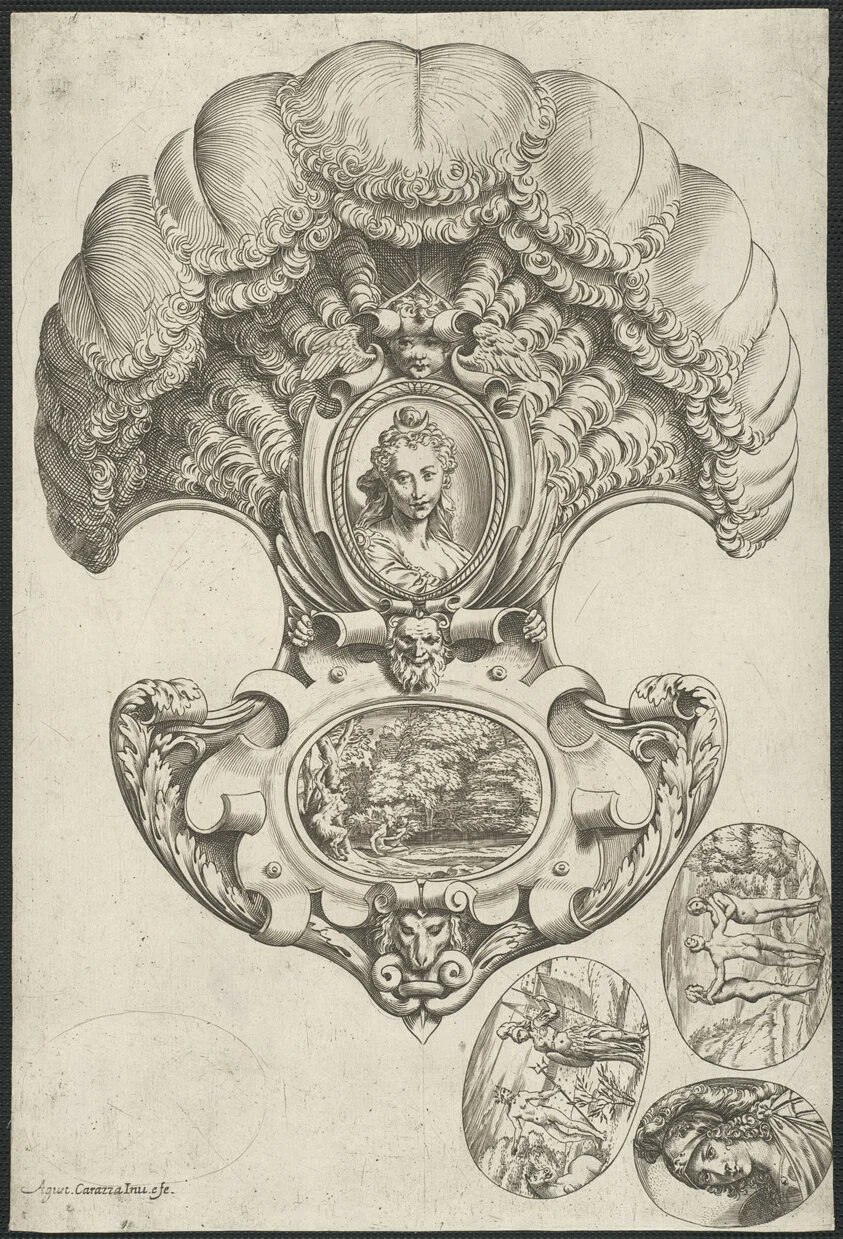
Agostino Carracci’s fanciful ostrich feather headdress engraving could be cut out and mounted on a stiff backing, then secured to a woman’s festive coiffure. The central oval cameo of the virgin huntress Diana offers the wearer one identity; three other ovals could replace it or the smaller scene of a voyeuristic satyr observing bathing nymphs. These alternate cameos include the wiser goddess Minerva, the three Graces dancing, and Minerva and Poseidon. The relatively damaged and scuffed surface of the engraving plate reinforces the idea that the print was meant to be cut out and assembled, and so keeping the margins pristine was unimportant.

A Headpiece in the Form of a Fan

Agostino Carracci

1589/95

Accession Number

44744

Medium

Engraving on ivory laid paper

Dimensions

Image/sheet, cut within platemark: 37 × 24.8 cm (14 5/8 × 9 13/16 in.)

Classification

engraving

Museum

The Art Institute of Chicago

Chicago, United States

Credit Line

The Joseph Brooks Fair Collection

Background & Context

Background Story

Agostino Carracci's A Headpiece in the Form of a Fan is an ornamental engraving that exemplifies the Carracci family's transformative influence on late Renaissance and early Baroque design. Created around 1589-95, this elaborate fan-shaped headpiece design showcases mythological and grotesque motifs interwoven with scrolling foliage, fantastical creatures, and classical architectural elements. Agostino, alongside his cousins Annibale and Ludovico, founded the progressive Accademia degli Incamminati in Bologna, which championed drawing from life as a corrective to the artificiality of late Mannerism. But Agostino was also the familys master printmaker, and this headpiece design demonstrates his ability to unite decorative invention with the rigorous burin work required for fine engraving. The fan structure organizes the ornamental elements into a unified visual field, with each zone containing its own narrative or decorative episode while contributing to the overall rhythm of the composition. Such ornamental prints served dual purposes: they were appreciated as art objects in their own right and functioned as pattern books for goldsmiths, embroiderers, and decorative painters.

Cultural Impact

Agostino Carracci's ornamental engravings established a vocabulary of decorative motifs that bridged Renaissance classicism and Baroque exuberance, directly influencing the development of the grotesque and cartouche styles in European decorative arts. His prints circulated widely as design sources for craftsmen across the continent.

Why It Matters

An ornamental engraving by Agostino Carracci that exemplifies the Carracci reform of design, combining classical structure with imaginative decorative invention in a format that served both aesthetic appreciation and practical craft application.