Accession Number
27436
Medium
Monotype in brown on buff wove paper
Dimensions
Image: 15 × 23 cm (5 15/16 × 9 1/16 in.); Sheet: 18.5 × 27.5 cm (7 5/16 × 10 7/8 in.)
Classification
monotype
Credit Line
Prints and Drawings Purchase Account
Background & Context
Background Story
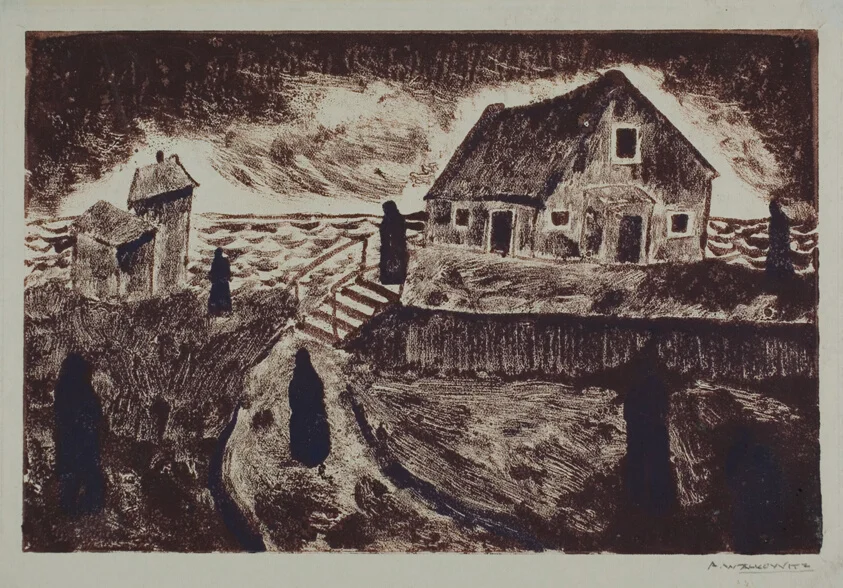
Abraham Walkowitz's At the Shore is an early monotype that reveals the artist's fascination with movement and atmospheric effects along the coastline. Created in 1898, during a period when Walkowitz was absorbing the lessons of modernist experimenters in New York, the work captures figures distributed along a beach with an economy of line that anticipates his later abstract explorations. The monotype technique—painting on a plate and pressing it onto paper to produce a single unique image—gives the composition a soft, blurred quality well suited to depicting the hazy light of a seaside day. Walkowitz was among the earliest American artists to embrace progressive abstraction, and this small monotype demonstrates how even his figurative work was oriented toward capturing essential rhythms rather than literal description. The brown ink on buff paper creates a tonal unity that dissolves the boundary between figures and their environment, a formal concern that would define his mature watercolors of Isadora Duncan dancing and his kinetic cityscapes of New York.
Cultural Impact
Walkowitz's monotypes represent an important transitional moment in American art, when European modernist ideas were first being absorbed and reinterpreted by American artists. His prolific output—he produced thousands of works—helped establish abstraction as a legitimate mode of expression in the United States.
Why It Matters
An early monotype by Walkowitz that blends figurative observation with proto-abstract simplification, showcasing the artist's pioneering role in bringing modernist sensibilities to American art.


