Accession Number
27995
Medium
Etching in black on ivory laid paper
Dimensions
Image/plate: 21.9 × 32.4 cm (8 5/8 × 12 13/16 in.); Sheet: 22.2 × 32.7 cm (8 3/4 × 12 7/8 in.)
Classification
etching
Credit Line
Edna Wilhelmine Rose Fund
Background & Context
Background Story
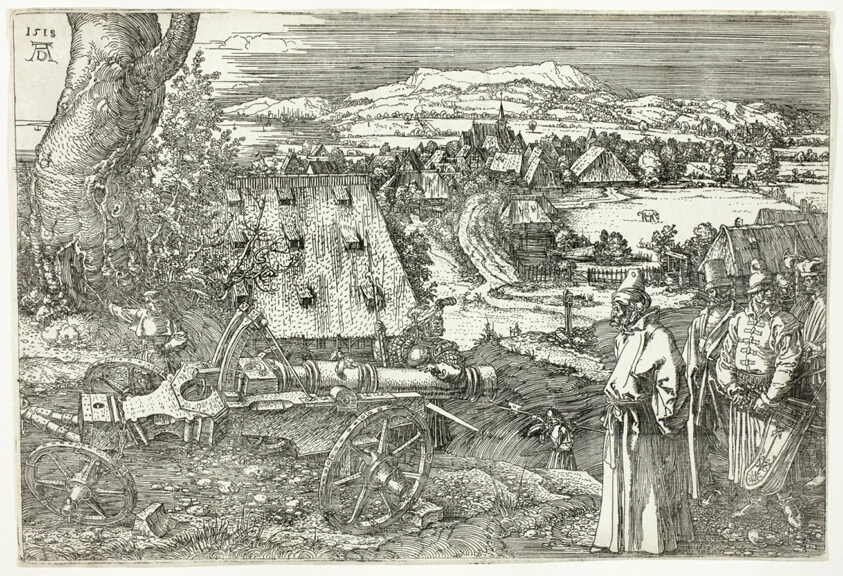
"Landscape with Cannon (The Great Cannon)" is a 1518 etching by Albrecht Dürer that captures the German Renaissance master in his most topographically ambitious and technically experimental printmaking mode, the image showing a landscape dominated by a massive cannon rendered with the same attention to detail and compositional balance that characterized his most powerful prints. The composition is a medium-sized etching—image/plate 21.9 × 32.4 centimeters, sheet 22.2 × 32.7 centimeters—showing a landscape with a cannon with the etching in black on ivory laid paper creating a surface of extraordinary precision and atmospheric depth. The cannon dominates the composition with a sense of military power and technological pride that reflects the era's fascination with new weaponry. The 1518 date places this work in the period of Dürer's travels to the Netherlands and his engagement with the military and political subjects of his time. Art historians have connected this print to the broader tradition of the military subject in Northern European art, from the woodcuts of the period to the paintings of the Renaissance, noting that Dürer's treatment is more focused on the topographical precision and the compositional balance, the transformation of military technology into artistic monument, than the dramatic action or the political propaganda of these other traditions.
Cultural Impact
This 1518 etching made cannon landscape topographically monumental through medium 21cm massive weaponry precision and ivory-laid-paper atmospheric military pride, using Netherlands-travel period to transform Renaissance technology into compositional artistic monument beyond woodcut dramatic political propaganda.
Why It Matters
It matters because Dürer etched a cannon in a landscape and made the paper feel like it was thundering with the pride and terror of a new age—proving that even a machine could be art if the composition was balanced enough.