Accession Number
28221
Medium
Etching in black on ivory laid paper
Dimensions
Image/plate: 22.4 × 15.7 cm (8 7/8 × 6 3/16 in.); Sheet: 22.5 × 15.8 cm (8 7/8 × 6 1/4 in.)
Classification
etching
Credit Line
Clarence Buckingham Collection
Background & Context
Background Story
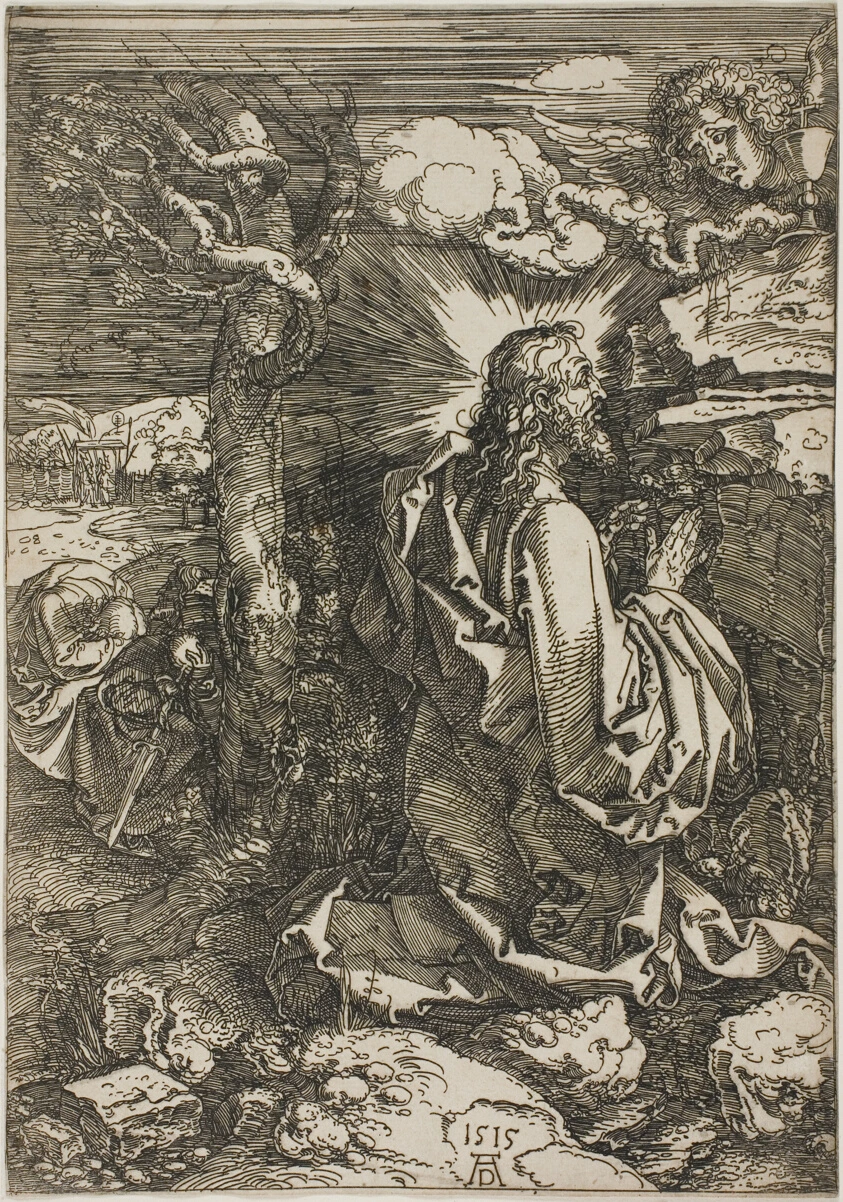
This 1515 etching of "Agony in the Garden" represents a second impression by Albrecht Dürer of one of his most spiritually profound compositions, demonstrating the Northern Renaissance master's practice of producing multiple impressions from his copperplates to satisfy the demands of collectors and to disseminate his religious vision. The composition is a medium-sized etching—image/plate 22.4 × 15.7 centimeters, sheet 22.5 × 15.8 centimeters—showing Christ in prayer with the etching in black on ivory laid paper creating a surface of extraordinary precision and spiritual luminosity. The slight variations between impressions testify to the hand-worked nature of Dürer's printmaking process and the individual character of each impression. The ivory laid paper provides a warm, luminous ground that enhances the sense of divine presence and human suffering. The existence of multiple impressions in major collections attests to the enduring power of Dürer's religious images and their continued ability to move viewers across the centuries. Art historians value these multiple impressions for what they reveal about Dürer's printmaking practice and the dissemination of his art during his lifetime.
Cultural Impact
This second 1515 Agony impression made Northern-Renaissance spirituality individually reproducible through medium 22cm hand-worked copperplate variation and ivory-paper luminous divine-human suffering, using printmaking practice to disseminate enduring religious vision beyond single-unique masterpiece limitations.
Why It Matters
It matters because Dürer made another impression and proved that sacred feeling could be shared across time and space, one print at a time—showing that even a copy could carry grace if the copperplate was true.