Accession Number
41635
Medium
Etching in black on ivory laid paper
Dimensions
22.1 × 15.4 cm (8 3/4 × 6 1/8 in.)
Classification
etching
Credit Line
Gift of Mrs. Morris Woolf
Background & Context
Background Story
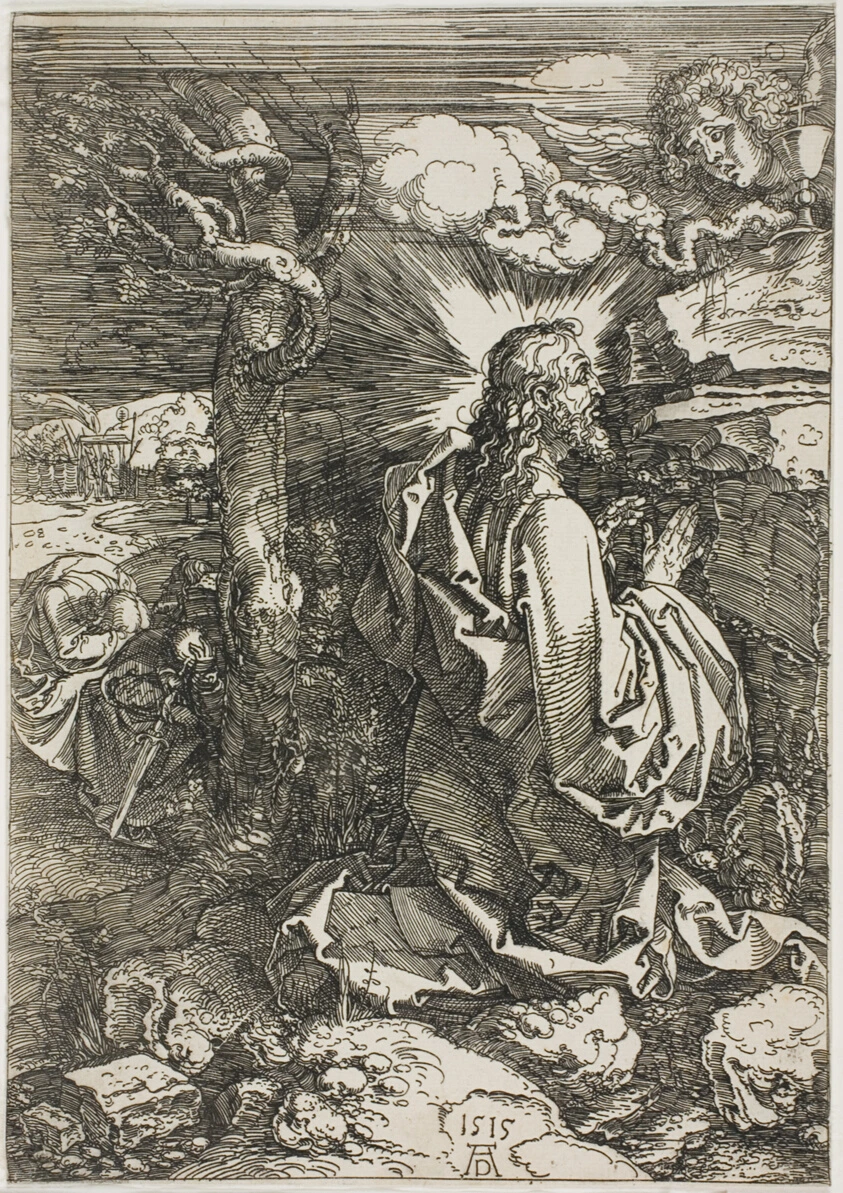
"Agony in the Garden" is a 1515 etching by Albrecht Dürer that captures the German Renaissance master in his most spiritually intense and technically refined printmaking mode, the image showing Christ in the Garden of Gethsemane rendered with the same attention to detail and emotional depth that made Dürer the greatest printmaker of the Northern Renaissance. The composition is a medium-sized etching—22.1 × 15.4 centimeters—showing Christ in prayer with the etching in black on ivory laid paper creating a surface of extraordinary precision and spiritual luminosity. The ivory laid paper provides a warm, luminous ground that makes the etched lines appear rich and substantial, enhancing the sense of divine presence and human suffering. The 1515 date places this work in the period of Dürer's most intensive production of prints and his establishment as the leading graphic artist of the European Renaissance. Art historians have connected this etching to the broader tradition of the Passion in Northern European art, from the paintings of van Eyck to the prints of the period, noting that Dürer's treatment is more focused on the technical precision and the spiritual intensity, the transformation of sacred narrative into visual theology, than the emotional excess or the dramatic spectacle of these other traditions.
Cultural Impact
This 1515 etching made Gethsemane spiritually precise through medium 22cm fine Northern-Renaissance detail and ivory-laid-paper luminous divine presence, using intensive 1515 printmaking to transform Christ's agony into visual theology beyond van Eyck emotional dramatic spectacle.
Why It Matters
It matters because Dürer etched Christ praying and made the paper feel like it was sharing the weight of the world's sorrow—proving that even a line could be a prayer if the etching was reverent enough.