Accession Number
53303
Medium
Etching in black on ivory laid paper
Dimensions
Image/plate: 18.3 × 13.3 cm (7 1/4 × 5 1/4 in.); Sheet: 18.5 × 13.5 cm (7 5/16 × 5 3/8 in.)
Classification
etching
Credit Line
Clarence Buckingham Collection
Background & Context
Background Story
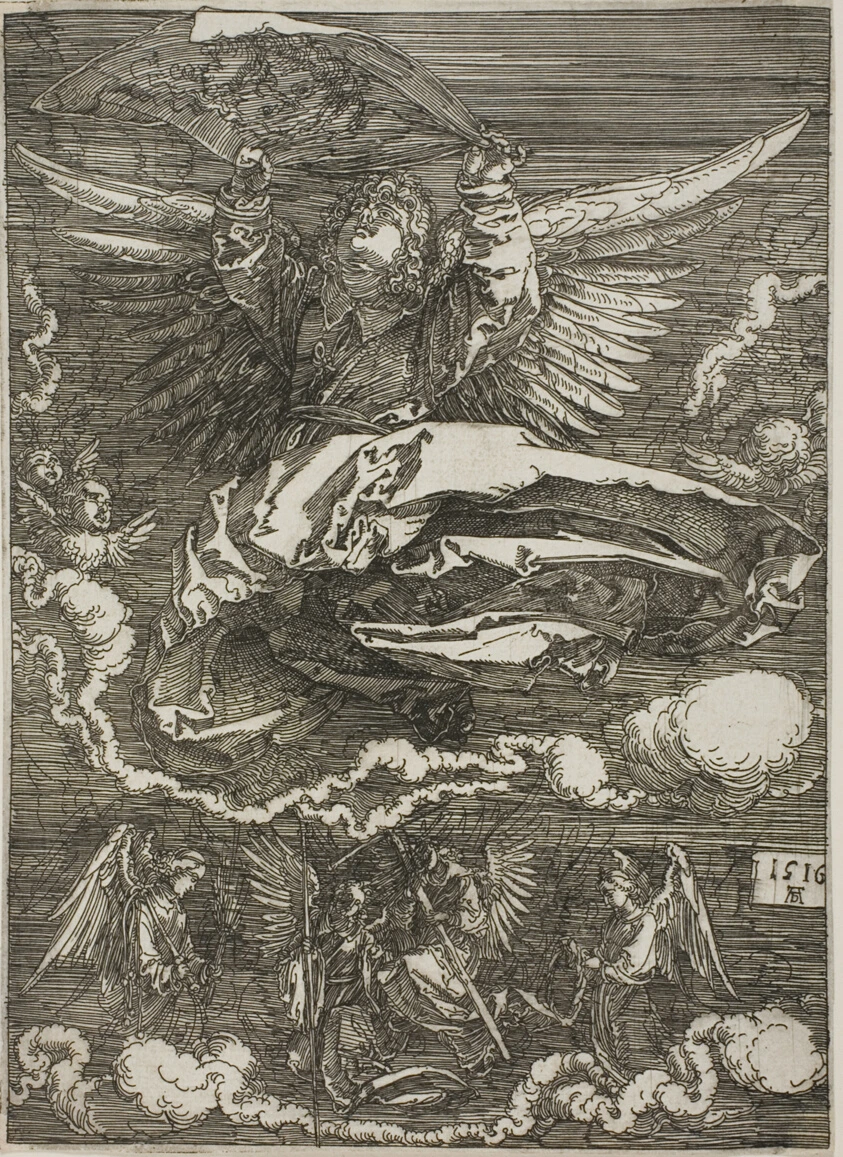
"Sudarium Spread Out by an Angel" is one of Dürer's most delicately composed late etchings, executed in 1516 as part of his ongoing exploration of Passion imagery through the innovative medium of acid-bitten metal. The image shows the veiled face of Christ—the sudarium or holy cloth that bore the imprint of his features—held aloft by an angel against a dark background, the cloth itself rendered with the transparency and luminosity that Dürer achieved through extraordinarily fine, controlled etching. The composition is centered and symmetrical, the angel's wings framing the cloth like a retable or altarpiece, the whole image functioning as a portable devotional object that could bring the sacred presence into private prayer. The etching technique is refined to an almost invisible touch: the lines are so fine that they suggest the texture of linen rather than the bite of acid, creating an illusion of fabric that surpasses even Dürer's achievements in engraving. This technical refinement is characteristic of his late period, when he was pushing each medium to its absolute limit. The subject of the sudarium was central to medieval and Renaissance devotion: the cloth that received Christ's image was considered a relic of the highest order, and its representation in art allowed the faithful to experience the sacred without physical pilgrimage. Art historians have connected this print to the broader tradition of "veronica" imagery in Northern European art, from the Byzantine icons that inspired it to the prints of Lucas van Leyden that it influenced. The 1516 date places this work in the final year of Dürer's life, suggesting that it may represent a last testament of faith from an artist who had spent decades exploring the boundaries between sacred and profane.
Cultural Impact
This 1516 late etching refined Passion devotion to near-invisible linen texture, pushing acid-bitten metal to its limit while creating a portable altarpiece for private prayer in the artist's final year.
Why It Matters
It matters because Dürer drew a cloth with Jesus's face and made the paper feel like linen—proving that even metal and acid could become gentle if the faith was strong enough.