Accession Number
53306
Medium
Etching in black on ivory laid paper
Dimensions
Image: 18.3 × 13.3 cm (7 1/4 × 5 1/4 in.); Sheet: 18.6 × 13.7 cm (7 3/8 × 5 7/16 in.)
Classification
etching
Credit Line
Clarence Buckingham Collection
Background & Context
Background Story
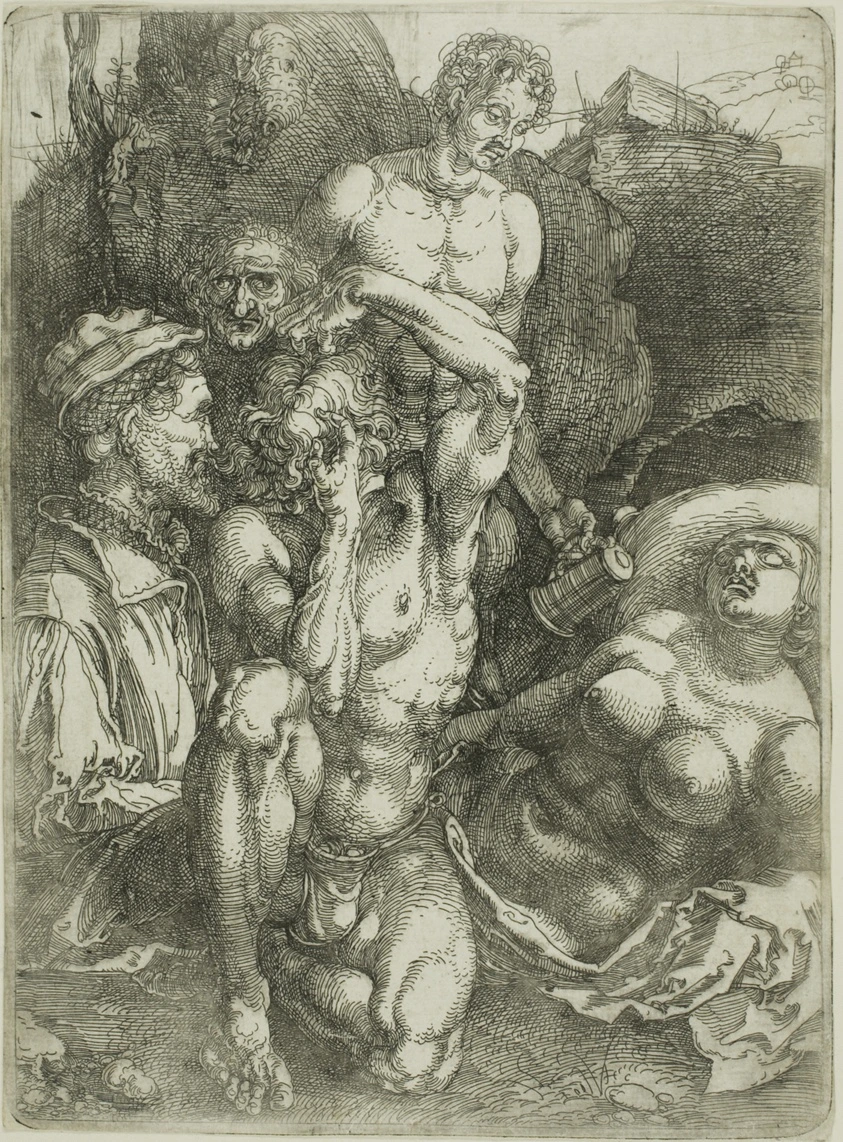
"The Desperate Man" is one of Dürer's most dramatic and self-revelatory etchings, executed around 1515–16 and traditionally identified as a self-portrait in a state of spiritual or psychological crisis. The image shows a man's face twisted in anguish, his mouth open in a scream or groan, his hair wild and disordered, the whole composition radiating outward from the face in a burst of chaotic energy that is unique in Dürer's oeuvre. The etching technique is extraordinarily energetic: the lines are rapid, almost violent, creating a texture of nervous energy that contrasts sharply with the controlled precision of Dürer's engravings. This technical freedom is itself expressive: the medium becomes a vehicle for emotion rather than a tool for description. The identification of the figure as Dürer himself is based on the facial features, which resemble the self-portraits from the 1490s, though the expression is so distorted that certainty is impossible. The title "Desperate Man" is modern; the original purpose of the image remains unclear, though it may have been intended as a study of a psychological type, a "physiognomy" in the tradition that Dürer explored in his theoretical writings. The image also connects to the broader Northern Renaissance fascination with the grotesque and the demonic, from Bosch's nightmare visions to Grünewald's crucifixion. Art historians have debated whether this etching represents a genuine psychological crisis or a theatrical performance of despair for artistic effect. In either case, it demonstrates that Dürer's art was not limited to the serene perfection of his religious panels but could encompass the full range of human experience, including the darkest corners of the mind.
Cultural Impact
This c. 1515 etching channeled violent psychological crisis through rapid, chaotic line energy, challenging Dürer's reputation for serene perfection by embracing Northern Renaissance grotesque darkness.
Why It Matters
It matters because Dürer drew himself screaming and nobody believed it was him—proving that even the master of order could let the lines run wild when the mind demanded it.