Accession Number
94607
Medium
Etching in black on cream laid paper
Dimensions
Image/plate: 21.8 × 32.5 cm (8 5/8 × 12 13/16 in.); Sheet: 22 × 33 cm (8 11/16 × 13 in.)
Classification
etching
Credit Line
The Charles Deering Collection
Background & Context
Background Story
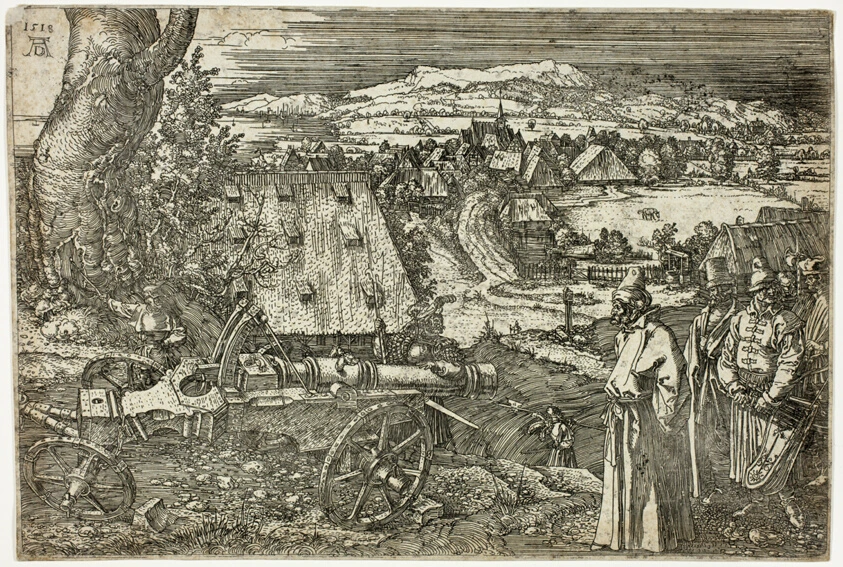
"Landscape with Cannon" is one of the most enigmatic prints in Dürer's oeuvre, an etching from 1518 that transforms the traditional devotional landscape into something approaching modern propaganda. The composition shows a coastal scene with a large cannon in the foreground, its barrel pointing toward a distant city that seems to be under attack or threat. The landscape itself is rendered with Dürer's characteristic precision—trees, rocks, and water described with the care he usually reserved for religious subjects—but the military subject was unprecedented in his printmaking. The cannon was a relatively new technology in European warfare, and Dürer's inclusion of it signals his engagement with contemporary events: the print was probably produced during the period of Habsburg-Valois conflict that would culminate in the Italian Wars. Some scholars have read the image as a patriotic statement supporting Emperor Maximilian I, for whom Dürer served as court artist; others see it as a more neutral observation of technological progress. The etching technique allows a freedom of line that Dürer's engravings rarely achieve, with broad atmospheric strokes in the sky and water that suggest the influence of contemporary Italian landscape drawing. The small scale—22 × 33 centimeters—makes the image personal rather than public, a quality that distinguishes it from the monumental woodcuts of Maximilian's triumphal projects. In the history of landscape printmaking, this etching occupies a pivotal position between the devotional backgrounds of medieval art and the independent landscape traditions that would emerge in the Netherlands during the following century.
Cultural Impact
This enigmatic etching introduced military technology into European landscape printmaking, bridging devotional tradition and modern propaganda through the unprecedented image of a threatening cannon.
Why It Matters
It matters because Dürer painted a cannon like a saint—proving that the new machines of war deserved the same careful attention as the old stories of heaven.