Accession Number
108968
Medium
Etching in black on ivory laid paper
Dimensions
Image: 31.1 × 21.2 cm (12 1/4 × 8 3/8 in.); Sheet: 31.1 × 21.3 cm (12 1/4 × 8 7/16 in.)
Classification
etching
Credit Line
The Wallace L. DeWolf and Joseph Brooks Fair Collections
Background & Context
Background Story
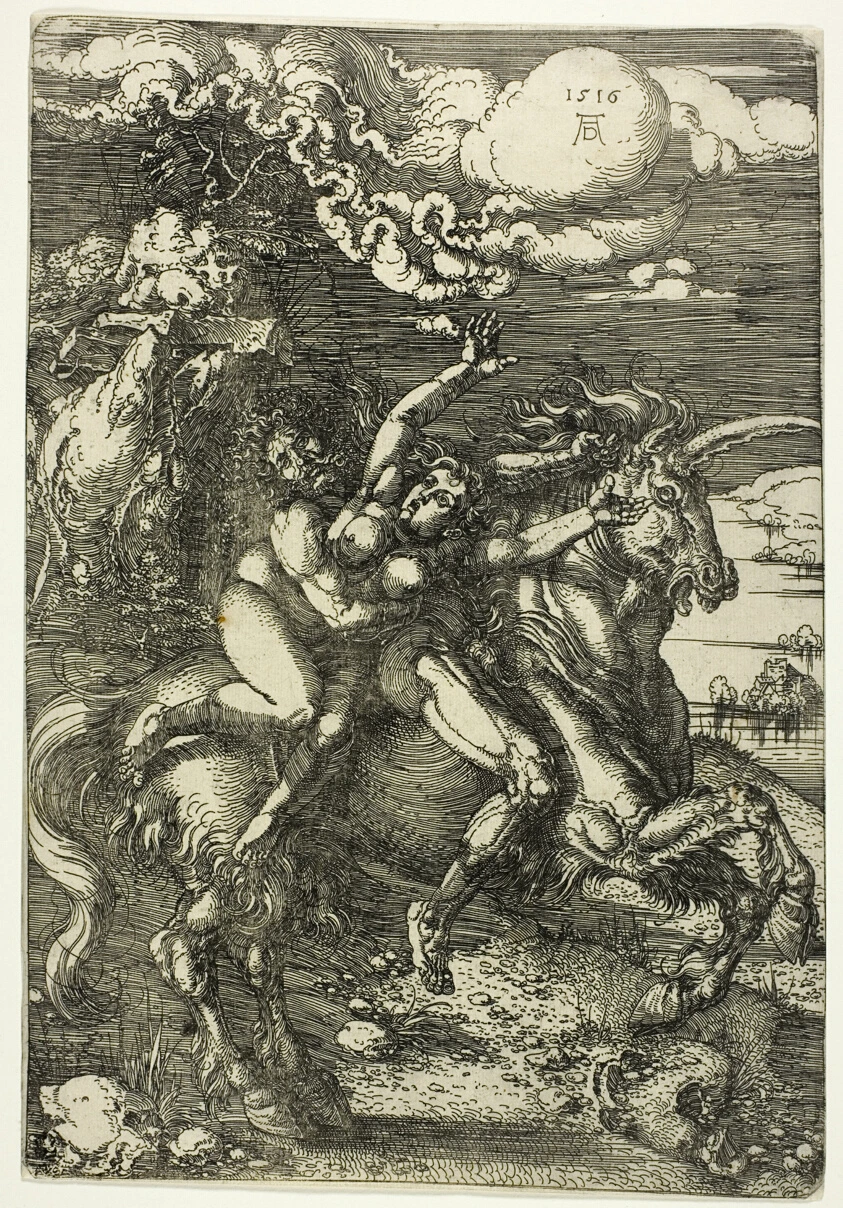
This etching of "The Abduction of Proserpine on a Unicorn" was engraved by Dürer in 1516 but printed on ivory laid paper in the 1540s or 1550s, a posthumous publication that testifies to the continuing demand for his designs decades after his death. The subject—Pluto's abduction of Proserpine, transported here on a unicorn rather than the traditional chariot—belongs to the classical mythology that Dürer had begun exploring in his Italian journey of 1505–1507. The unicorn itself is a striking substitution: by replacing the classical god with a Christian symbol of purity, Dürer creates an image that operates simultaneously in pagan and Christian registers, a visual pun that delighted Renaissance humanists. The etching technique is more fluid than Dürer's tighter engravings, with broader strokes that suggest movement and atmosphere rather than the crystalline precision of his burin work. This looseness is characteristic of his late etchings, when he was experimenting with the medium's capacity for tonal variation. The composition shows Proserpine twisting away from her captor, her body caught in a spiraling movement that recalls the figura serpentinata of Italian Mannerism—a style Dürer knew through prints and drawings rather than direct observation. The publication history is also significant: the posthumous printing indicates that Dürer's heirs and workshop maintained his plates for decades, preserving his designs while exploiting the collector's market that had developed around his name. In the history of printmaking, this image demonstrates that etching could achieve the same narrative complexity as engraving when handled by a master.
Cultural Impact
This posthumously printed etching fused pagan abduction with Christian unicorn symbolism, demonstrating Dürer's late experimentation with tonal fluidity and his enduring market power after death.
Why It Matters
It matters because Dürer put a unicorn where Pluto should be—proving that even mythology could be rewritten by a German with a sense of humor.