Red Yellow Blue White and Black II

Description

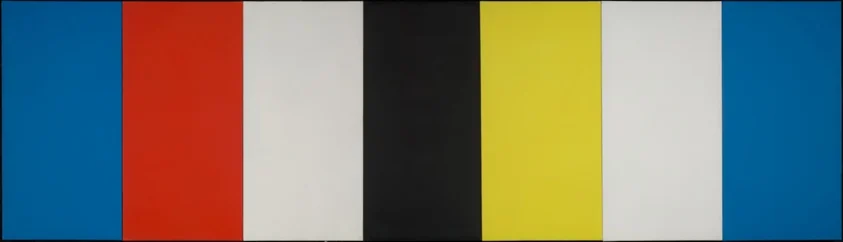
Red Yellow Blue White and Black II is an early example of Kelly’s multipanel paintings. While living in Europe between 1948 and 1954, the artist encountered winged altarpieces in churches and cathedrals, which sparked his interest in works composed of separate pieces. He began arranging the colors of his paintings using chance techniques, removing himself from decisions that would influence the aesthetic of the finished artwork. Rather than use handmade marks in this piece, Kelly relied on intersecting edges and flat planes of monochrome color to express form.

Provenance

[Matthew Marks Gallery, New York] sold to Anstiss and Ronald Krueck, 2001; gifted to the Art Institute of Chicago in incrimates 2001–2017.

Red Yellow Blue White and Black II

Ellsworth Kelly

1953

Accession Number

157156

Medium

Oil on canvas; 7 joined panels

Dimensions

Each: 99.1 × 50.2 cm (39 × 19 3/4 in.); Overall: 99.1 × 351.2 cm (39 × 138 1/4 in.)

Classification

oil on canvas

Museum

The Art Institute of Chicago

Chicago, United States

Credit Line

Gift of the Anstiss and Ronald Krueck Collection
Background & Context

Background Story

Ellsworth Kelly's "Red Yellow Blue White and Black II" (1953) is an oil on canvas consisting of seven joined panels, a major early work that establishes Kelly's mature vocabulary of form and color. The title announces exactly what the painting contains: panels or forms in red, yellow, blue, white, and black (the "II" indicates a later version of a composition first explored earlier). The seven panels create a sequence of colors that the eye reads across the work, each color maintaining its identity while participating in the larger composition. Kelly's approach to color was influenced by his observations of the natural world and by his study of modern art, particularly the work of Matisse, whom he admired. The seven-panel format is ambitious and confident, the young artist asserting his vision on a grand scale. This painting was created in the same period as Kelly's first solo exhibition in New York, marking his emergence as a major figure in American abstraction. Today it is recognized as a landmark of mid-century American art.

Cultural Impact

Kelly's multi-panel color compositions were groundbreaking in their reduction of painting to the essential elements of color, shape, and sequence, influencing generations of abstract artists.

Why It Matters

Seven panels of pure color arranged in sequence, this painting reduces abstraction to its essentials while creating a visual experience of extraordinary richness and clarity.