Accession Number
88580
Medium
Oil on canvas
Dimensions
228.6 × 304.8 cm (90 × 120 in.)
Classification
Painting
Credit Line
Purchased with funds provided by Mr. and Mrs. Arnold H. Maremont through the Kate Maremont Foundation
Background & Context
Background Story
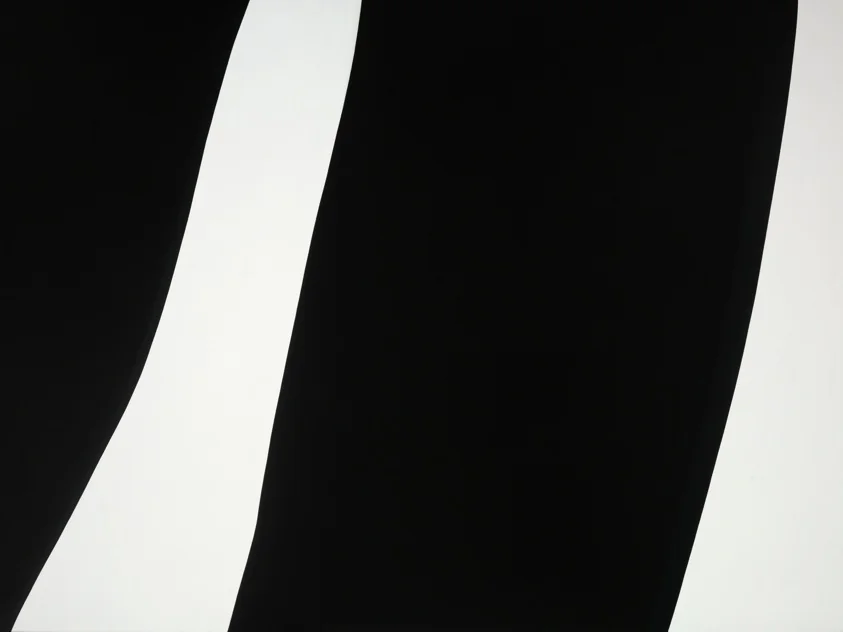
Ellsworth Kelly's "Black and White" (1960/61) is an oil on canvas that reduces painting to its most fundamental opposition: black and white. By eliminating color—the element most associated with painting—Kelly forces the viewer to focus on form, shape, and the relationship between positive and negative space. The black and white forms may be arranged in a dynamic composition, perhaps with a black form on a white ground or a more complex interlocking of the two colors. The oil on canvas technique is smooth and uninflected, with no visible brushstrokes to distract from the purity of the forms. This work belongs to the period when Kelly was exploring the limits of minimalism, pushing painting toward the condition of the object. The date range 1960/61 places this work at the beginning of the 1960s, a decade that would see the full flowering of Minimalism and the further evolution of Kelly's art. "Black and White" is a work of radical simplicity that nonetheless achieves remarkable visual power.
Cultural Impact
Kelly's black-and-white paintings were crucial to the development of Minimalism, demonstrating that the exclusion of color could heighten the viewer's awareness of form, shape, and the physical presence of the painting as an object.
Why It Matters
By eliminating color, this black-and-white painting focuses attention on the most fundamental elements of visual art: form, shape, the relationship between figure and ground, and the physical presence of the painted surface.