Provenance
Sold by Bernheim-Jeune, Paris, to Walter S. (1872-1954) and Kate L. Brewster (c. 1879-1947), Chicago, March 13, 1925 [invoice]; bequeathed by Kate, to the Art Institute, 1950.
Accession Number
68404
Medium
Pastel, on cream laid paper
Dimensions
57.6 × 40.5 cm (22 11/16 × 16 in.)
Classification
pastel
Credit Line
Bequest of Kate L. Brewster
Background & Context
Background Story
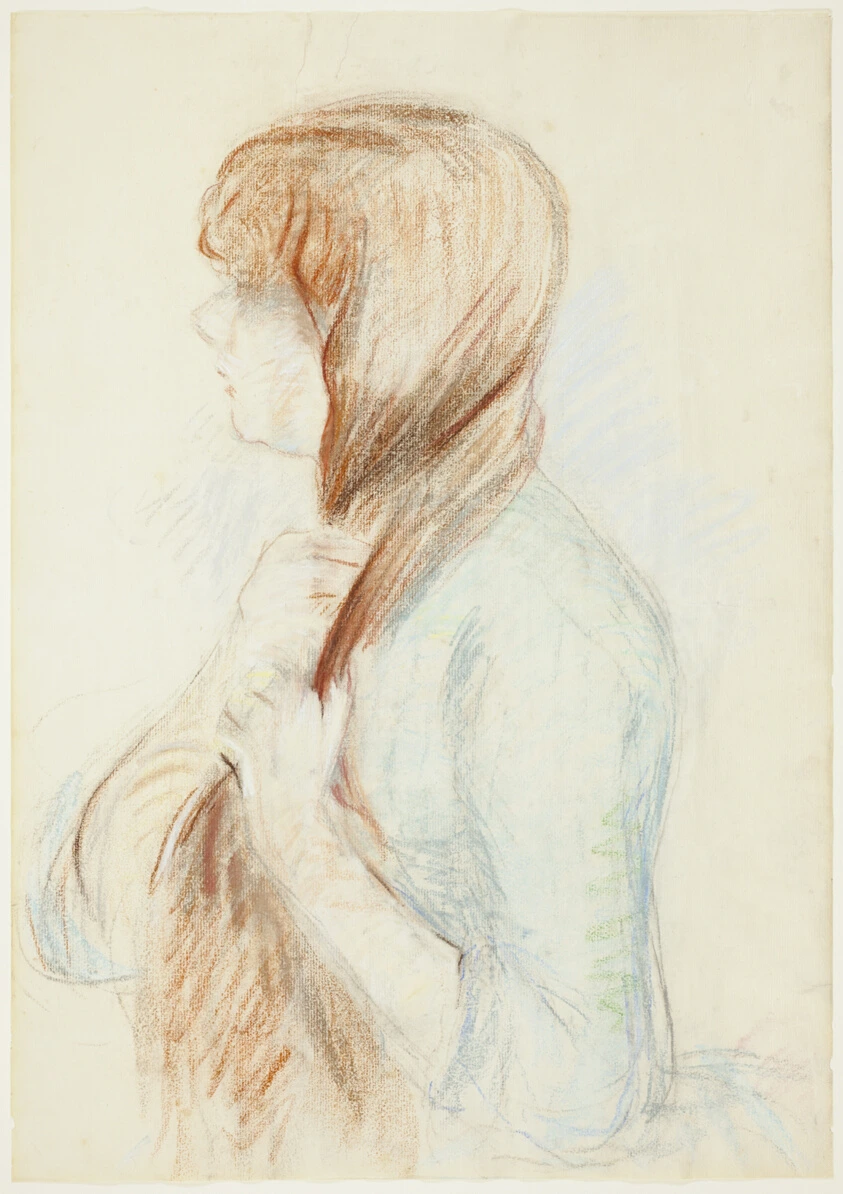
"Girl Plaiting her Hair (La Natte)" is one of Berthe Morisot's most beautiful and characteristic pastels, executed in 1894 during the final years of her life when she was producing some of her most luminous and emotionally resonant works. The composition shows a young woman or girl arranging her hair in a braid, the simple domestic action rendered with the pastel medium's unique capacity to combine color and texture in a single stroke. The palette is warm and rosy—creams, pinks, and the warm browns of hair and skin—that creates an atmosphere of youthful innocence and feminine intimacy. The technique is extraordinarily fluid: Morisot's pastel strokes are soft and blended, creating a surface that feels like skin itself, the tactile quality of the medium making the viewer want to reach out and touch the image. The cream laid paper provides a warm ground that unifies the composition and prevents the pastels from appearing chalky or dry. The 1894 date places this work in the same year as Morisot's death, suggesting that it may represent a final celebration of the subjects that had sustained her throughout her career: women, children, and the quiet moments of domestic life that she elevated to the status of high art. Art historians have compared this pastel to the drawings and paintings of Mary Cassatt, noting that Morisot's treatment is more atmospheric, less structurally defined than her American contemporary. The work also demonstrates the influence of Impressionist color theory on Morisot's pastel practice: the colors are not local or descriptive but optical, chosen for their effect on the viewer's eye rather than their correspondence to observed reality.
Cultural Impact
This 1894 pastel elevated domestic hair-braiding to luminous high art through skin-like tactile stroke warmth, using rosy optical color to celebrate feminine intimacy in the artist's final year.
Why It Matters
It matters because Morisot drew a girl braiding her hair and made it look like a prayer—proving that even the smallest gesture could glow if the pastel was soft enough.