Building

Description

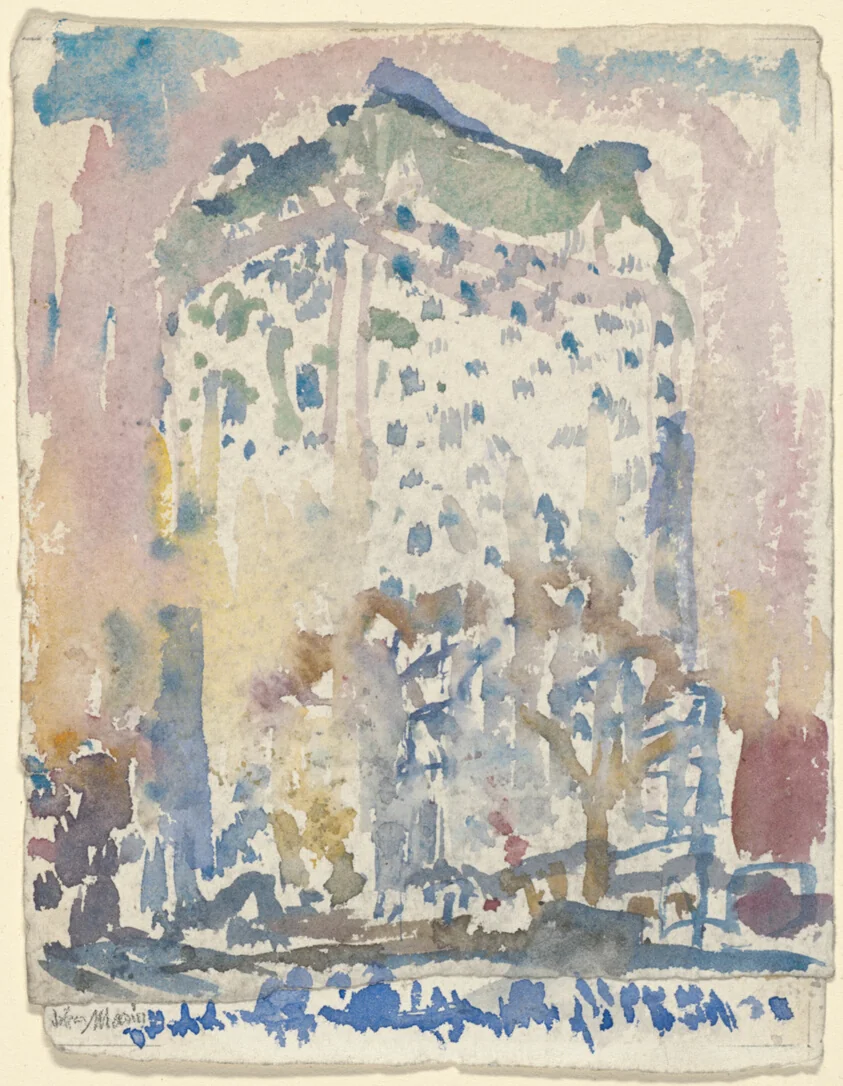
Here Marin created a compelling celebration of monumental architecture in a small format. He stationed himself in Central Park, facing the Plaza Hotel, and selected a true watercolor paper that would hold up to heavy applications of water and pigment. He did not rely on an initial pencil drawing, but instead worked quickly and loosely, tamping his brush repeatedly to capture the effect created by the hotel’s hundreds of shimmering windows. Leaving many areas of the paper white to show through his varied marks, Marin approximated the way the eye might move rapidly across such a scene. Later he attached an extra strip of paper along the bottom edge to denote activity on the street, making the Plaza seem more distant and emphasizing its height.

Provenance

Alfred Stieglitz (1864–1946), New York; Stieglitz Estate (Georgia O'Keeffe (1887–1986), executor) [stamped, center, verso, in purple: “COLLECTION / AS"]; given to the Art Institute of Chicago, 1956.

Building

John Marin

1910

Accession Number

2898

Medium

Watercolor with re-wetting and blotting on lightweight, slightly textured, off-white wove paper, pieced

Dimensions

16.1 × 12.6 cm (6 3/8 × 5 in.)

Classification

watercolor

Museum

The Art Institute of Chicago

Chicago, United States

Credit Line

Alfred Stieglitz Collection

Background & Context

Background Story

John Marin's Building (1910) is a watercolor with re-wetting and blotting on lightweight, slightly textured, off-white wove paper, pieced. Marin (1870-1953) was one of the most original American watercolorists of the early 20th century, known for his dynamic, expressive depictions of the urban landscape. This early watercolor from 1910 shows a building, perhaps in New York or another American city, rendered with a freedom and energy that distinguishes Marin's work. The watercolor technique is experimental: Marin used re-wetting and blotting to create varied textures and effects, building the forms of the building through layers of translucent color. The pieced paper suggests that the work was assembled from multiple sheets. The composition is dynamic, the building captured not as a static structure but as a living, energetic presence. Marin's watercolors of buildings and cityscapes were revolutionary in their time, bringing an expressive freedom to architectural subjects that had previously been treated with more documentary precision.

Cultural Impact

Marin was one of the most innovative American watercolorists of the 20th century, influencing the development of American modernism through his dynamic, expressive landscapes and cityscapes.

Why It Matters

This watercolor of a building captures the energy and dynamism of urban architecture, Marin's experimental technique of re-wetting and blotting creating a surface of extraordinary vitality.