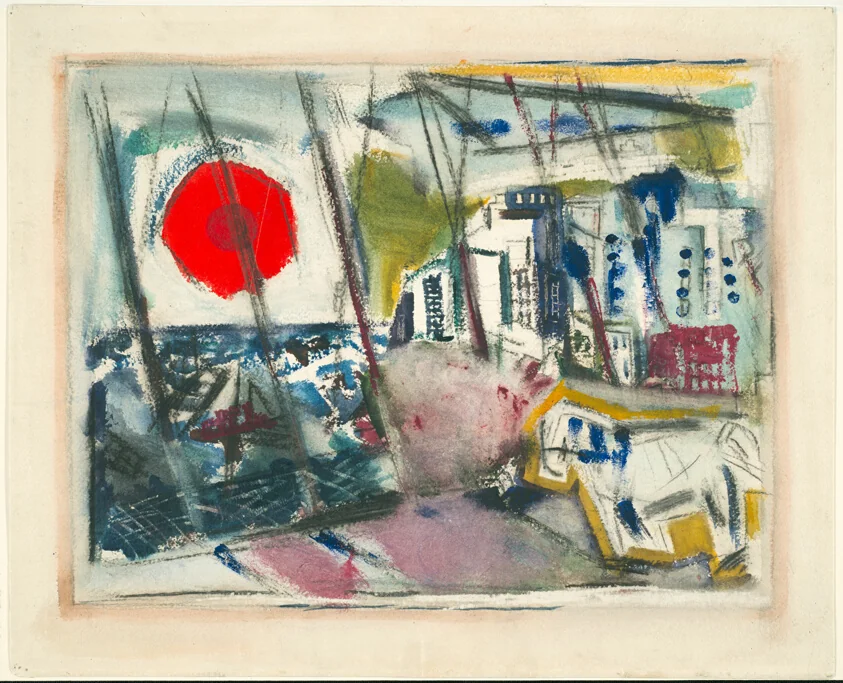
The Red Sun, Brooklyn Bridge

Description

This celebrated image of the Brooklyn Bridge is probably Marin’s first full-scale realization of this iconic subject in watercolor. Made from a vantage point on the bridge itself, this work highlights the strong diagonal lines of the suspension cables, through which we see an intense, vibrating red sun. As the artist explained, he endeavored to paint pictures that would recapture the emotional experience of what he called the city’s “pull forces.” Here he did this through a kinetic interplay of line and color, using complementary color relationships and an extraordinary range of unorthodox methods for applying paint—such as the blue dots at right, which were stamped directly from the tube—to keep the eye in perpetual motion.

Provenance

Alfred Stieglitz (1864–1946), New York; Stieglitz Estate (Georgia O'Keeffe (1887–1986), executor); given to the Art Institute, 1949.

The Red Sun, Brooklyn Bridge

John Marin

1922

Accession Number

113432

Medium

Watercolor with opaque watercolor, scraping, and wiping, and fabricated charcoal with stumping, on thick, rough-textured, ivory wove paper (all edges trimmed)

Dimensions

54.2 × 66.5 cm (21 3/8 × 26 3/16 in.)

Classification

watercolor

Museum

The Art Institute of Chicago

Chicago, United States

Credit Line

Alfred Stieglitz Collection

Background & Context

Background Story

"The Red Sun, Brooklyn Bridge" is one of John Marin's most explosive and iconic watercolors, painted in 1922 during the period when he was producing the series of New York cityscapes that established his reputation as the great American painter of urban modernity. The composition shows the Brooklyn Bridge silhouetted against a blazing red sun, the bridge's cables and towers rendered with the sweeping, calligraphic brushwork that Marin had developed to translate the kinetic energy of the modern city into the fluid medium of watercolor. The red sun dominates the composition: a burning disk of vermilion and orange that threatens to overwhelm the architectural framework of the bridge, suggesting both the energy of modern construction and the apocalyptic violence that Marin sensed beneath the surface of urban progress. The technique is extraordinarily varied: opaque watercolor, scraping, wiping, and fabricated charcoal with stumping create a surface that feels almost sculptural, the thick paper support absorbing and reflecting light in ways that make the image change with the viewer's position. The 1922 date places this work in the same year as Marin's famous "Lower Manhattan" series and his exhibitions at Alfred Stieglitz's gallery, when he was achieving the national recognition that would make him the official painter of American modernism for a generation. Art historians have compared this watercolor to the bridge paintings of Joseph Stella and the photographs of Strand and Steichen, noting that Marin's treatment is more abstract, more emotionally charged than these contemporaries. The work also anticipates Abstract Expressionism: the gestural freedom, the monumental scale, and the expressive use of color all point toward the innovations of Pollock and de Kooning, though Marin maintained his commitment to observed subject matter even at his most abstract.

Cultural Impact

This 1922 watercolor translated Brooklyn Bridge modernity into explosive apocalyptic calligraphy, using mixed opaque-scraping-charcoal technique on thick paper to anticipate Abstract Expressionism while maintaining architectural observation.

Why It Matters

It matters because Marin painted a bridge on fire with the sun and made it look like the city was singing—proving that even steel could dance if the red was loud enough.