Provenance
Sidney Janis Gallery, New York [undated frame label]. Private collection; sold, Sotheby's, New York, May 9, 1990, lot 343, to a private collection, New York [according to donor records]. Sold by David Nolan Gallery, New York, to Irving Stenn Jr., Chicago, Nov. 19, 2020; given to the Art Institute of Chicago, 2023.
Accession Number
264772
Medium
Opaque and translucent watercolor and pastel, over graphite, on cream wove paper
Dimensions
45.1 × 30.5 cm (17 13/16 × 12 1/16 in.)
Classification
drawing
Credit Line
Gift of the Irving Stenn, Jr. Family
Background & Context
Background Story
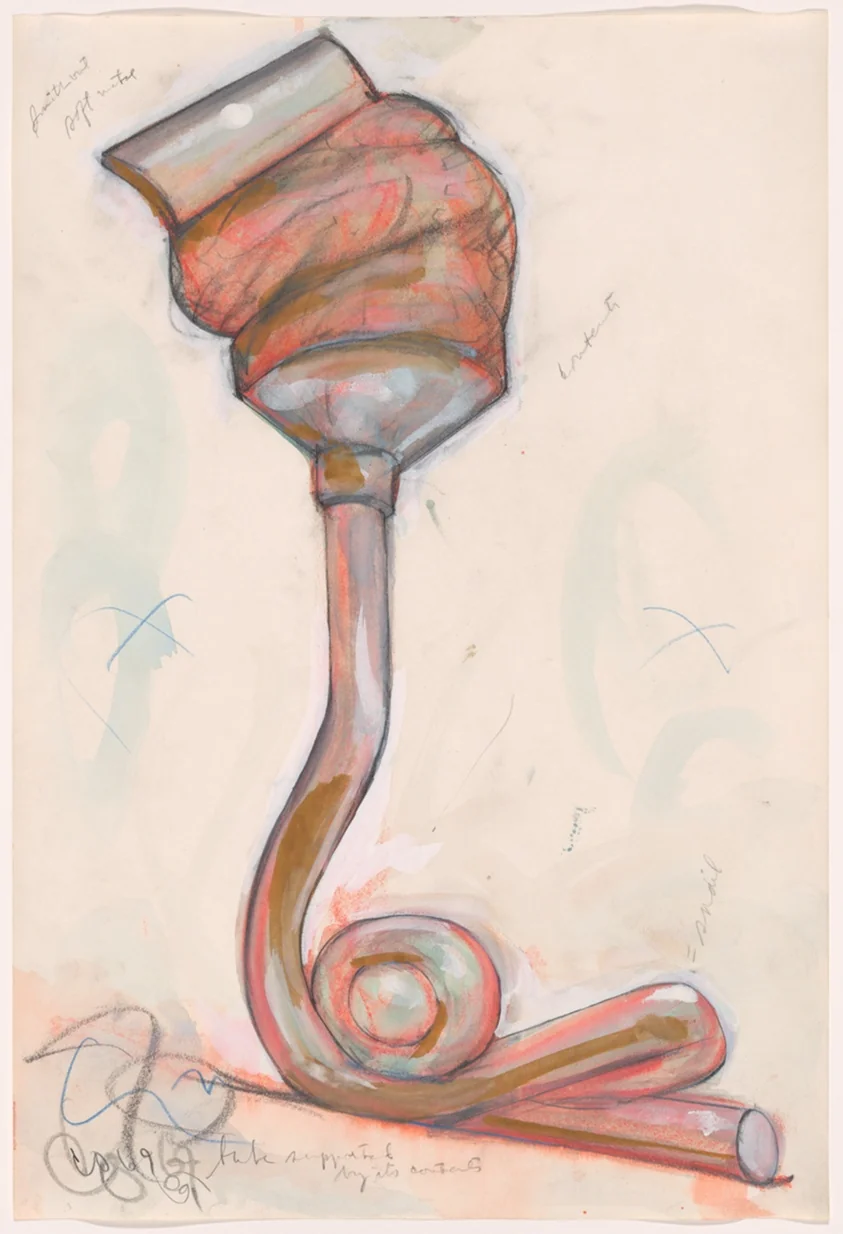
"Tube Supported by Its Contents" is a 1969 drawing by Claes Oldenburg that documents the American Pop artist's working process during the period of his most ambitious sculptural projects, the image showing a study for one of the soft sculptures that made him famous with the same attention to material and form that he brought to the finished works. The composition shows a tube—probably a toothpaste tube or a similar consumer product—supported by the very substance it contains, the paradoxical structure suggesting both the logic of consumer packaging and the absurdity of artistic transformation. The medium is watercolor and pastel over graphite on cream wove paper, the combination of transparent and opaque media creating a surface of extraordinary richness and variation that suggests both the softness of the sculptural material and the hardness of the commercial object. The 1969 date places this work in the period of Oldenburg's most intensive production of soft sculptures, the drawings serving as both studies and independent works that explored the formal and conceptual possibilities of transforming hard objects into soft forms. Art historians have connected this drawing to the broader tradition of the artist's study in modern art, from the sketchbooks of the Impressionists to the process drawings of the Minimalists, noting that Oldenburg's treatment is more focused on the transformation of the object, the metamorphosis from consumer product to artistic form that is the central concern of his practice.
Cultural Impact
This 1969 watercolor study made soft-sculpture paradox graphically rich through opaque-translucent pastel-watercolor surface variation, using cream-paper graphite foundation to explore consumer-tube-to-art-form metamorphosis logic.
Why It Matters
It matters because Oldenburg drew a tube standing on what was inside it and made packaging feel like philosophy—proving that even toothpaste could be architecture if the support was absurd enough.