New England Scenery

Description

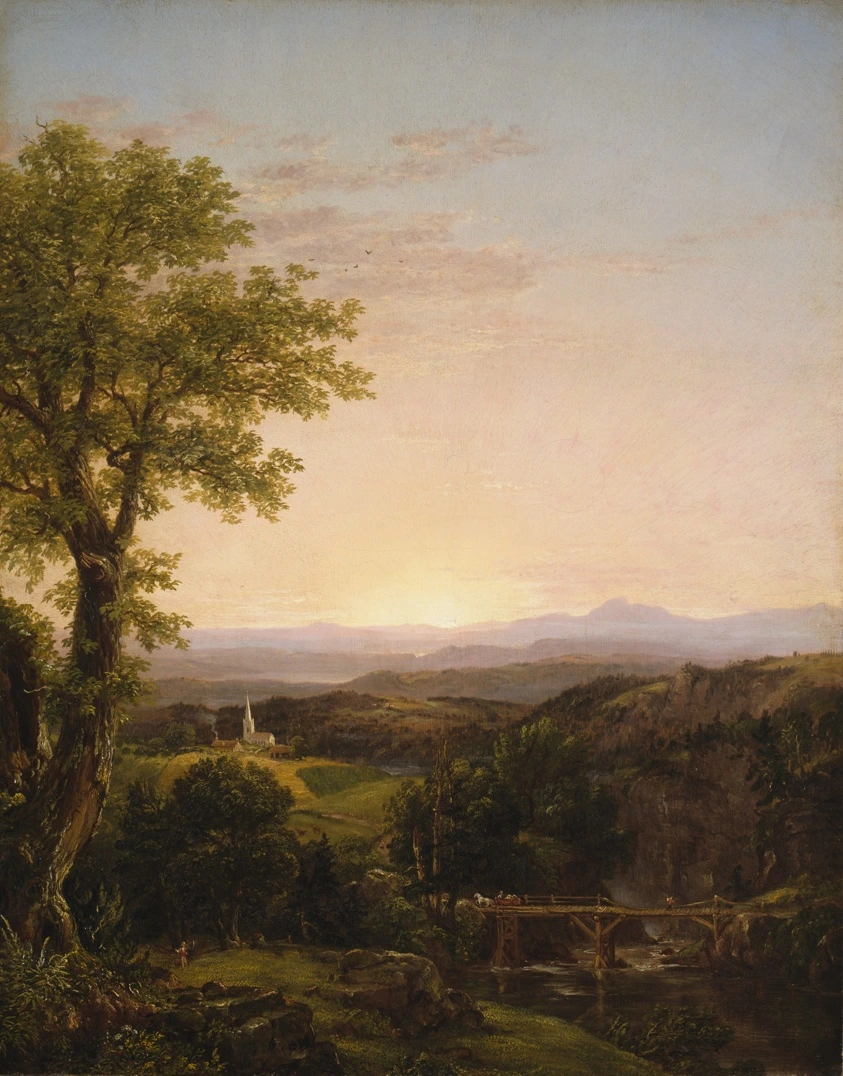
Although Thomas Cole is best known for his scenes of the American wilderness, he also rendered pastoral vistas of cultivated landscapes. This work depicts New Hampshire’s White Mountains, an area that Cole traveled to and painted on numerous occasions, as did other 19th-century landscape artists. The prominent church spire at middle distance emphasizes the role of religion in agrarian society and the glow of the low sun expresses a sense of optimism for a rural America. The painting conveys an ideal that was increasingly far from reality, however, as the United States was then being transformed by rapid urbanization and the Industrial Revolution.

Provenance

Thomas Cole, from 1839; W.F. Ladd, New York, around 1841; Charles Baker, New York, by 1853; Samuel Nickerson, Chicago, 1876; given to the Art Institute of Chicago, 1900.

New England Scenery

Thomas Cole

1839

Accession Number

57163

Medium

Oil on canvas

Dimensions

57.1 × 46.7 cm (22 1/2 × 18 3/8 in.)

Classification

Painting

Museum

The Art Institute of Chicago

Chicago, United States

Credit Line

Mr. and Mrs. Samuel M. Nickerson Collection
Background & Context

Background Story

Thomas Coles New England Scenery from 1839 is an oil on canvas that exemplifies the founder of the Hudson River School painters approach to the American landscape, in which the topographic specificity of a recognizable place is combined with the idealizing ambition of the pastoral tradition to create an image that is simultaneously a record of a particular location and a meditation on the relationship between nature and civilization. The New England landscape, with its rolling hills, agricultural fields, and scattered farmhouses, provided Cole with a subject that combined the wild beauty of the American landscape that he had celebrated in his wilderness paintings with the cultivated landscape of European pastoral tradition, in which human habitation exists in harmonious relationship with the natural world. Cole, who had established his reputation with paintings of unspoiled wilderness, increasingly turned to the pastoral landscape in the 1830s and 1840s as the American landscape was being transformed by agricultural development and the expansion of settlement, and New England Scenery represents his approach to the cultivated landscape with the same mixture of topographic accuracy and idealizing ambition that distinguishes his wilderness paintings. The oil on canvas medium, applied with the careful detail and atmospheric perspective that characterizes Coles best work, creates a surface in which every element of the landscape, from the distant mountains to the foreground flowers, is rendered with the same devotional attention to detail that reflects Coles belief in the landscape as a manifestation of divine presence.

Cultural Impact

Coles pastoral landscapes are significant contributions to the tradition of American landscape painting, and New England Scenery demonstrates his approach to the cultivated landscape with the same idealizing ambition that distinguishes his wilderness paintings. The painting influenced the development of the Hudson River School and the broader tradition of American pastoral landscape.

Why It Matters

A 1839 oil on canvas painting by Cole of New England scenery combining wild beauty with cultivated pastoral harmony, applying the same devotional attention to every landscape element from distant mountains to foreground flowers in the Hudson River School tradition.