Distant View of Niagara Falls

Description

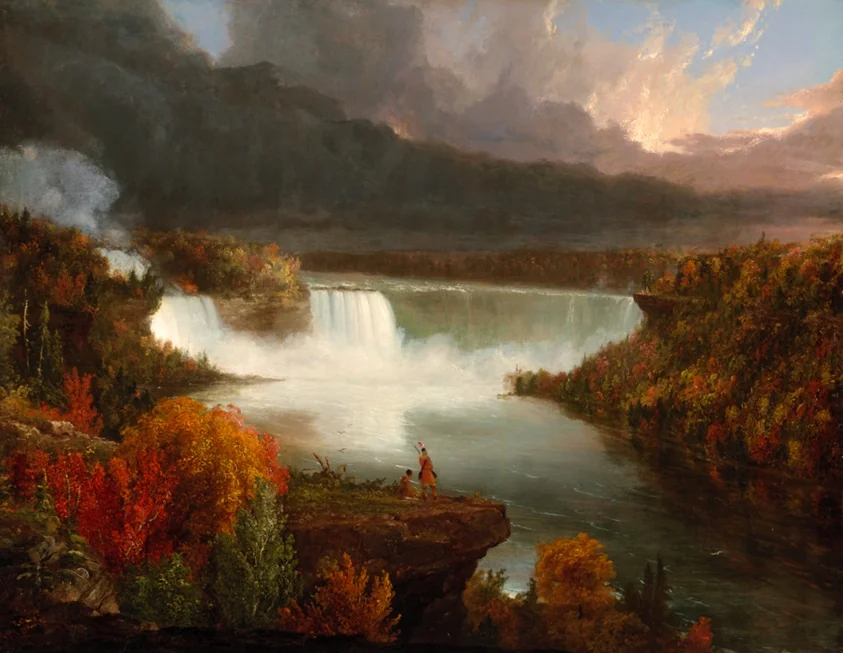
Thomas Cole visited Niagara Falls in May 1829, composing this romanticized, autumnal scene the following year. Portraying the grandeur of the American landscape, the artist omitted the factories, scenic overlooks, and hotels that populated the area in the early 19th century. Cole expressed concern about the environmental impact of voracious industrialism, but at the same time his painting erased the human devastation wrought by colonialism and conquest in the region, which encompassed Attiwonderonk, Haudenosaunee, and Wenrohronon lands. The two Native American figures at center, combined with the falls, identify the setting as North America, but their diminished presence in scale and number reinforces the false idea of the “vanishing Indian” and is meant to signal impending transformation rather than acknowledge their stolen sovereignty.

Provenance

Frank Sabin, London, by 1936; M. Knoedler, London, 1937; Mrs. Edith Mendelssohn-Bartholdy, London, by 1946; to the Art Institute of Chicago, 1946.

Distant View of Niagara Falls

Thomas Cole

1830

Accession Number

90048

Medium

Oil on wood panel

Dimensions

47.9 × 60.6 cm (18 7/8 × 23 7/8 in.)

Classification

Painting

Museum

The Art Institute of Chicago

Chicago, United States

Credit Line

Friends of American Art Collection
Background & Context

Background Story

Thomas Coles Distant View of Niagara Falls from 1830 is an oil on wood panel painting that exemplifies the founder of the Hudson River School painters approach to the American landscape, in which the specific topography of a particular place is transformed into a meditation on the relationship between the American wilderness and the divine. Cole, who made his reputation with landscapes of the Catskill Mountains and the White Mountains that presented the American wilderness as a new Eden uncorrupted by civilization, approached Niagara Falls with the same mixture of topographic accuracy and spiritual ambition that distinguishes his best work. The distant view of the title, in which the falls are seen from a vantage point that places them in the context of the surrounding landscape rather than filling the entire composition, allows Cole to show the falls as a natural feature of the American landscape rather than a spectacle, a choice that reflects his belief that the American landscape was a manifestation of divine presence rather than a mere curiosity. The oil on wood panel medium, which provides a smooth surface for the fine detail and atmospheric effects that distinguish Coles best work, creates a surface in which the falls and the surrounding landscape are rendered with the same precision and devotional attention that a 17th-century Dutch landscape painter would have brought to a view of a church. The year 1830 places this painting in the early years of Coles career, when he was establishing the landscape tradition that would define American painting for the next half century.

Cultural Impact

Coles landscapes of Niagara Falls are significant contributions to the tradition of American landscape painting, and Distant View of Niagara Falls demonstrates the combination of topographic accuracy and spiritual ambition that makes his work significant. The painting influenced the development of the Hudson River School and the broader tradition of American wilderness painting.

Why It Matters

A 1830 oil on wood panel painting by Cole of a distant view of Niagara Falls, placing the natural wonder in its surrounding landscape context as a manifestation of divine presence rather than a spectacle, establishing the Hudson River School tradition of American wilderness as new Eden.