Magnolias on Light Blue Velvet Cloth

Description

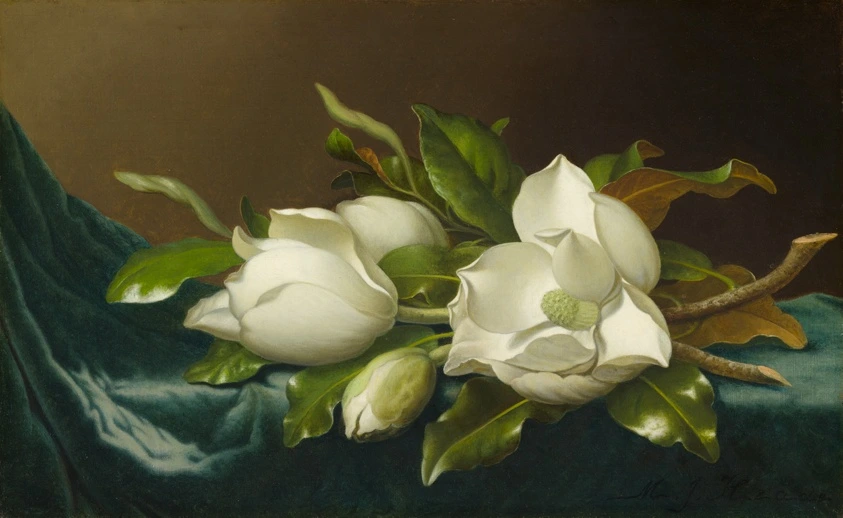
This sensuous and decorative image dates from the later part of Martin Johnson Heade’s long, varied, and peripatetic career. Traveling through much of the United States, to England and continental Europe, and (three different times) to Brazil, he produced work ranging from pristine views of East Coast salt marshes and lush tropical landscapes to pictures of exotic hummingbirds and orchids. At the age of sixty-four, Heade settled in Saint Augustine, Florida. There he began painting detailed arrangements of native flowers, including the Cherokee rose, orange blossom, and magnolia. Stretched out like an odalisque on blue velvet cloth, the curvaceous magnolia was meticulously rendered in pale, subtle hues and illuminated by a light so sharp that the image evokes the hyperintensity of a dream. The warm, steamy atmosphere is almost palpable, as is the blossom’s heady, pungent scent. The Art Institute’s Magnolias is one of a number of compositions by the artist featuring this dramatic yet delicate white flower.

Provenance

Private collection, Chestnut Hill, Penn., by 1975; Spanierman Gallery, New York Cit, 1983; sold to the Art Institute of Chicago, 1983.

Magnolias on Light Blue Velvet Cloth

Martin Johnson Heade

1885–95

Accession Number

100829

Medium

Oil on canvas

Dimensions

38.6 × 61.8 cm (15 1/4 × 24 3/8 in.)

Classification

Painting

Museum

The Art Institute of Chicago

Chicago, United States

Credit Line

Purchased with funds provided by Gloria and Richard Manney; Harold L. Stuart Endowment Fund
Background & Context

Background Story

"Magnolias on Light Blue Velvet Cloth" is an 1885–95 oil on canvas by Martin Johnson Heade that captures the American Luminist painter in his most coloristically refined and still-life specific mode, the image showing magnolias against a velvet cloth rendered with the same attention to floral beauty and material luxury that characterized his most celebrated still life compositions. The composition is a medium-sized canvas—38.6 × 61.8 centimeters—showing magnolias on light blue velvet with the oil on canvas creating a surface of extraordinary coloristic richness and floral luminosity. The light blue velvet provides a luxurious, chromatic ground that makes the white magnolias appear pure and luminous, enhancing the sense of floral beauty and material opulence. The 1885–95 extended date places this work in the period of Heade's most intensive production of floral still lifes and his exploration of the relationship between natural beauty and material luxury. Art historians have connected this painting to the broader tradition of the floral still life in American art, from the paintings of the Peale family to the works of the Victorian era, noting that Heade's treatment is more focused on the coloristic refinement and the material luxury, the transformation of observed flowers into visual jewel, than the botanical accuracy or the symbolic content of these other traditions.

Cultural Impact

This 1885-95 oil canvas made magnolias luxuriously refined through medium 38cm light-blue-velvet chromatic ground and floral white luminous purity, using intensive still-life production to transform natural beauty into material opulent visual jewel beyond Peale botanical symbolic accuracy.

Why It Matters

It matters because Heade painted magnolias on velvet and made the canvas feel like it was holding the most expensive breath in the world—proving that even a flower could be a treasure if the velvet was soft enough.