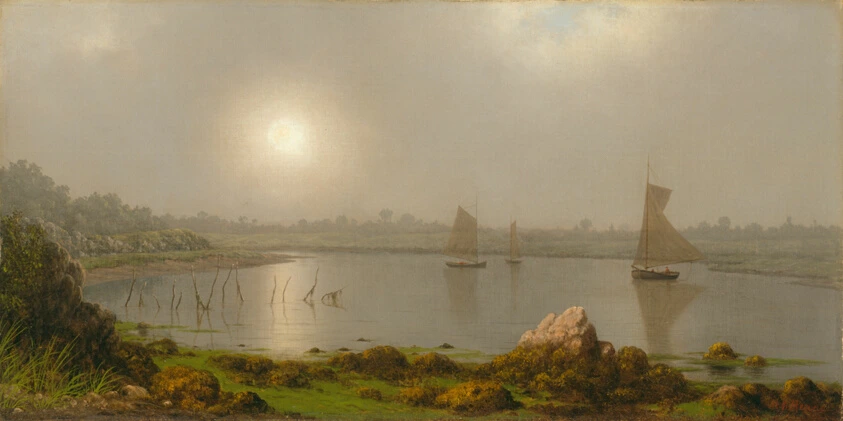
York Harbor, Coast of Maine

Description

This painting represents Martin Johnson Heade’s mature style from the 1870s and contains many of the compositional elements that have led modern scholars to celebrate the artist as a proponent of Luminism. A 20th-century term, Luminism has consistently been linked to the 19th-century philosophical doctrine of transcendentalism. Stylistically, it is characterized by a horizontal format; tight, invisible brushwork; and pervasive light emanating from an unseen source. Together these qualities embody the intellectual spirit of the American writer and philosopher Ralph Waldo Emerson (1803–1882), who found transcendental unity in the contemplation of nature’s stillness.

Provenance

William Evans II, Barneveld, New York, and by descent, to 1993; Hollis Taggert, New York, to 1994; Michael Altman, New York, 1995; sold to the Art Institute of Chicago, 1999.

York Harbor, Coast of Maine

Martin Johnson Heade

1877

Accession Number

152747

Medium

Oil on canvas

Dimensions

38.7 × 76.8 cm (15 1/4 × 30 1/4 in.)

Classification

Painting

Museum

The Art Institute of Chicago

Chicago, United States

Credit Line

Purchased with funds provided by Mrs. Herbert A. Vance; Americana, Lacy Armour and Roger McCormick endowments; through prior gifts of Dr. and Mrs. R. Gordon Brown, Emily Crane Chadbourne, George F. Harding Collection, Brooks McCormick, and James S. Pennington
Background & Context

Background Story

"York Harbor, Coast of Maine" is an 1877 oil on canvas by Martin Johnson Heade that captures the American Luminist painter in his most atmospherically serene and luminously precise mode, the image showing the coast of Maine rendered with the same attention to light, atmosphere, and coastal grandeur that made him the defining painter of the American Luminist movement. The composition is a medium-sized canvas—38.7 × 76.8 centimeters—showing York Harbor with the oil on canvas creating a surface of extraordinary luminosity and atmospheric stillness. The horizontal format enhances the sense of coastal expanse and luminous distance, the painting becoming a meditation on the relationship between light, water, and the human observer. The 1877 date places this work in the period of Heade's most mature production of marine paintings and his establishment as the leading painter of the American coast. Art historians have connected this painting to the broader tradition of the marine in American art, from the paintings of Lane to the works of the Hudson River School, noting that Heade's treatment is more focused on the atmospheric stillness and the luminous precision, the transformation of observed coast into Luminist vision, than the dramatic action or the sublime terror of these other traditions.

Cultural Impact

This 1877 oil canvas made York Harbor luminously serene through medium 38cm horizontal atmospheric stillness and coastal luminous distance, using mature marine production to transform Maine coast into Luminist vision beyond Lane dramatic sublime action.

Why It Matters

It matters because Heade painted the coast and made the canvas feel like it was holding a breath of salt air and golden light—proving that even water could be still if the light was right.