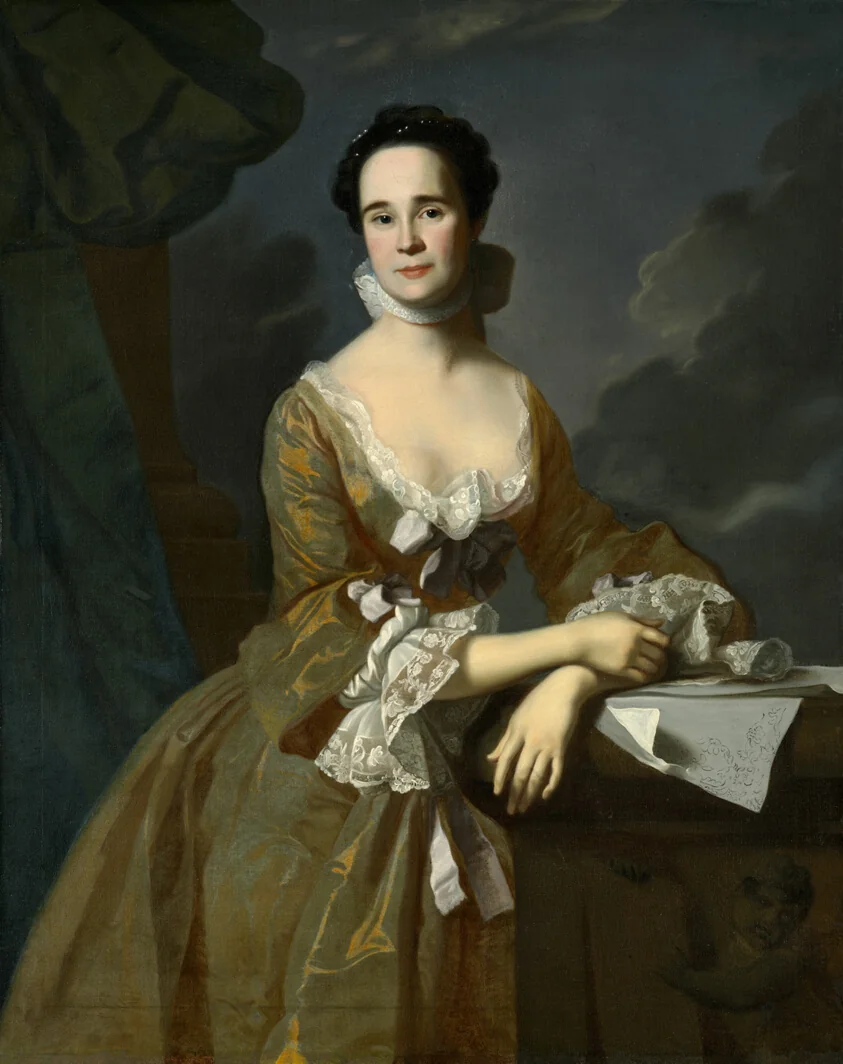
Mrs. Daniel Hubbard (Mary Greene)

Description

John Singleton Copley was largely self-taught, his only formal training from his stepfather Peter Pelham, an English artist who specialized in mezzotint engraving. He nonetheless garnered considerable success as a portrait painter before the Revolutionary War. The sitter here, Mary Greene Hubbard, was a member of Boston’s merchant class (Copley’s portrait of her husband, Daniel Hubbard [1947.27], is also in the Art Institute collection). Her pose, gown, and background were precisely copied from a British engraving of a noblewoman, yet Copley distinguished the work as his own by capturing the figure’s individual features as well as the surfaces and colors of the luxurious fabrics. A decade later, he left colonial Massachusetts for England to further his career and simultaneously escape the strong political divides among family, friends, and patrons amid the impending Revolution.

Provenance

Mr. and Mrs. Daniel Hubbard, Boston, from 1764 to 1796; by descent to Mrs. Daniel Hubbard, Boston, from 1796 to 1808; by descent to Henry Hubbard, Boston, from 1808 to 1844; by descent to Mary Greene Hubbard, Boston, from 1844 to 1882; by descent to William Scollay Whitwell, Boston, from 1882 to 1899; by descent to his daughter Mary Hubbard Whitwell, Brookline, Mass, from 1899 to 1908; by descent to her sister, Mrs. William Tudor (Elizabeth Whitwell), Boston, from 1908 to 1929; by descent to her son, Henry Dubois Tudor, Cambridge, Mass, from 1929 to 1947; the Art Institute of Chicago, 1947.

Mrs. Daniel Hubbard (Mary Greene)

John Singleton Copley

c. 1764

Accession Number

59787

Medium

Oil on canvas

Dimensions

127.6 × 100.9 cm (50 1/4 × 39 3/4 in.)

Classification

Painting

Museum

The Art Institute of Chicago

Chicago, United States

Credit Line

Art Institute of Chicago Purchase Fund

Background & Context

Background Story

John Singleton Copley's Mrs. Daniel Hubbard (Mary Greene) (c. 1764) is an oil on canvas portrait of the wife of Boston merchant Daniel Hubbard. This portrait is a companion to Copley's portrait of Daniel Hubbard and shows his ability to capture the character and social position of his female sitters with the same precision he brought to his portraits of men. Mary Greene Hubbard is shown in a dress appropriate to her social station, her features rendered with Copley's characteristic clarity and attention to detail. The textures of the fabric, the lace, and the hair are captured with extraordinary skill. The sitter's expression is composed and dignified. The palette is restrained but rich, with the warm tones of the complexion and fabric set off by the darker background. This paired portrait of Daniel and Mary Hubbard is one of the finest examples of Copley's ability to document the appearance, character, and social position of the colonial Boston elite.

Cultural Impact

Copley's paired portraits of husbands and wives are among the most important documents of colonial American society, capturing the individuals who shaped the political and economic life of pre-Revolutionary Boston.

Why It Matters

This portrait of Mary Greene Hubbard captures the dignity and refinement of a Boston merchant's wife, Copley's precise technique creating an image that is both a personal likeness and a document of social status.