Accession Number
198303
Medium
Oil on wood
Dimensions
74.3 × 99.7 cm (29 1/4 × 39 1/4 in.)
Classification
Painting
Credit Line
Gift of the artist
Background & Context
Background Story
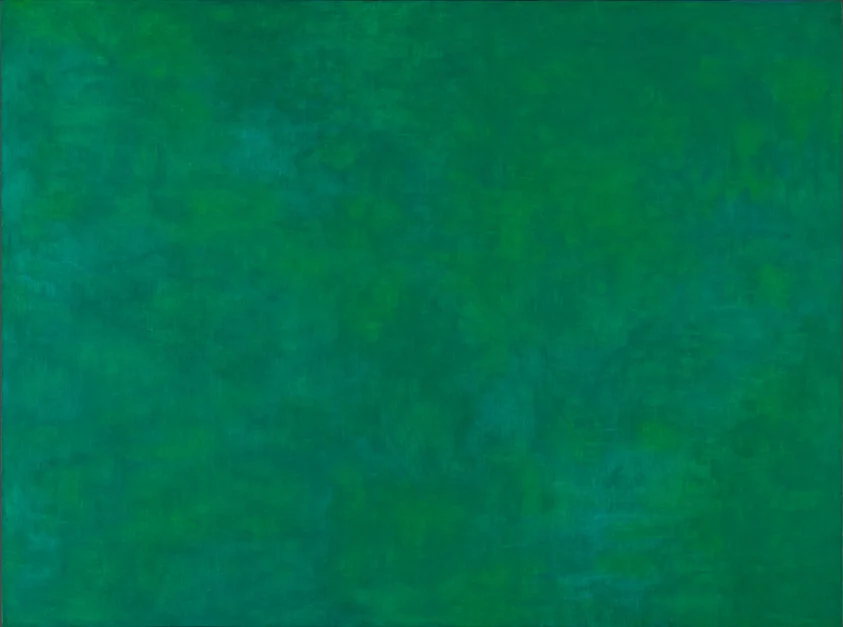
Ellsworth Kelly's "Tableau Vert" (Green Painting) (1952) is an oil on wood from the crucial early period of the artist's career. Kelly had recently returned from Paris, where he had spent six years absorbing the lessons of European modernism, and was beginning to develop the radically simplified abstract style that would define his career. "Tableau Vert" is a green painting—perhaps a single panel of green, or a composition of green forms on a ground. The oil on wood technique gives the painting a solid, object-like presence. The color green is allowed to be simply itself, not a representation of anything else. This work belongs to the period when Kelly was developing the approach that would make him one of the most influential American artists: the reduction of painting to its essential elements of shape, color, and surface, the elimination of gesture and expressive brushwork in favor of flat, uninflected fields of color. "Tableau Vert" announces Kelly's project: to make paintings that are not pictures of something but things in themselves.
Cultural Impact
Kelly's early monochrome and multi-panel works of the 1950s were revolutionary in their rejection of Abstract Expressionist gesture and subjectivity, establishing a new direction for American abstraction.
Why It Matters
This early green painting announces Kelly's radical project: the reduction of painting to its essential elements, the color green allowed to be simply and purely itself without representational or expressive justification.