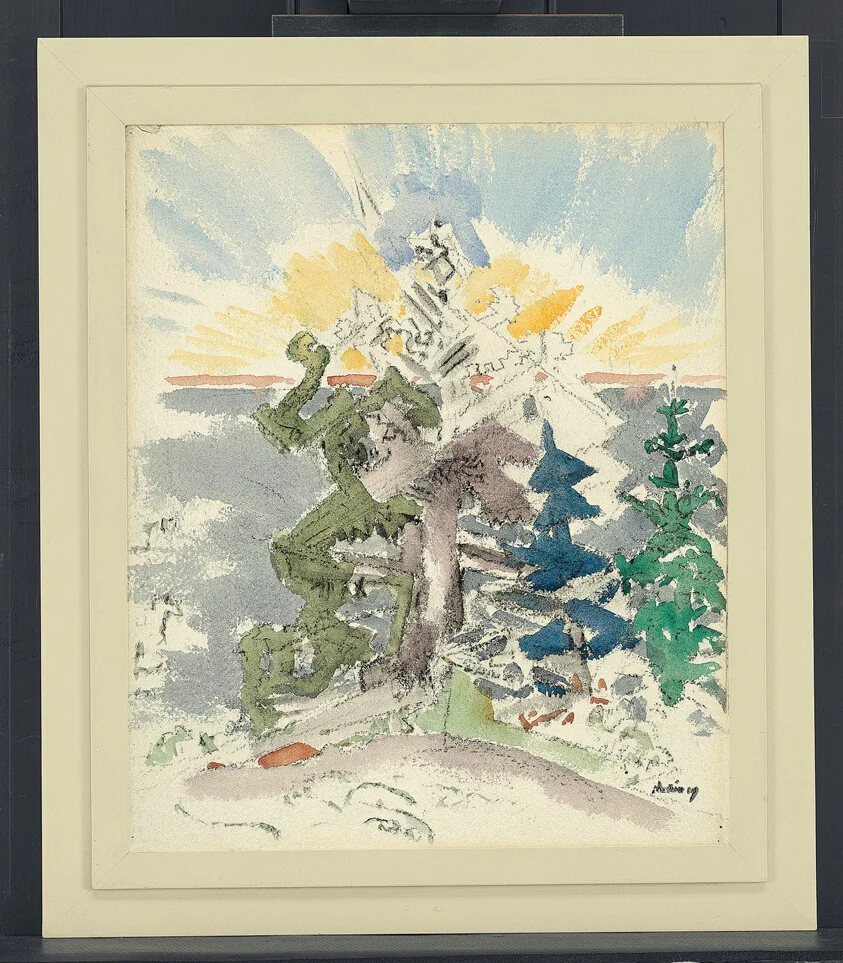
Tree and Sea, Maine

Description

Here Marin emphasized the colors, shapes, and textures that differentiate the various pines found along the Maine coast. A particularly gnarled, distorted tree moves with the frenetic energy of a dancer, while its companions rattle and sway in the breeze. Marin combined his hieroglyphic mark making with a carefully orchestrated color palette: rays of yellow sun warm the horizon, while touches of bright red-orange lead the eye into space. Again defying tradition, he used charcoal wash to darken and muddy the red tones of the clustered trees in the middle ground. He painted over heavy charcoal lines, smearing the particles to create a dark haze. Juxtaposing complexity of line with an unusually direct application of color, the artist captured a sensation of life in motion that is joyful, almost spiritual.

Provenance

Alfred Stieglitz (1864–1946), New York; Stieglitz Estate (Georgia O'Keeffe (1887–1986), executor); given to the Art Institute of Chicago, 1949.

Tree and Sea, Maine

John Marin

1919

Accession Number

65972

Medium

Watercolor with charcoal and charcoal wash, on moderately thick, moderately textured, off-white wove paper (lower and right edges trimmed), in original frame

Dimensions

42.3 × 35.2 cm (16 11/16 × 13 7/8 in.)

Classification

watercolor

Museum

The Art Institute of Chicago

Chicago, United States

Credit Line

Alfred Stieglitz Collection

Background & Context

Background Story

"Tree and Sea, Maine" is one of Marin's most elegant early watercolors, painted in 1919 during a pivotal period when he was moving from the tight architectural drawings of his European years toward the explosive abstraction that would define his American maturity. The composition shows a tree in the foreground with the sea beyond, but the treatment is already transitional: the tree is reduced to a calligraphic gesture, a single vertical stroke with branching extensions, while the sea dissolves into horizontal bands of blue and white that suggest rhythm rather than waves. The medium of watercolor with charcoal wash allows both precision and atmospheric softness; the charcoal adds tonal depth that pure watercolor cannot achieve, while the paper texture creates a granular surface that catches light like sand or weathered bark. This work belongs to Marin's first Maine summers after his return from Europe, when he was discovering that the American landscape demanded a different visual language than the cathedrals and streets of France and Italy. The painting also reflects the influence of Cézanne's constructive brushwork, particularly in the way the tree trunk is built from parallel strokes that suggest volume through direction rather than shading. Art historians have noted that this transitional period (1914–1920) was when Marin developed the personal style that Alfred Stieglitz promoted as the quintessential expression of native American modernism. The work stands as evidence that abstraction did not emerge from theoretical speculation but from prolonged engagement with specific places—Marin's Maine was not a generic seascape but a location he knew through repeated visits and intimate observation.

Cultural Impact

This transitional watercolor developed Marin's signature calligraphic abstraction from European architectural drawing toward native American modernism, combining Cézanne's constructive stroke with charcoal atmospheric depth.

Why It Matters

It matters because a tree and the sea became a conversation between vertical and horizontal—Marin finding the grammar of American abstraction in Maine salt air.