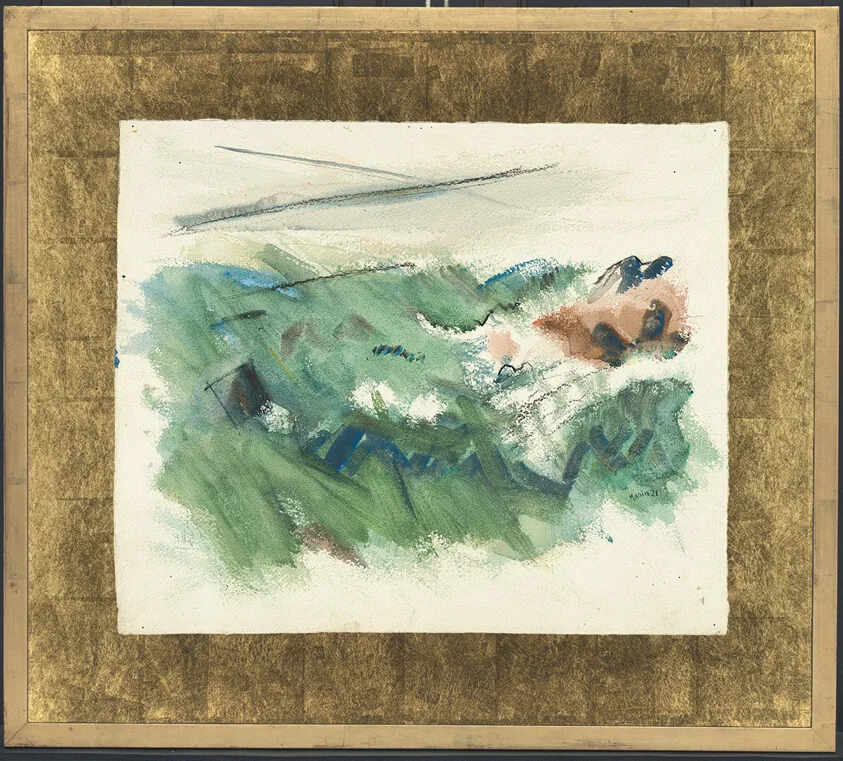
The Green Sea – Movement – Stonington, Maine

Description

An early instance of Marin’s changing framing aesthetic can be seen in his handling of this watercolor, which was adhered to a gilded mount and then fitted in a spare gilded frame. This approach, which left plenty of space around the sheet, emphasizes the artwork’s materiality, an important concept for Marin. Unlike the white enamel frames he had favored throughout the previous decade, his gilded mounts and frames of the early 1920s were not intended to harmonize with his art. Rather, the use of gold was meant to be visually jarring, here drawing the viewer into the violent sea and proving the strength of the composition.

Provenance

Alfred Stieglitz (1864–1946), New York; Stieglitz Estate (Georgia O'Keeffe (1887–1986), executor); given to the Art Institute of Chicago, 1949.

The Green Sea – Movement – Stonington, Maine

John Marin

1921

Accession Number

65975

Medium

Watercolor with wiping and charcoal on thick (estimated), slightly textured, ivory wove paper, hinged to paperboard, faced with ivory wove (estimated) paper, gilt with gold leaf (top and right edges trimmed), in original frame

Dimensions

41.3 × 49.5 cm (16 5/16 × 19 1/2 in.); Mount: 57.8 × 64.5 cm (22 13/16 × 25 7/16 in.)

Classification

watercolor

Museum

The Art Institute of Chicago

Chicago, United States

Credit Line

Alfred Stieglitz Collection

Background & Context

Background Story

"The Green Sea – Movement – Stonington, Maine" is one of John Marin's most dynamic watercolors, painted in 1921 during the period when he was translating the kinetic energy of the Maine coast into a visual language that would influence American Modernism for decades. The composition shows waves breaking against the rocky shore of Stonington, but the subject is merely a pretext for Marin's true interest: the translation of motion into pigment. The watercolor medium is pushed to its physical limits here, with broad washes of emerald and viridian combined with wiping and charcoal scraping that creates turbulence on the paper surface. Marin's technique of "willing accidents"—allowing water and pigment to interact unpredictably—was central to his method; he would tilt the board, spray water, or wipe away passages to create effects that no brush alone could achieve. This improvisational approach aligns him with jazz musicians of the same period, who were also exploring the balance between structure and spontaneity. The painting also reflects Marin's identification with the American landscape tradition: where European watercolorists sought atmospheric subtlety, Marin pursued muscular power, making the medium perform feats of graphic strength usually associated with oil or charcoal. Art historians have compared these Maine seascapes to the abstract wave paintings of Dove and Hartley, though Marin's treatment is more explicitly tied to observed nature. The work influenced Abstract Expressionism directly: Pollock's drip paintings and de Kooning's gestural abstractions both descend from Marin's demonstration that watercolor could sustain violent physical energy.

Cultural Impact

This watercolor pushed the medium to its kinetic limits through wiping and charcoal scraping, establishing the improvisational "willed accident" method that directly influenced Abstract Expressionism.

Why It Matters

It matters because Marin made watercolor act like a storm—proving that gentleness could be abandoned in favor of green fury.