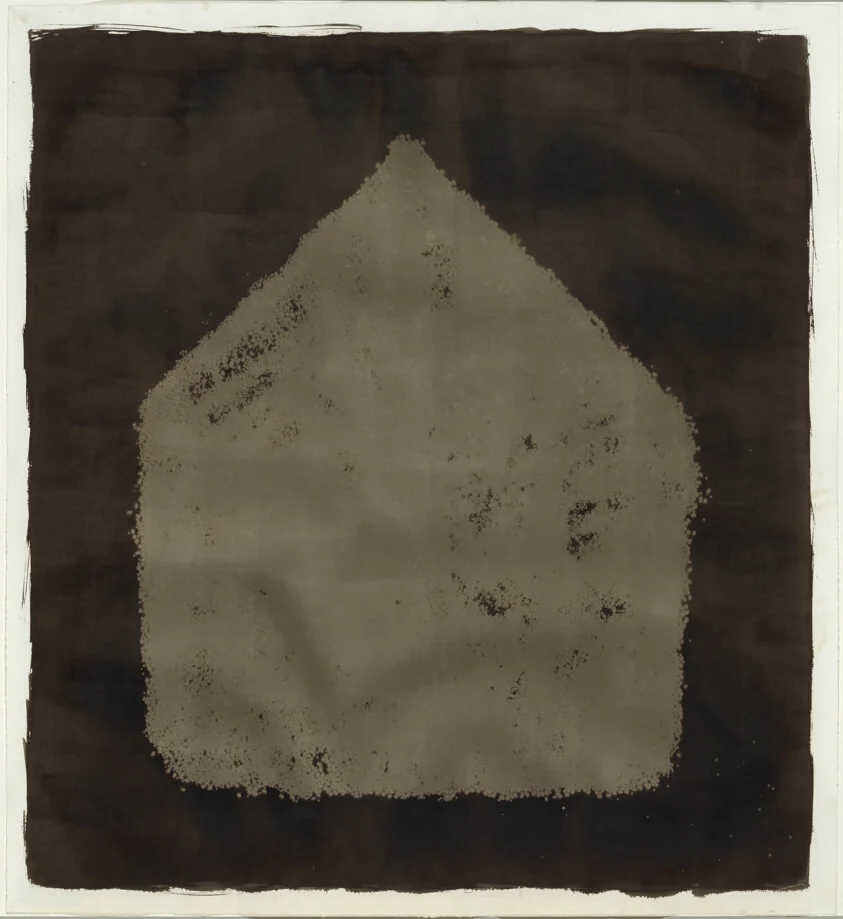
Our House, from the series "Chickenbones and Watermelon Seeds: The African American Experience as Abstract Art"

Description

Rashid Johnson mines the histories of black Americans, materially and symbolically linking his work to an African American past. This print uses the Vandyke printing process, named for its resemblance in hue to paintings by Flemish painter Anthony van Dyck. Johnson brushed hand-made paper with a photosensitive iron-salt solution, then piled the surface with black-eyed peas and exposed it to light. Other works in the series use chicken bones and watermelon seeds, food staples associated with African American consumption during the centuries of slavery. Johnson’s loaded symbol of home—a small place of comfort within a larger, hostile environment—owes its shape to comfort food.

Our House, from the series "Chickenbones and Watermelon Seeds: The African American Experience as Abstract Art"

Rashid Johnson

2001

Accession Number

235621

Medium

Vandyke print

Dimensions

Image, approx: 132 × 119 cm (52 × 46 7/8 in.); paper, approx: 139.5 × 127.2 cm (54 15/16 × 50 1/8 in.); frame: 146.4 × 136.5 × 5 cm (57 11/16 × 53 3/4 × 2 in.)

Classification

photograph

Museum

The Art Institute of Chicago

Chicago, United States

Credit Line

Gift of Dedrea and Paul Gray
Background & Context

Background Story

"Our House" is a 2001 Vandyke print from Rashid Johnson's series "Chickenbones and Watermelon Seeds: The African American Experience as Abstract Art" that captures the contemporary American artist in his most conceptually ambitious and culturally resonant mode, the image showing a house rendered with the Vandyke print technique on a monumental scale. The composition is a very large print—image approximately 132 × 119 centimeters, paper approximately 139.5 × 127.2 centimeters—showing a house with the Vandyke print creating a surface of extraordinary warmth and cultural weight. The title "Our House" suggests both the personal history of the artist's family and the collective history of African American domestic experience, the image becoming a meditation on home, memory, and cultural identity. The 2001 date places this work in the period of Johnson's establishment as a leading contemporary artist and his exploration of African American cultural history as a subject for abstract art. Art historians have connected this work to the broader tradition of the domestic image in African American art, from the photographs of Parks to the installations of contemporary artists, noting that Johnson's treatment is more focused on the cultural genealogy and the personal memory, the transformation of domestic space into cultural monument, than the formal abstraction or the aesthetic composition of these other traditions.

Cultural Impact

This 2001 monumental Vandyke print made house culturally monumental through approximately 132cm iron-salt warm tone and frame 146cm domestic identity weight, using series African American Experience as Abstract Art to transform family home into collective cultural monument beyond Parks formal aesthetic documentary.

Why It Matters

It matters because Johnson printed a house and made the paper feel like it was holding the weight of every African American home that ever sheltered a dream—proving that even a building could be history if the scale was vast enough.