Accession Number
151910
Medium
Vandyke print
Dimensions
Image: 56.7 × 60.3 cm (22 3/8 × 23 3/4 in.); Paper: 57.5 × 77.2 cm (22 11/16 × 30 7/16 in.)
Classification
brownprints (Van Dyke prints)
Credit Line
Purchased with funds provided by John A. Bross
Background & Context
Background Story
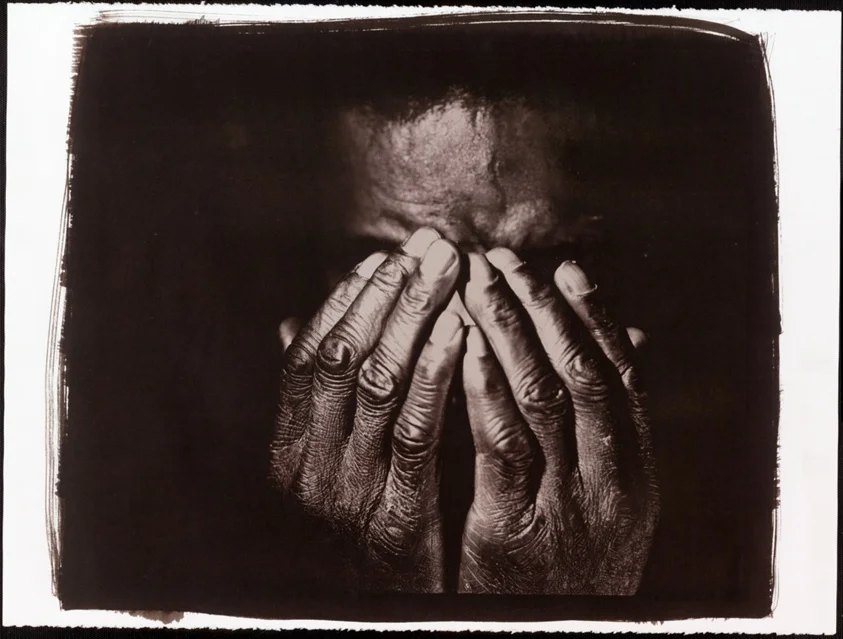
"Jonathan's Hands" is a 1998 Vandyke print by Rashid Johnson that captures the contemporary American artist in his most intimately personal and materially inventive early mode, the image showing hands rendered with the same attention to physical presence and cultural identity that would characterize his entire practice. The composition is a medium-sized Vandyke print—image 56.7 × 60.3 centimeters, paper 57.5 × 77.2 centimeters—showing hands with the photographic technique creating a surface of extraordinary warmth and human intimacy. The Vandyke print, an early photographic process using iron salts, creates rich brown tones that suggest both the historical depth of the medium and the personal warmth of the subject. The 1998 date places this work in the early period of Johnson's career, when he was producing the photographic works that established his reputation as a leading voice in contemporary African American art. Art historians have connected this work to the broader tradition of the hand image in American art, from the photographs of the Farm Security Administration to the conceptual works of the contemporary period, noting that Johnson's treatment is more focused on the personal identity and the cultural genealogy, the transformation of physical detail into cultural testimony, than the formal analysis or the aesthetic abstraction of these other traditions.
Cultural Impact
This 1998 Vandyke print made hands intimately cultural through medium 56cm iron-salt brown-tone warmth and large-format photographic presence, using early career to transform physical detail into African American identity testimony beyond Farm Security formal aesthetic abstraction.
Why It Matters
It matters because Johnson printed someone's hands and made the paper feel like it was holding a story about belonging and being seen—proving that even a photograph could be a family album if the brown tones were warm enough.