Provenance
Possibly (the artist's estate sale, Henry J. and George Henry Robins, London, 20-22 June 1829, 1st day, no. 132, as _Telemachus in the Island of Calypso_, unfinished).[1] possibly Henry Corbould [1787-1844], in 1832.[2] (Mortimer Brandt [1905-1993], New York); acquired by Mrs. E. Lovette West [1885-1962, Bess Palmer West], Bronxville, New York; her daughter, Mrs. Robert A. Beyers [1906-1987, Bernice West Beyers], Chittenden, Vermont, and Dallas;[3] gift 1963 to the Corcoran Gallery of Art, Washington; acquired 2015 by the National Gallery of Art.
[1] Several versions by West exist of this subject. This provenance is according to Helmut von Erffa and Allen Staley, _The Paintings of Benjamin West_, New Haven and London, 1986: 259, no. 183. The 1829 artist's estate sale was one of two sales held that year by the artist's sons, Raphael Lamar West (1769-1850) and Benjamin West, Jr. (1772-1848).
[2] Von Erffa's and Staley's catalogue (see note 1) suggested that if this was the painting lent by Corbould to an exhibition in 1832, it may have been completed either by him or by his son, Edward Henry Corbould (1815-1905), as both were artists. Another possibility was suggested by Dorinda Evans, _Benjamin West and His American Students_, exh. cat., National Portrait Gallery, Washington; Pennsylvania Academy of the Fine Arts, Philadelphia, 1980-1981, Washington, 1980: 147 fig. 111, 148, 187 n. 46, who wrote that the figures of Calypso and her companions appear to be by one of West's students.
[3] Mrs. Beyers, a sculptor, was a descendant of Benjamin West, although her exact line of descent has not yet been determined.
Accession Number
2015.19.98
Medium
oil on canvas
Dimensions
overall: 104.1 × 149.2 cm (41 × 58 3/4 in.) | framed: 125.73 × 149.23 cm (49 1/2 × 58 3/4 in.)
Classification
Painting
Credit Line
Corcoran Collection (Gift of Bernice West Beyers)
Tags
Painting Neoclassical & Romantic (1751–1850) Oil Painting Canvas American
Background & Context
Background Story
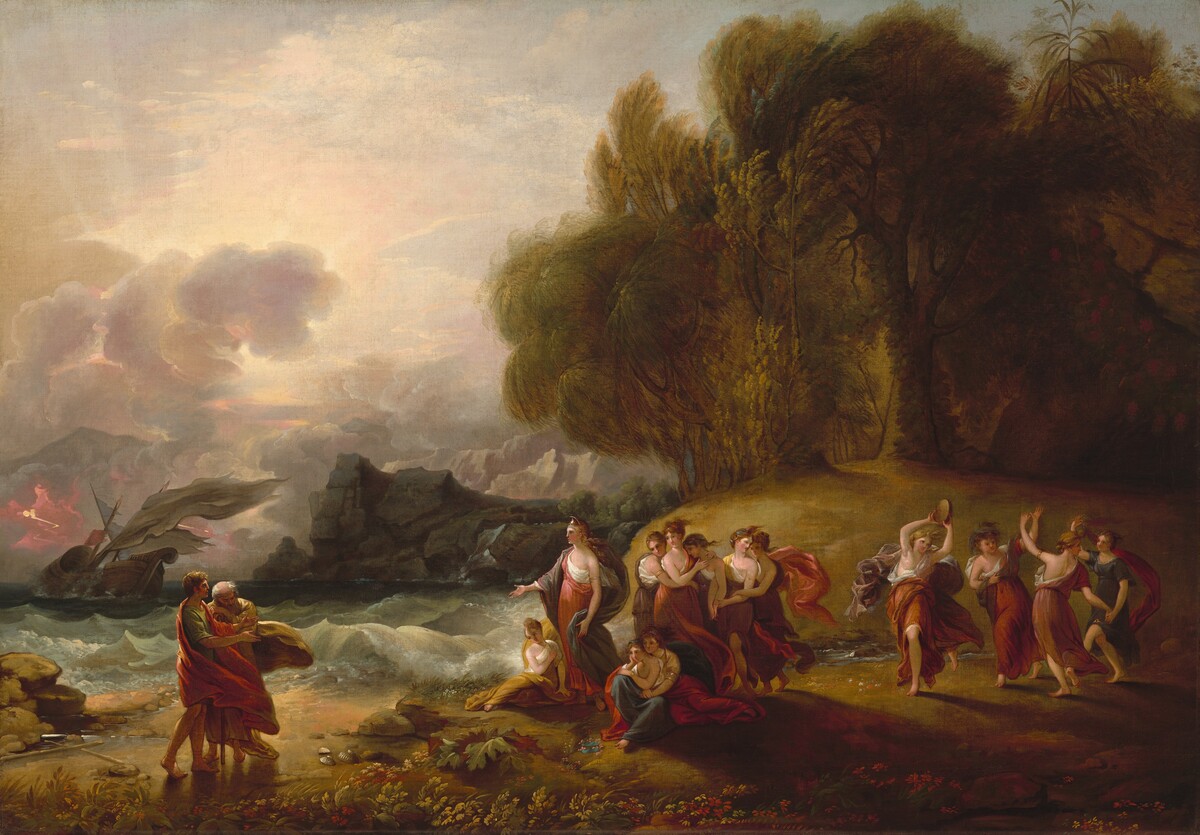
Based on a beloved episode from Fénelon's Adventures of Telemachus (1699), this painting shows the young Telemachus on the island of the nymph Calypso, who attempts to keep him as her lover just as she had kept his father Odysseus. West painted it around 1809, late in his career, when his neoclassical style was giving way to a more romantic sensibility. The landscape is more atmospheric than in his earlier work, and the emotional interchange between the figures suggests the influence of the new Romantic movement that was beginning to challenge neoclassical dominance.
Cultural Impact
Fénelon's Telemachus was one of the most widely read books in 18th-century Europe — a philosophical adventure story that served as a vehicle for political and moral commentary. West's choice of this subject connects him to an Enlightenment literary culture that valued didactic narrative and emotional restraint.
Why It Matters
Telemachus and Calypso shows West in transition, still committed to neoclassical composition but reaching toward the emotional depths that would define Romanticism. It captures the hinge moment between two artistic eras.