Provenance
Painted for King George III of England but never delivered;[1] ownership rights returned in 1828 by King George IV to the artist's sons, Raphael Lamar West [1766-1850] and Benjamin West, Jr. [1772-1848]; (sale, George Robins, London, 22-25 May 1829, 4th day, no. 154); bought by Smith, apparently for Raphael West;[2] (sale, George Robins, London, 16 July 1831, no. 40).[3] Private collection, Yorkshire, England;[4] (sale, Phillips, Son & Neale, London, 13 December 1988, no. 35);[4] (Thomas Agnew and Sons, London); purchased 27 February 1989 by NGA.
[1] The painting is listed in West's manuscript account for 1797 of works painted for George III, with the price of £525 (Historical Society of Pennsylvania), and in his 1801 account, printed as the first appendix to John Galt, _The Life, Studios, and Works of Benjamin West, Esq., President of the Royal Academy_, 2 vols. [reproduced, two vols. in one, as _The Life of Benjamin West_, Intro. by Nathalia Wright, Gainesville, Florida, 1960], London, 1820: 209, "The Account of Pictures painted by Benjamin West for His Majesty, by his Gracious Commands, from 1768 to 1780. A True Copy from Mr. West's Account Books, with their several Charges and Dates"; see Helmut Von Erffa and Allen Staley, _The Paintings of Benjamin West_, New Haven and London, 1986 286, and for a discussion of these accounts, 159-160, 579.
[2] George Robins, _A Catalogue Raisonné of the Unequalled Collection of Historical Pictures, and Other Admired Compositions, the Works of the revered and highly-gifted Painter, the late Benjamin West, Esq._, [22-25 May 1829], London, 1829: 46; Von Erffa and Staley 1986: 286.
[3] George Robins, _A Catalogue of Nine Pictures, of the First Class; the genuine property of Mr. Raphael West_, [16 July 1831], London, 1831: 7.
[4] According to the 1988 sale catalogue, the ancestor of this owner probably purchased the painting at the 1831 sale.
Accession Number
1989.12.1
Medium
oil on canvas
Dimensions
overall: 186.8 x 278.1 cm (73 9/16 x 109 1/2 in.)
Classification
Painting
Credit Line
Avalon Fund and Patrons' Permanent Fund
Tags
Painting Neoclassical & Romantic (1751–1850) Oil Painting Canvas American
Background & Context
Background Story
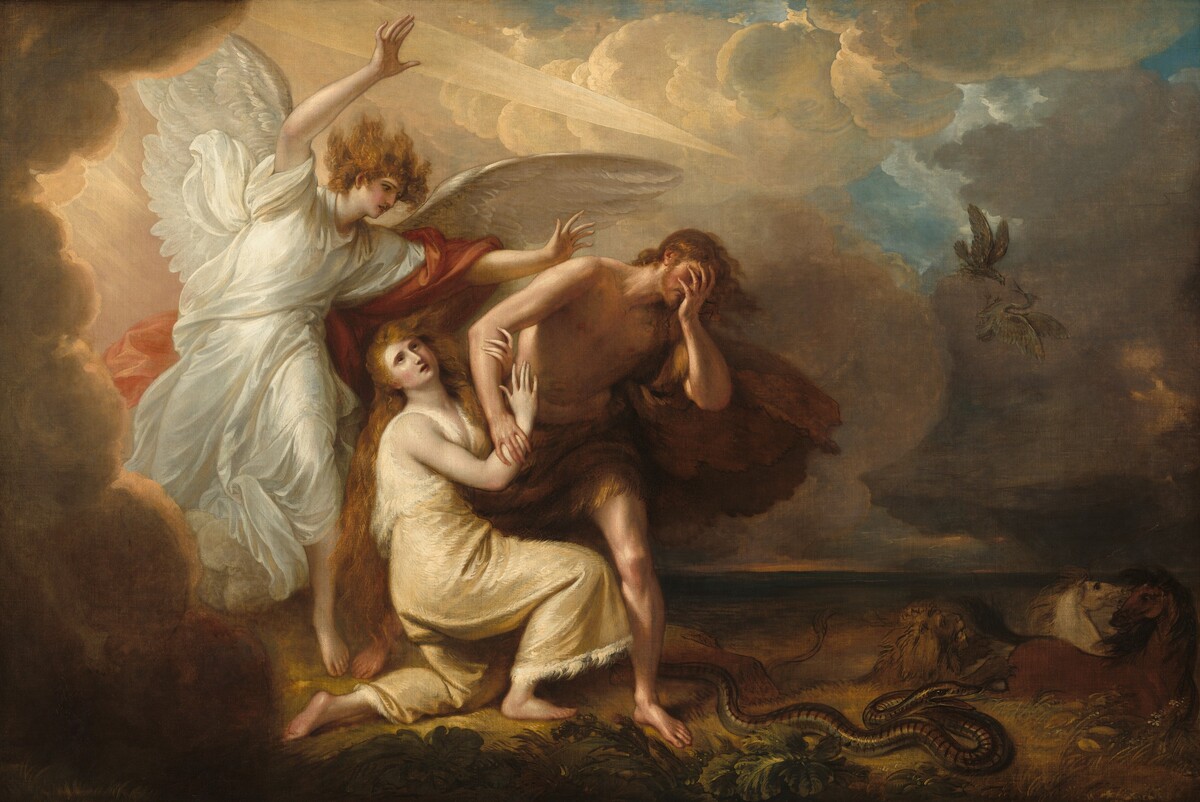
West painted this large biblical subject in 1791, at the height of his Royal Academy presidency and his neoclassical phase. The Expulsion draws on the tradition of Masaccio and Michelangelo but interprets it through West's characteristically composed, neoclassical lens. Adam and Eve are idealized figures whose poses recall antique sculpture, while the angel wielding the flaming sword provides the dramatic contrast between divine authority and human anguish. West, who had studied in Rome and absorbed the lessons of Raphael and the antique, brings a sculptural quality to the figures even as the narrative demands emotional intensity.
Cultural Impact
The painting reflects West's theory that history painting should combine the beautiful with the expressive — a difficult balance that engaged the finest minds of the Enlightenment. His Adam and Eve are not writhing in baroque agony; they are noble figures undergoing a catastrophic moment with the dignity of antique heroes.
Why It Matters
This Expulsion demonstrates why West was considered the natural successor to Raphael in 18th-century London. His ability to synthesize Renaissance composition with neoclassical restraint made him the definitive history painter of his generation.