Provenance
Richard Grosvenor, 1st earl Grosvenor [1731-1802]; his son, Robert Grosvenor, 1st marquis of Westminster [1767-1845]; his son, Richard Grosvenor, 2nd marquis of Westminster [1795-1869]; his son, Hugh Lupus Grosvenor, 1st duke of Westminster [1825-1899]; his grandson, Hugh Richard Arthur Grosvenor, 2nd duke of Westminster [1879-1953];[1] his estate; (sale, Sotheby's, London, 15 July 1959, no. 125); (John Nicholson Gallery, London and New York); sold 11 December 1959 to NGA.
[1] Helmut Von Erffa and Allen Staley, _The Paintings of Benjamin West_, New Haven and London, 1986: 209; for the owners' dates see George Edward Cokayne, _The Complete Peerage of England, Scotland, Ireland, Great Britain and the United Kingdom, extant, extinct or dormant_, new ed., 13 vols., London, 1910-1959: 12(1959):537-542.
Accession Number
1959.8.1
Medium
oil on canvas
Dimensions
overall: 152.7 x 214 cm (60 1/8 x 84 1/4 in.) | framed: 180.3 x 241 cm (71 x 94 7/8 in.)
Classification
Painting
Credit Line
Andrew W. Mellon Fund
Tags
Painting Neoclassical & Romantic (1751–1850) Oil Painting Canvas American
Background & Context
Background Story
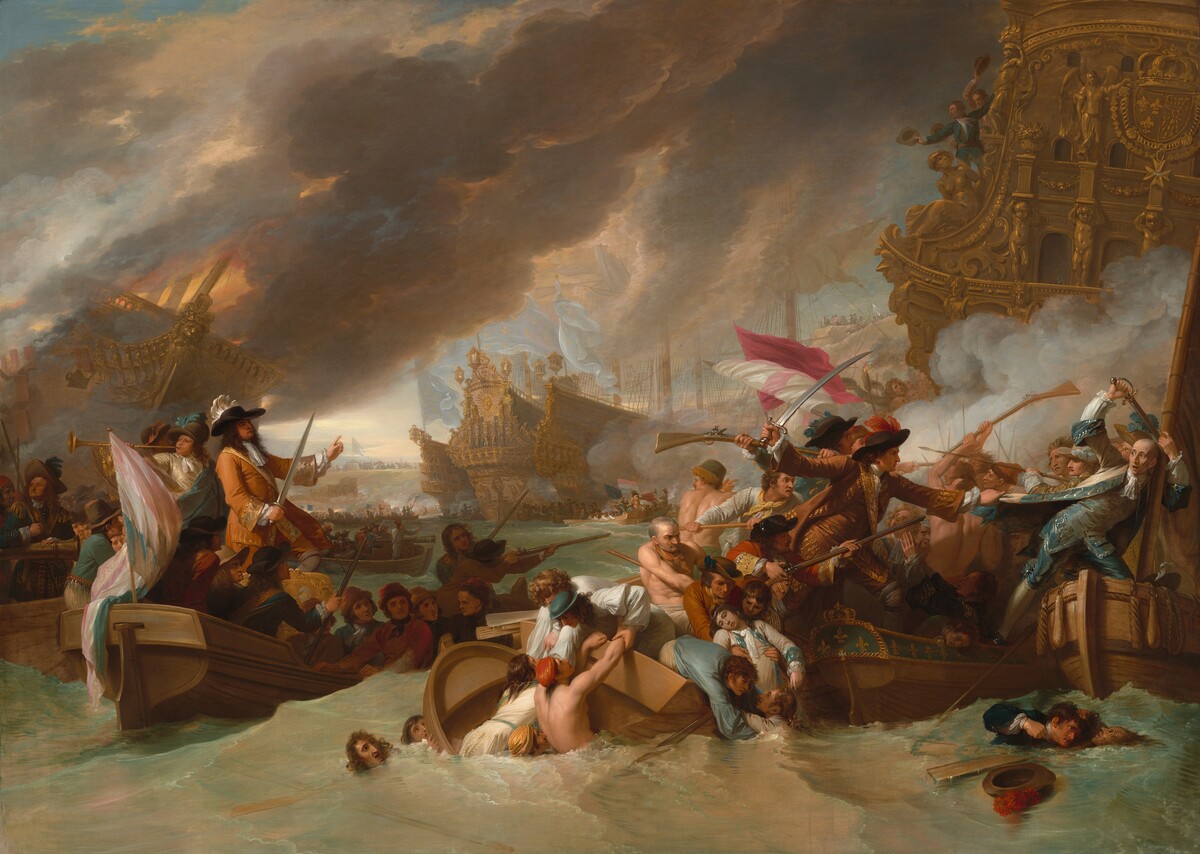
The Battle of La Hogue (1692) was a decisive Anglo-Dutch naval victory over the French that ended James II's hopes of invading England. West painted it in 1778, at a moment when the American Revolution was testing British military confidence. By choosing a past triumph, West created a patriotic narrative that also served as a reminder of British naval resilience — a pointed reassurance during a war that Britain was losing. The painting depicts the dramatic finale in which English sailors row burning fireships into the French fleet, destroying it in the shallows.
Cultural Impact
West was a master of using historical subjects to address contemporary anxieties. La Hogue is simultaneously a naval painting, a history painting, and a political statement. As an American expatriate in London, West navigated a complex position — painting British patriotic subjects while his native country was rebelling against British rule. His success in this balancing act demonstrates his extraordinary diplomatic and artistic intelligence.
Why It Matters
The Battle of La Hogue is West at his most theatrical and most politically engaged. It demonstrates that history painting was never neutral: it was always an argument about the present disguised as a story about the past.