Provenance
Commissioned by François Jules Duvaucel [1672-1739] for a salon in the Château de La Norville, France; remained in the château through successive owners until sometime between 1901 and 1906; (Fauché, Paris), by 1907;[1] purchased 1922 through (André Carlhian, Paris) by Dr. Alexander Hamilton Rice [1875-1956] and his wife, Eleanor Elkins Widener Rice [1861-1937], for the dining room of their Fifth Avenue manion, New York;[2] by inheritance 1956 to Mrs. Rice's children, George D. Widener, Jr. [1889-1971] and Eleanor Widener Dixon [1891-1966, Mrs. Fitz Eugene Dixon]; gift 1957 to NGA.
[1] The history of the decoration of the Château de La Norville is thoroughly described by Bruno Pons, _Grands décors français, 1650-1800: reconstitués en Angleterre, aux Etats-Unis, en Amérique du Sud et en France_, Dijon, 1995: 221-426. See also Abbé A.E. Genty, _Histoire de la Norville et de sa seigneurie_, Brussels and Geneva, 1885: 112-129.
[2] Mrs. Rice was born Eleonor Elkins in Philadelphia. Her first husband was George Dunton Widener, who perished with their elder son, Harry, in the sinking of the _Titanic_ in 1912. She married Dr. Alexander Hamilton Rice in 1915. Her two other children with Widener inherited the New York residence after Dr. Rice's death.
Records of the Carlhian firm are in the Special Collections of the Research Library at the Getty Research Institute, Los Angeles, accession no. 930092. Copies of documents referring to the wall paneling are in the NGA curatorial files; see in particular the letter of 6 July 1923, from André Carlhian to Mrs. Rice, in which he tells her that "the Pineau boiserie which you bought from Fauché comes from the Chateau de la Norville, near Arpajon - about 20 miles from Paris." Both the six Huet paintings (NGA 1957.7.1-6) and the paneling (_boiserie_) by Pineau were given to the National Gallery of Art; the latter is NGA 1957.7.7.
Accession Number
1957.7.4
Medium
oil on canvas
Dimensions
overall: 90.1 x 149.5 cm (35 1/2 x 58 7/8 in.)
Classification
Painting
Credit Line
Gift of George D. Widener and Eleanor Widener Dixon
Tags
Painting Baroque (1600–1750) Oil Painting Canvas French
Background & Context
Background Story
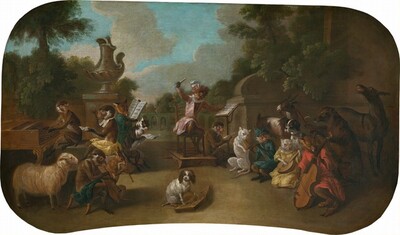
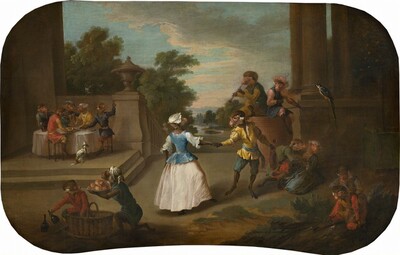
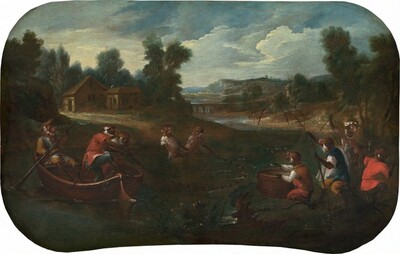
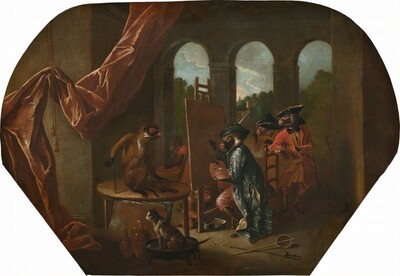
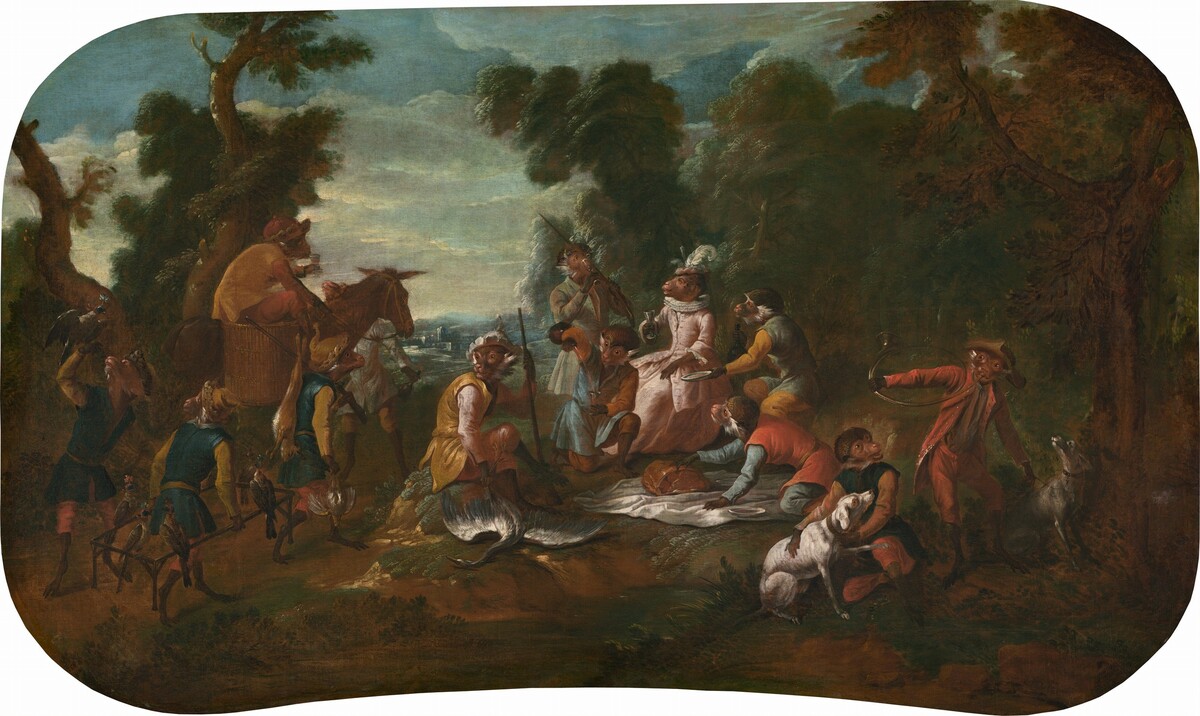
The Picnic — monkeys dining alfresco with all the ceremony of a aristocratic déjeuner sur l'herbe — completes Huet's satirical survey of 18th-century leisure activities. Where The Concert satirized art, The Dance satirized social ritual, and The Fishermen satirized sport, The Picnic satirizes gastronomy and the elaborate social codes of outdoor dining. The monkeys handle their food, their utensils, and their social interactions with the same absurd formality that characterizes the other paintings in the series, making the entire quartet a comprehensive commentary on the artificiality of aristocratic culture.
Cultural Impact
The outdoor meal or fête champêtre was one of the central subjects of Rococo painting, celebrated by Watteau, Fragonard, and their contemporaries as an image of aristocratic pleasure. Huet's monkey-picnic is a direct parody of this tradition, replacing the elegant figures of fête champêtre painting with monkeys who maintain the same postures and social rituals. The parody works because the original tradition was already close to self-parody — the conventions of the genre were so refined that replacing humans with monkeys barely changes the image.
Why It Matters
The Picnic completes Huet's satirical cycle: art, dance, sport, and now food — the four pillars of aristocratic leisure, all performed by monkeys with perfect solemnity. The series argues that all culture is performance, and that the monkeys' earnestness is no more ridiculous than the aristocrats' own.