Provenance
Commissioned by François Jules Duvaucel [1672-1739] for a salon in the Château de La Norville, France; remained in the château through successive owners until sometime between 1901 and 1906; (Fauché, Paris), by 1907;[1] purchased 1922 through (André Carlhian, Paris) by Dr. Alexander Hamilton Rice [1875-1956] and his wife, Eleanor Elkins Widener Rice [1861-1937], for the dining room of their Fifth Avenue manion, New York;[2] by inheritance 1956 to Mrs. Rice's children, George D. Widener, Jr. [1889-1971] and Eleanor Widener Dixon [1891-1966, Mrs. Fitz Eugene Dixon]; gift 1957 to NGA.
[1] The history of the decoration of the Château de La Norville is thoroughly described by Bruno Pons, _Grands décors français, 1650-1800: reconstitués en Angleterre, aux Etats-Unis, en Amérique du Sud et en France_, Dijon, 1995: 221-426. See also Abbé A.E. Genty, _Histoire de la Norville et de sa seigneurie_, Brussels and Geneva, 1885: 112-129.
[2] Mrs. Rice was born Eleonor Elkins in Philadelphia. Her first husband was George Dunton Widener, who perished with their elder son, Harry, in the sinking of the _Titanic_ in 1912. She married Dr. Alexander Hamilton Rice in 1915. Her two other children with Widener inherited the New York residence after Dr. Rice's death.
Records of the Carlhian firm are in the Special Collections of the Research Library at the Getty Research Institute, Los Angeles, accession no. 930092. Copies of documents referring to the wall paneling are in the NGA curatorial files; see in particular the letter of 6 July 1923, from André Carlhian to Mrs. Rice, in which he tells her that "the Pineau boiserie which you bought from Fauché comes from the Chateau de la Norville, near Arpajon - about 20 miles from Paris." Both the six Huet paintings (NGA 1957.7.1-6) and the paneling (_boiserie_) by Pineau were given to the National Gallery of Art; the latter is NGA 1957.7.7.
Accession Number
1957.7.3
Medium
oil on canvas
Dimensions
overall: 91.5 x 143.6 cm (36 x 56 9/16 in.)
Classification
Painting
Credit Line
Gift of George D. Widener and Eleanor Widener Dixon
Tags
Painting Baroque (1600–1750) Oil Painting Canvas French
Background & Context
Background Story
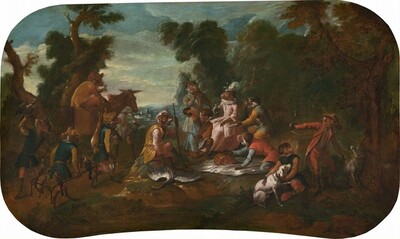
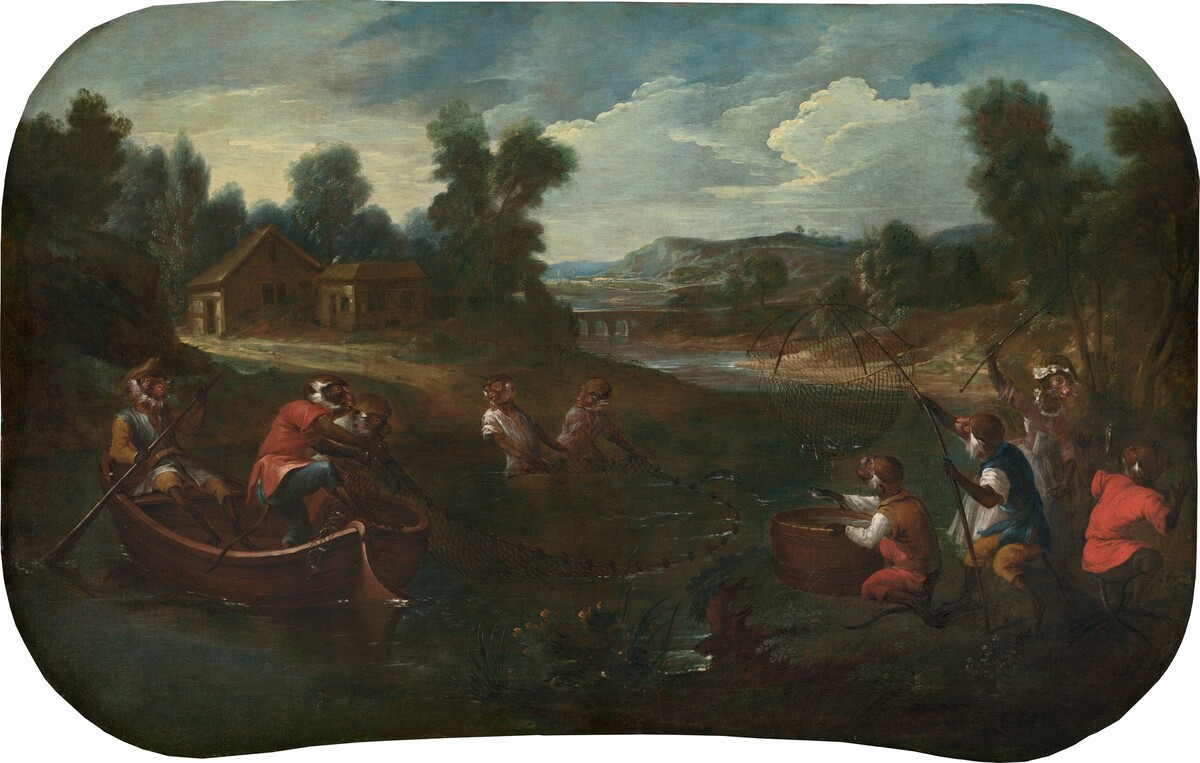
The Fishermen is the most pastoral of Huet's singerie series, depicting monkeys engaged in the genteel sport of angling — a leisure activity that was particularly associated with aristocratic and bourgeois recreation in the 18th century. The monkeys sit by a stream with their fishing rods, dressed in the appropriate costume for outdoor leisure, maintaining the same composed seriousness that The Concert and The Dance satirize in indoor settings. The bucolic setting and the peaceful activity create a gentler satire than the more socially intense Concert and Dance, but the point is the same: the monkeys' earnest performance of a human leisure activity reveals that activity as a cultural performance rather than a natural behavior.
Cultural Impact
Fishing as a leisure activity was a relatively new cultural phenomenon in 18th-century France, imported from England where it had become associated with the country gentry. Huet's monkey-fishermen participate in this imported culture with the same earnestness as their musical and dancing counterparts, suggesting that all leisure activities — whether artistic, social, or sporting — are learned performances rather than natural behaviors.
Why It Matters
The Fishermen is Huet's gentlest satire: monkeys fishing with the seriousness of gentlemen, their earnest performance of leisure exposing the learned quality of all recreational behavior. Even the most apparently natural leisure activity turns out to be a cultural performance when monkeys do it.