Provenance
In France during the 18th century.[1] George Godolphin Osborne, 10th duke of Leeds [1862-1927], Hornby Castle, near Bedale, Yorkshire, by 1902;[2] by inheritance to his, John Francis Godolphin Osborne, 11th duke of Leeds [1901-1963], Hornby Castle; sold December 1945 to (Wildenstein & Co., Inc., Paris, New York, and London);[3] sold December 1946 to the Samuel H. Kress Foundation, New York;[4] gift 1952 to NGA.
[1] The painting was engraved in reverse by Catherine Elise Lempeurer in the mid-18th century under the title _Le Bénédicité flamant_. In the catalogues for the 1910, 1934, and 1938 exhibitions in which it was included, the painting is listed as from the Duc d'Orleans collection, but no painting by Le Nain is recorded in that collection, unless it was given to another artist.
[2] _Historical and Descriptive Catalogue of Pictures Belonging to the Duke of Leeds_, London, 1902: 40, no. 201, as _Flemish Interior_ by Le Nain. It is not known when the painting entered this collection; no mention of it was found in documents relating to the art collection in the estate papers of the Dukes of Leeds held by the Yorkshire Archaeological Society, Leeds, England (see e-mails of 20 and 28 October 2008, from Kirsty McHugh, archivist, to Anne Halpern, in NGA curatorial files).
[3] During the preparation of the NGA systematic catalogue of its French paintings of the 15th to 18th centuries, Joseph Baillio of Wildenstein & Co. kindly provided the date when the company acquired the painting from the Duke of Leeds.
[4] See The Kress Collection Digital Archive, https://kress.nga.gov/Detail/objects/35.
Accession Number
1952.2.20
Medium
oil on canvas
Dimensions
overall: 55.6 x 64.7 cm (21 7/8 x 25 1/2 in.) | framed: 59.1 x 71.8 x 7 cm (23 1/4 x 28 1/4 x 2 3/4 in.)
Classification
Painting
Credit Line
Samuel H. Kress Collection
Tags
Painting Baroque (1600–1750) Oil Painting Canvas French
Background & Context
Background Story
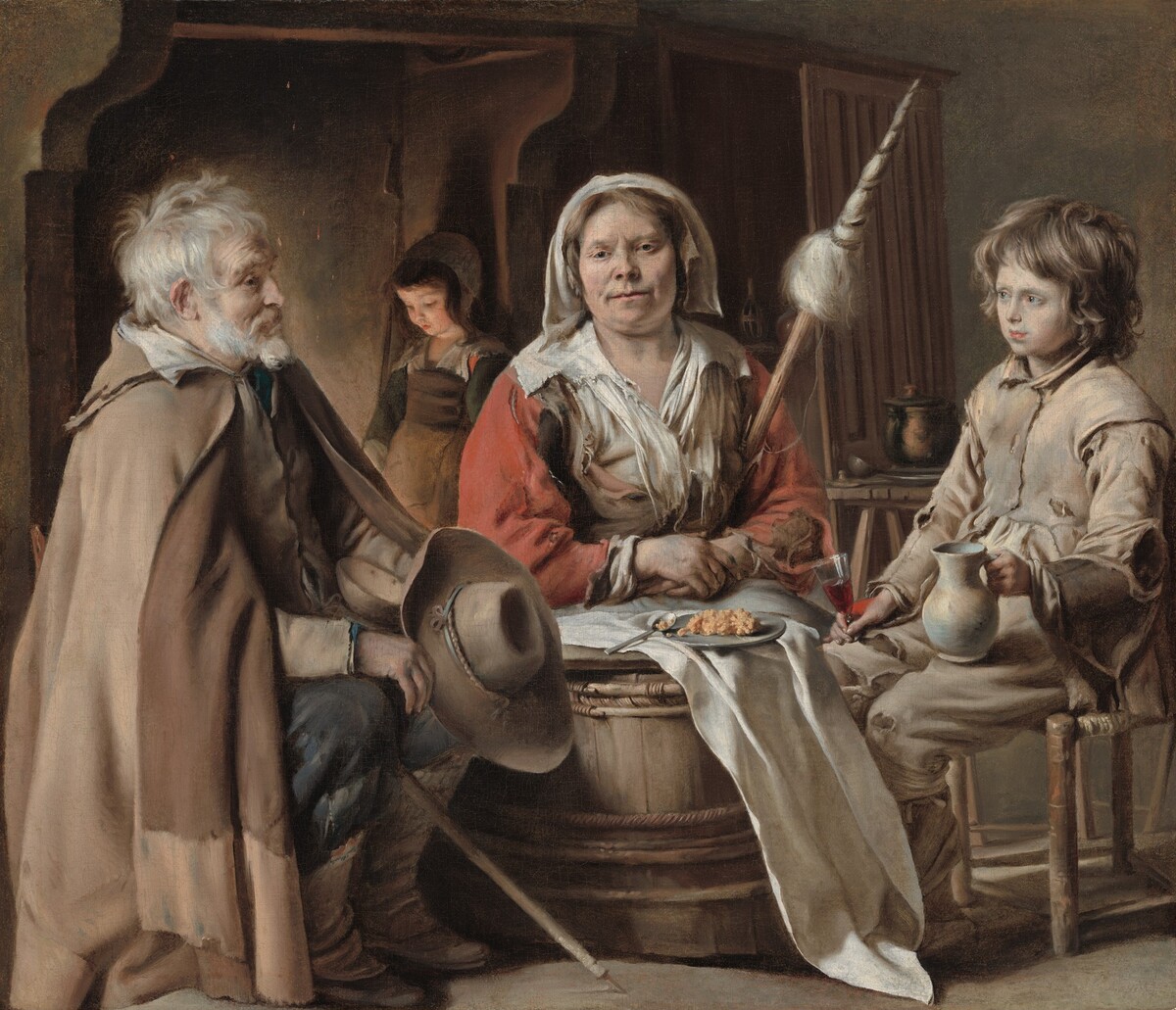
The Le Nain brothers—Antoine (c. 1588-1648), Louis (c. 1593-1648), and Mathieu (c. 1607-1677)—were French painters known for their genre scenes of peasant life that combine the dignity of portraiture with the naturalism of genre painting. Peasant Interior from c. 1645 is attributed to Louis Le Nain, whose peasant scenes are the most dignified and monumental of the three brothers. The painting depicts a peasant family in their interior with the gravitas and stillness that distinguish Louis's peasant scenes from the more anecdotal genre painting of his contemporaries, creating a type of peasant painting that is simultaneously humble and monumental.
Cultural Impact
Peasant Interior is important in the history of French painting because it demonstrates the Le Nain brothers' revolutionary treatment of peasant subjects with the dignity and gravitas previously reserved for portraiture. Louis Le Nain's peasant interiors create a type of genre painting that is simultaneously humble and monumental—a combination that would influence the development of French Realist painting from Chardin through Courbet.
Why It Matters
Peasant Interior is Louis Le Nain's dignified peasant painting: a peasant family rendered with the gravitas and stillness previously reserved for portraiture, creating a genre painting that is simultaneously humble and monumental. The c. 1645 painting demonstrates the Le Nain brothers' revolutionary treatment of peasant subjects with the dignity of portrait painting.
![Saint Bernard and Saint Catherine of Alexandria with the Virgin of the Annunciation [right panel]](https://api.nga.gov/iiif/e6890364-4d99-4684-a62b-5060ee3c3446/full/400,/0/default.jpg)