Provenance
Thomas Gainsborough [1727-1788], London; (his estate sale by private contract, Schomberg House, London, 30 March 1789 and days following, no. 10, as _Travelling Musicians_). George Hibbert [1757-1837], London; (joint sale with Sir Simon H. Clarke, Christie's, London, 14 May 1802, no. 33, bought in); George Hibbert [1757-1837], London; (his sale, Christie's, London, 13 June 1829, no. 36); Rev. Thomas Frognall Dibdin [d. 1847]; sold December 1829 to Joseph Neeld [d. 1856], Grittleton House, near Chippenham, Wiltshire; by inheritance to his brother, Sir John Neeld, 1st bt. [1805-1891], Grittleton House; by inheritance to his son, Sir Algernon William Neeld, 2nd bt. [1846-1900], Grittleton House; by inheritance to his brother, Sir Audley Dallas Neeld, 3rd bt. [1849-1941], Grittleton House; by inheritance to Joseph Neeld's descendant through an illegitimate daughter, Lionel William [Inigo-Jones] Neeld [d. 1956], Grittleton House; (his sale, Christie, Manson & Woods, London, 9 June 1944, no. 18); purchased by Koetser or Rocker.[1] (Wildenstein & Co., Paris, New York, and London); sold December 1944 to the Samuel H. Kress Foundation, New York;[2] gift 1946 to NGA.
[1] According to an undated letter from early 1986, an annotated copy of the 1944 Neeld sale catalogue at the Getty Provenance Index states that "Rocker" purchased lot 18 (Julia A. Armstrong to Suzannah Fabing, in NGA curatorial files). However, two other annotated copies of the sale catalogue (photocopies from both in NGA curatorial files, one from the Knoedler Library fiche of British sales) indicate that lot 18 was purchased by "Koetser," almost certainly the dealer David M. Koetser. This theory is supported by a passage in _The Paintings of The Betty and David M. Koetser Foundation_ (introduction by Malcolm M. Waddingham, catalogue by Christian Klemm, Zurich and Doornspijk, 1988: 10), in which Koetser's purchase of "the rare _Landscape with Peasants_ by Louis Le Nain" is described. It is possible that "Rocker" was a pseudonym used by Koetser. It is not clear whether Koetser was buying for himself, or for, or with, Wildenstein. Koetser's letter of 20 January 1969 to Colin Eisler contains a list of some of the non-Italian paintings he sold to the Kress Foundation followed by the sentence "And indirectly, Louis Le Nain's 'Landscape'..." (copy in NGA curatorial files).
[2] The "memorandum of agreement" between Wildenstein and the Kress Foundation for the purchase of ten paintings, including Louis Le Nain's _Peasants in a Landscape_, is dated 28 December 1944 (copy in NGA curatorial files). Colin Eisler, _Paintings from the Samuel H. Kress Collection: European Schools Excluding Italian_, Oxford, 1977: 266 n. 14, incorrectly gives the date of the Kress acquisition as 1946, misspells Hibbert's name as Hibbard, and indicates the painting sold for fifty guineas in 1789, when the Ellis Waterhouse letter to which he refers only says the painting was _priced_ at fifty guineas. See also The Kress Collection Digital Archive, https://kress.nga.gov/Detail/objects/1222.
Accession Number
1946.7.11
Medium
oil on canvas
Dimensions
overall: 46.5 x 57 cm (18 5/16 x 22 7/16 in.) | framed: 71.1 x 81.9 x 10.2 cm (28 x 32 1/4 x 4 in.)
Classification
Painting
Credit Line
Samuel H. Kress Collection
Tags
Painting Baroque (1600–1750) Oil Painting Canvas French
Background & Context
Background Story
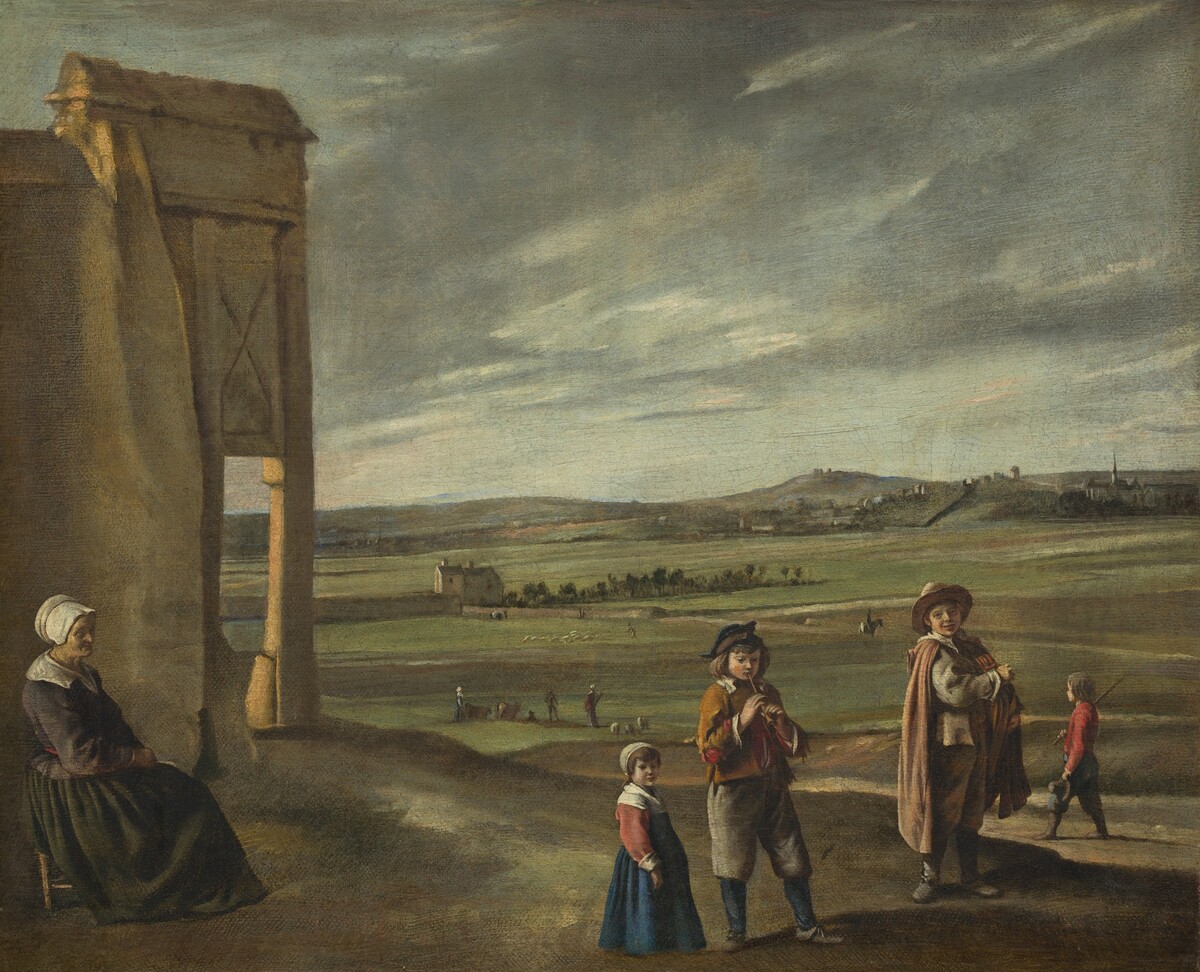
Landscape with Peasants from around 1640 is attributed to Louis Le Nain, the brother generally credited with the most poetic and intimate of the Le Nain paintings. The landscape provides the setting for a group of peasants engaged in rural activities, arranged in a composition that gives them the same monumental dignity that the Le Nain brothers brought to their indoor peasant scenes. The 1640 date places this in the period when the brothers were producing their most accomplished work, before the deaths of Antoine and Louis in 1648 ended the most productive phase of the Le Nain workshop.
Cultural Impact
Louis Le Nain's landscape with peasant subjects is important in the history of French landscape painting because it combines the pastoral landscape tradition with the sympathetic observation of peasant life that distinguishes the brothers' work. The peasants are not staffage—decorative figures added to animate the landscape—but the painting's principal subjects, placed in a landscape that exists to serve their activities rather than the other way around.
Why It Matters
Landscape with Peasants is Louis Le Nain giving peasants the landscape: not decorative staffage in a pastoral setting, but the painting's principal subjects, with the landscape arranged to serve their activities. The 1640 date places this in the brothers' most productive period, when peasant life and landscape setting were given equal dignity.

![Saint Bernard and Saint Catherine of Alexandria with the Virgin of the Annunciation [right panel]](https://api.nga.gov/iiif/e6890364-4d99-4684-a62b-5060ee3c3446/full/400,/0/default.jpg)