Masters of Their Craft
Artists
Discover the visionaries who shaped the course of art history.
39,743 artists in the collection
Coreen Simpson
American
Core, Sharon
American
American, born 1965
Corey Postiglione

Corinth, Lovis
German
German, 1858 - 1925
Lovis Corinth (21 July 1858 – 17 July 1925) was a German artist and writer whose mature work as a painter and printmaker realized a synthesis of impressionism and expressionism. Corinth studied in Paris and Munich, joined the Berlin Secession group, later succeeding Max Liebermann as the group's president. His early work was naturalistic in approach. Corinth was initially antagonistic towards the expressionist movement, but after a stroke in 1911 his style loosened and took on many expressionistic qualities. His use of color became more vibrant, and he created portraits and landscapes of extraordinary vitality and power. Corinth's subject matter also included nudes and biblical scenes.

Coriolano, Bartolomeo
Italian
Italian, active 1627/1653
Bartolommeo Coriolano (1590 or 1599–1676, pronunciation ko-ree-o-lă'no and sometimes spelled Coriolanus) was an Italian printmaker during the Baroque period, mainly in colour woodcuts. His father, Cristoforo Coriolano, and brother, Giovanni Battista Coriolano were also woodcut printmakers, although there is some doubt over the actual relationship between Cristoforo and Bartolommeo Coriolano. Coriolano had a daughter, Teresa Maria Coriolano, who later became a painter and engraver. Coriolano trained under the painter Guido Reni and based many of his woodcuts on the work of his teacher as reproductive prints, as was common. He was successful and popular, though not an innovator in the technique. Eventually, he came to the attention of Pope Urban VII who granted Coriolano knighthood, as a "Roman count", and a pension. Coriolano's works are the most celebrated of the works produced by the Coriolano family.
Corita Kent
American
1918 - 1986
Cork Glasshouses
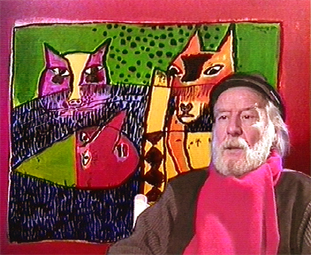
Corneille
Dutch
Dutch, born 1922
Corneille – Guillaume Cornelis van Beverloo (3 July 1922 – 5 September 2010), better known under his pseudonym Corneille, was a Dutch artist. Corneille was born in Liège, Belgium, although his parents were Dutch and moved back to the Netherlands when he was 12. He studied art at the Academy of Art in Amsterdam, in the Netherlands. He was one of the founders of the REFLEX movement in 1948 and in 1949 he was also one of the founders of the COBRA movement, which has had great influence on Scandinavian art. He was active within the group from the beginning, not only painting but also publishing poetry in the Cobra magazine. He was a cofounder of the Experimentele Groep in Holland. Corneille was inspired by the drawings of children, and believed in the importance of approaching children with art that connects with their experience. When he heard during a Cobra Museum visit in the nineties that there was an “Art Lending for Children” he talked with the founder Roby Bellemans and asked him to send more information to his home in Paris about this project. He decided to promote the initiative. He started with a support list and persuaded other artists such as Shinkichi Tajiri to sign. The...
Corneille de Lyon
Corneille de Lyon
Netherlandish

Corneille de Lyon
French
French, active 1533 - 1575
Corneille de Lyon (early 16th century – 8 November 1575 (buried)) was a Dutch painter of portraits who was active in Lyon, France, from 1533 until his death. In France and the Netherlands he is also still known as Corneille de La Haye (Dutch: Cornelis van Den Haag) after his birthplace, The Hague. Although he is well documented as the leading painter in this distinctively French style, because he never signed or dated his paintings very few identifiable works can be firmly traced as his, with the first one identified in 1962. Distinguishing his hand from the many other artists working in the same style is therefore extremely difficult, if not impossible; works tend to be attributed to him on grounds of quality alone. Corneille's portraits are nearly miniature in scale, ranging from the size of a postcard to about 8" x 10". Corneille worked in oil paint on wood panels. The flesh areas are painted very thinly, while the greenish backgrounds are painted more thickly. Similarities with the work of Hans Holbein may point to the use of tracing frames by both painters. The Louvre in Paris and New York's Metropolitan Museum of Art are both good places to study Corneille's work, whilst versions...
Corneille, Michel
French
French, 1642 - 1708