Masters of Their Craft
Artists
Discover the visionaries who shaped the course of art history.
39,743 artists in the collection
Charmion von Wiegand
American
1896 - 1983

Charnay, Désiré
French
French, 1828 - 1915
Claude-Joseph Désiré Charnay (2 May 1828 – 24 October 1915) was a French traveller and archaeologist notable both for his explorations of Mexico and Central America, and for the pioneering use of photography to document his discoveries.
Charon, Charles
American
American, active c. 1935
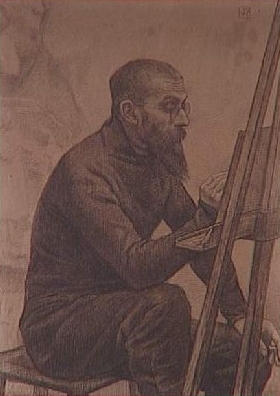
Charpentier, Alexandre
French
French, 1856 - 1909
Alexandre-Louis-Marie Charpentier (1856–1909) was a French sculptor, medalist, craftsman, and cabinet-maker.
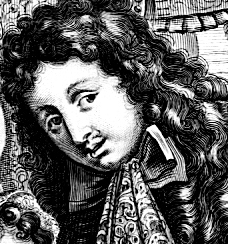
Charpentier, Etienne
French
French, c. 1707 - 1792
Marc-Antoine Charpentier (French: [maʁk ɑ̃twan ʃaʁpɑ̃tje]; 1643 – 24 February 1704) was a French Baroque composer during the reign of Louis XIV. One of his most famous works is the main theme from the prelude of his Te Deum H.146, Marche en rondeau. This theme is still used today as a fanfare during television broadcasts of the Eurovision Network and the European Broadcasting Union. Marc-Antoine Charpentier dominated the Baroque musical scene in seventeenth century France because of the quality of his prolific output. He mastered all genres, and his skill in writing sacred vocal music was especially hailed by his contemporaries. He began his career by going to Italy, where he fell under the influence of Giacomo Carissimi as well as other Italian composers, perhaps Domenico Mazzocchi. He would remain marked by the Italian style and become the only one with Jean-Joseph Cassanéa de Mondonville in France to approach the oratorio. In 1670, he became a master of music (composer and singer) in the service of the Duchess of Guise. From 1690 Charpentier composed Médée, on a piece by Corneille. It was a determining failure in his career of composer: he henceforth devoted himself to religious...
Charpentier, François-Philippe
French
French, 1734 - 1817
François-Philippe Charpentier (b. Blois, 1734; d. there 22 July 1817) was a French engraver and inventor. His father was a bookbinder, a poor man who reportedly made many sacrifices so that his son might attend the Jesuit college at Blois; but after young Charpa few years he was compelled to leave and work to support himself. He chose to pursue the art of engraving, and entered the atelier of a copperplate engraver in Paris. He made a number of inventions related to this field, the first being a purely mechanical process for engraving in aquatint (gravure au lavis) and in colour. After making many prints using the technique, he sold the secret. An engraver and patron of art, the Comte de Caylus, was one of the first to use the new machine. Louis XVI gave him the appointment of "Royal Mechanician" (Mécanicien du Roi), and provided a studio for him in the gardens of the Louvre, where he used a burning-mirror for melting metals without fire. He invented a fire-engine which was very widely adopted and, in 1771, a machine for drilling metals. Another invention for mechanical engraving was one which enabled lace-manufacturers to engrave in a few hours elaborate patterns and designs which...
Charron
French
Charters, Cann & Dunn
Chase, Louisa
American
American, 1951 - 2016
Louisa Lizbeth Chase (March 18, 1951 – May 8, 2016) was an American neo-expressionist painter and printmaker.

Chase, William Merritt
American
American, 1849 - 1916
William Merritt Chase (November 1, 1849 – October 25, 1916) was an American painter, known as an exponent of Impressionism and as a teacher. He is also responsible for establishing the Chase School, which later became the Parsons School of Design.
Chas. S. Cudlip

Chassériau, Théodore
French
French, 1819 - 1856
Théodore Chassériau (French pronunciation: [teɔdɔʁ ʃaseʁjo]; Spanish: Teodoro Chasseriau; September 20, 1819 – October 8, 1856) was a Dominican-born French Romantic painter noted for his portraits, historical and religious paintings, allegorical murals, and Orientalist images inspired by his travels to Algeria. Early in his career he painted in a Neoclassical style close to that of his teacher Jean-Auguste-Dominique Ingres, but in his later works he was strongly influenced by the Romantic style of Eugène Delacroix. He was a prolific draftsman, and made a suite of prints to illustrate Shakespeare's Othello. The portrait he painted at the age of 15 of Prosper Marilhat makes Chassériau the youngest painter exhibited at the Louvre museum.