Masters of Their Craft
Artists
Discover the visionaries who shaped the course of art history.
39,743 artists in the collection
Hasemann, Arminius
German
German, born 1888
Adolf Sommerfeld, also Andrew Sommerfield (May 4, 1886, in Kolmar (today Chodzież in Poland) – February 18, 1964, in Baden AG (Switzerland)) was a German-British architect and builder of Jewish origins.
Hashagen, A.
American
American, active 1847
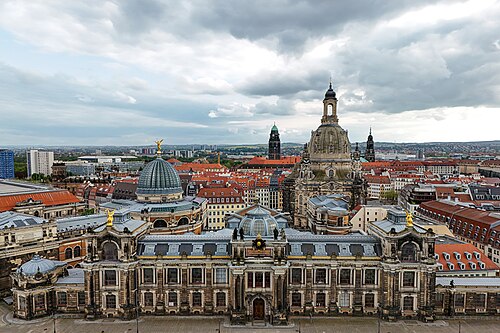
Dresden (; German: [ˈdʁeːsdn̩] ; Upper Saxon: Dräsdn; Upper Sorbian: Drježdźany, pronounced [ˈdʁʲɛʒdʒanɨ]) is the capital city of the German state of Saxony and its second most populous city after Leipzig. It is the 12th most populous city of Germany, the fourth largest by area (after Berlin, Hamburg, and Cologne), and the third-most populous city in the area of former East Germany, after Berlin and Leipzig. Dresden's urban area comprises the towns of Freital, Pirna, Radebeul, Meissen, Coswig, Radeberg, and Heidenau and has around 790,000 inhabitants. The Dresden metropolitan area has over 1.3 million inhabitants. Dresden is the second largest city on the River Elbe after Hamburg. Most of the city's population lives in the Elbe Valley, but a large, albeit very sparsely populated, area of the city east of the Elbe lies in the West Lusatian Hill Country and Uplands (the westernmost part of the Sudetes) and thus in Lusatia. Many boroughs west of the Elbe lie in the Ore Mountain Foreland, as well as in the valleys of the rivers rising there and flowing through Dresden, the longest of which are the Weißeritz and the Lockwitzbach. The name of the city as well as the names of most of its boroughs...

Hashey, Jan
American
American, born 1938
The Bulgarian bag (Bulgarian: Българска торба / Български чувал), also known as the Bulgarian training bag (Bulgarian: Българска тренировъчна торба), is a crescent-shaped piece of exercise equipment used in strength training, plyometric weight training, cardiovascular training, and general physical fitness. The bags are made of leather or canvas and filled with sand; they weigh from 11 pounds (5.0 kg) to 50 pounds (23 kg) and have flexible handles to allow for both upper and lower body training, and for building grip strength.
Hashiguchi Goyô
Hashim
Indian
1598 - 1650
Hashimoto Gahô
Hashimoto Kansetsu
Hashimoto Kiyoshi
Hashimoto Koei (Ikeda Koei)
Hashimoto Okiie
Hashimoto, Okiie
Japanese
Japanese, 1899 - 1993
Okiie Hashimoto (橋本興家, Hashimoto Okiie, IPA: [o.ki:.e], 1899–1993) was a Japanese artist and educator. Best known as part of the postwar revival of the sōsaku-hanga (Creative Prints) movement, he began his career as a school art teacher. In 1936, he began creating woodblock prints after he attended a workshop organized by prominent sōsaku-hanga artist Un’ichi Hiratsuka and began creating woodblock prints, which he successfully entered at major salon-style exhibitions in 1937. In 1939, he joined the newly formed First Thursday Society (Ishimoku-kai, 一木会), which gathered around Kōshirō Onchi, who would become a leading figure in the postwar Creative Prints movement. In his prolific career in printmaking, he was known for an innovative use of simplified and decorative forms that exude a modern feel. He was interested in expressing the effects of light as much as carefully controlled geometry in composition and forms. Although Hashimoto portrayed diverse subjects, including flowers and figures in his late years, he preferred to work on Japanese architectures and gardens, partly in order to memorialize rapidly disappearing castles. In his lifetime, his achievements were rewarded with his...
Hashimoto (Yoshu) Chikanobu